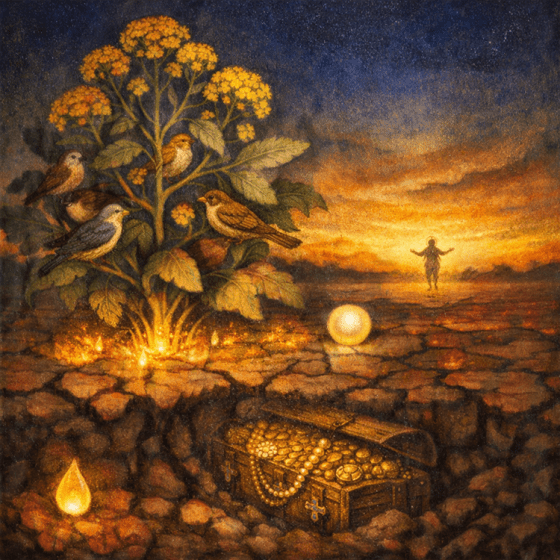
The parables of Jesus are not moral lessons — they are maps of awakening, spoken by a realized being transmitting from direct experience. A farmer scatters seed on four kinds of ground. A son comes to himself in a far country. A merchant sells everything for a single pearl. When we hear them in their own voice and follow where they lead, we find they have always been describing the structure of consciousness itself — and a kingdom that is not coming but already here, already leavened into the flour of ordinary life, waiting for the moment we come to ourselves.
Tag: avidya
When the Fog Is Called Faith
The essay reflects on personal experiences within a spiritual community, exposing the illusion of organized belief systems that prioritize adherence over authenticity. It highlights the human longing for belonging and meaning, emphasizing that true awakening transcends institutional teachings. By recognizing our shared vulnerabilities, liberation arises from embracing our inherent nature of love, moving beyond conditioned identities.
The Unbroken Self: Integrity as a Spiritual Condition
The concept of integrity transcends mere behavioral consistency; it embodies a deeper condition of the soul, signifying wholeness and authenticity. Rooted in ancient wisdom, integrity involves aligning one’s inner self with outer actions. Genuine integrity emerges not from perfection, but from an honest acknowledgment of all facets of oneself, promoting a return to original unity.
The Viral Fire
Hate is not the truth of the human being. It is the report of one in pain — a nervous system that cannot rest, a psyche that has not yet been able to integrate what it has suffered, a soul that has not yet found its way to the recognition that dissolves the hostile boundary between self and other. To understand this is not to excuse what hate produces in the world. It is to see it clearly enough that the seeing itself becomes the beginning of something else.