

Introduction
There is a question so old it has worn grooves into the stone of every civilization that ever looked up at the night sky and wondered. Not the question of whether something continues — most traditions answer that with quiet confidence — but the question of what continues, and in what form, and toward what. The body wilts. Even that word — wilts — carries something truer than dies. A wilting is not an annihilation. It is a return to source, a flower releasing its held form back into the vine.
What we are asking here is not a theological puzzle to be solved. It is an inquiry to be entered — with the full weight of metaphysical rigor, with the openness of the devotee, and with the raw honesty of someone who has sat quietly enough to feel, even now, that something in here was never entirely biological.
The Misidentification
What does the body actually contain?
Before we can speak of where we go, we must be precise about what we are. Because most of our fear — and most of our confusion — about death is rooted in a single ancient error: the belief that we are primarily the body, and that the body’s ending is therefore our ending.
Shankara, the great eighth-century systematizer of Advaita Vedanta, named this error adhyasa — superimposition. The habit of overlaying the Self with what the Self is merely witnessing. We superimpose identity onto the body the way we might mistake a reflection in water for the thing reflected. The water stirs, the reflection breaks — and we mourn the face that was never in the water to begin with.
Kashmir Shaivism goes further, and perhaps more intimately. Abhinavagupta’s teaching is that consciousness — Chit, the second aspect of Sat-Chit-Ananda — didn’t merely inhabit the body. Consciousness contracted into the body, voluntarily, the way Shiva contracts into each apparently limited form as an act of creative play. Spanda — the divine throb, the pulse beneath all pulsing — is what animates the biological. When the body wilts, the contraction releases. Awareness, which was always the substance of the experience, expands back into its natural boundlessness.
This is not metaphor. The traditions that speak this way insist they are pointing at something verifiable — not after death, but now, in deep meditation, in the silence after the silence, in the moment the witnessing awareness recognizes itself and laughs at having taken the costume for the actor.
The Maps of the Between
What does consciousness move through when the body releases it?
The Tibetan Buddhist Bardo Thodol — known in the West as The Tibetan Book of the Dead, though a more accurate rendering is Liberation Through Hearing in the Between — is among the most extraordinary documents in the world’s spiritual literature. Tradition holds that it was composed by Padmasambhava in the eighth century, written down by his principal student Yeshe Tsogyal, and concealed as a terma — a treasure text — in the Gampo hills of central Tibet, to be discovered when the time was right. In the fourteenth century, the tertön Karma Lingpa retrieved it. Scholars generally hold that the text reached its compiled form under Karma Lingpa’s hand, while its conceptual roots draw from earlier tantric streams — but whether eighth-century transmission or fourteenth-century synthesis, the teaching itself is unchanged: at the moment of death, the first arising is the Clear Light — Dharmata — pure, unmediated awareness without content, without boundary, without subject or object. This is not darkness. It is the luminosity that was always the ground of every experience.
Most consciousnesses, unrecognized, flinch. The brightness is too total, too selfless. And so begins the journey through the bardo — the between-state — where the mind continues to generate experience from its own karmic momentum, encountering peaceful and wrathful deities that are, the text insists, nothing other than projections of one’s own awareness. The teaching throughout is the same: recognize. What you see is you. What you fear is you. The light is you.
The Katha Upanishad arrives at the same clearing from a different direction. Young Nachiketa, sent by his father to the house of Yama — Death himself — waits three days unfed at the threshold. When Yama finally receives him, he offers three boons. Nachiketa’s third wish is the one that burns through the text like a coal: Tell me what lies beyond death.Even Yama hesitates. He offers wealth, pleasure, power — anything but this answer. Nachiketa refuses them all. And Yama, recognizing the rare quality of the one before him, finally speaks: The Self was never born. It cannot die. The sword does not cut it. The fire does not burn it. The water does not wet it. The wind does not dry it. What Nachiketa sought to understand beyond death turns out to be what he already was. The question answers itself by dissolving the questioner.
What the Devotee Knows
What does love carry across the threshold?
Metaphysics can take us far. But there is a knowing that lives below the conceptual — in the chest, in the throat, in the tears that come without being summoned. The Bhakti traditions have always insisted that love is not a stage to be transcended on the way to impersonal awareness. Love is itself a form of knowing. And what love knows about death is different from what philosophy knows.
Ramakrishna, the nineteenth-century Bengali mystic who burned with devotion to Kali and moved between samadhi and ordinary consciousness the way most of us move between waking and sleeping, once said that the devotee and the Divine remain two in love — eternally — because love requires the gesture of relation. The wave and the ocean are never exactly the same, never exactly different. This is not a consolation for those unable to bear Advaita’s final step. It is a distinct metaphysical claim: that the love which moved in this life continues — not as sentiment, not as memory, but as substance, as the actual medium of what persists.
Mirabai, the sixteenth-century Rajput princess who abandoned kingdom and caste and conventional life for her devotion to Krishna, sang her way through everything the world called loss. Her poetry is not about transcending the personal. It is about the personal becoming so saturated with the Divine that the boundary between them simply ceases to hold. When she sings of Krishna, she is not singing toward something absent. She is singing from inside the presence. Death, for Mirabai, would not have been separation. It would have been the final removal of whatever thin membrane still remained between the lover and the beloved.
The Sufi tradition names this baqa — subsistence in the Real, what remains after fana, the annihilation of the false self. Rumi’s great image of the reed flute crying for the reed bed is not merely a metaphor for longing. It is a map of the soul’s entire trajectory — the cutting away from origin, the music made possible only by that wound, and the return that the music was always secretly moving toward. What returns is not nothing. What returns is the love that was always the truest content of the self.
The Phenomenology of Letting Go
What does it feel like from inside when the self begins to release?
This question belongs not only to the dying. It belongs to everyone who has sat long enough in silence to feel the edges of the self become permeable. Everyone who has wept without knowing why in the presence of sacred music. Everyone who has looked at the sky at dusk and felt, for a moment, that the one who was looking had grown very large, or very quiet, or very thin.
These are not pathological episodes. The traditions regard them as rehearsals — the self practicing, in small doses, what it will ultimately be asked to do fully. In Vedantic terms, the ego — ahamkara, the I-maker — periodically loosens its grip. In those moments, what is revealed is not emptiness but presence — a presence that was always there, like a room that was always lit, though we had our backs to the source.
The Christian mystical tradition speaks of what Meister Eckhart called Abgeschiedenheit — detachment, or more precisely, releasement. Not the cold withdrawal of someone who has stopped caring, but the warm spaciousness of someone who has stopped grasping. Eckhart’s most radical teaching — which nearly earned him posthumous condemnation — was that the soul, in its innermost ground, is identical with the Gottheit, the Godhead, prior even to the personal God of theology. Death, in this framework, is the soul returning not to heaven as a location but to the Ground as its own deepest nature.
What this feels like, in the body, before the body releases: a quieting. A gradual recognition that the thoughts were never the thinker. That the feelings were weather, not climate. That underneath the entire drama of a life — its loves and wounds and passages and losses — something was watching that was never quite touched. Not coldly. Not remotely. But with a quality of presence so total it could not be disturbed.
That something is what continues. That something is what we are.
Epilogue
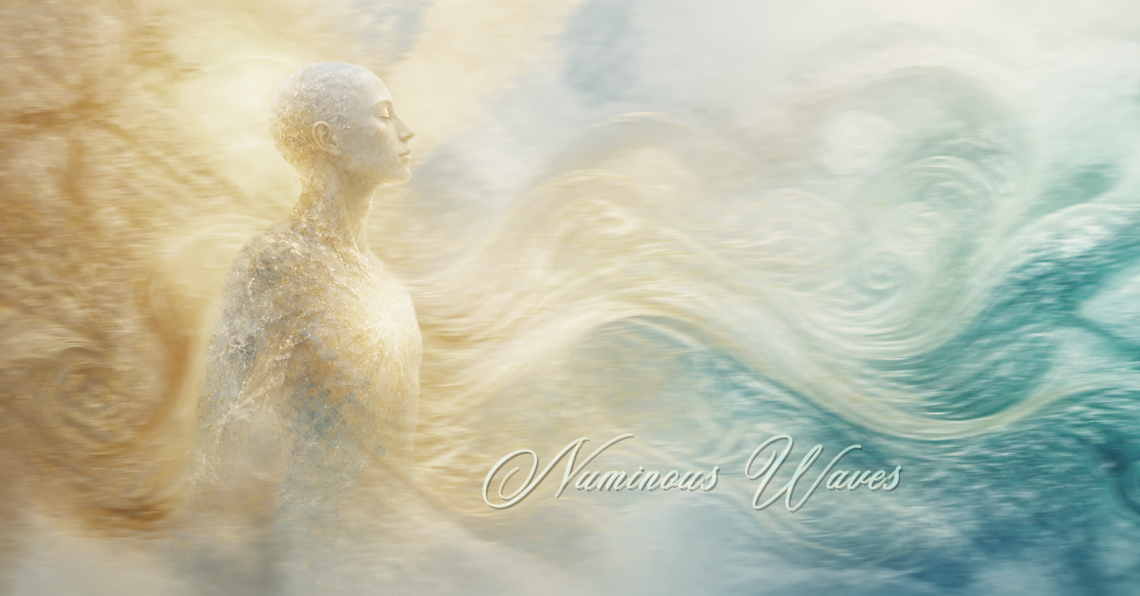
The body wilts the way a wave subsides — not into absence, but into what it always was. The ocean does not mourn the wave. It simply receives it back, already knowing that this was never a loss, only a return made visible. What we carried — the love, the awareness, the long arc of recognition — does not evaporate at the threshold. It expands. It was only ever waiting for the contraction to release.
We go, in the end, where we always were. We just stop pretending otherwise.
Sources & References
- Katha Upanishad — trans. Eknath Easwaran (Nilgiri Press); trans. Patrick Olivelle (Oxford University Press)
- The Tibetan Book of the Dead (Bardo Thodol) — trans. Chogyam Trungpa & Francesca Fremantle (Shambhala); trans. Robert Thurman (Bantam)
- Abhinavagupta, Tantraloka — scholarly commentary by Mark Dyczkowski, The Doctrine of Vibration (SUNY Press)
- Meister Eckhart, The Complete Mystical Works — trans. Maurice O’C Walshe (Crossroad Publishing)
- Rumi, The Masnavi — trans. Jawid Mojaddedi (Oxford University Press); trans. Coleman Barks, The Essential Rumi
- Ramakrishna, The Gospel of Sri Ramakrishna — trans. Swami Nikhilananda (Ramakrishna-Vivekananda Center)
- Mirabai, Mirabai: Ecstatic Poems — trans. Robert Bly & Jane Hirshfield (Beacon Press)
- Adi Shankaracharya, Vivekachudamani — trans. Swami Madhavananda (Advaita Ashrama)

A very meaningful and comprehensive essay, Stefan! Loved how you ended: “The body wilts the way a wave subsides — not into absence, but into what it always was. The ocean does not mourn the wave. It simply receives it back, already knowing that this was never a loss, only a return made visible.” Most of us have subsided into the Ocean many times, and intrinsically we “know” that the Ocean will always receive us with arms wide open. Into its Light, we surrenderingly go! Home we are! Thank you for this profound piece! A lot to reflect on here! With appreciation, sending you light and blessings, my friend! ✨🙏🌊
Thank you Susana. Having Emoitional Authority as my Human Design I’m comfortable with the Wave that needs to settle before decisions are made. And once the wave settles there is a definite Oneness that resonates within the wave that moves outward to fulfill the ocean of recognition. As noted in Human Design, 2027 brings a huge change. “The motor function of the emotional system ends — along with it, the drive and desire fueled by need, desire, and passion.  What remains is pure awareness. A shift from emotional reaction to emotional clarity, from dependence on external validation to an inner sense of truth. “
We are evolving into a beautiful experience, a beautiful expression of creativity. The ego’s dark edge that cries for recognition is transforming. Creativity finds the Divine Consciousness in the ocean of so many waves. The Yuga is shifting. 🙏🏼