

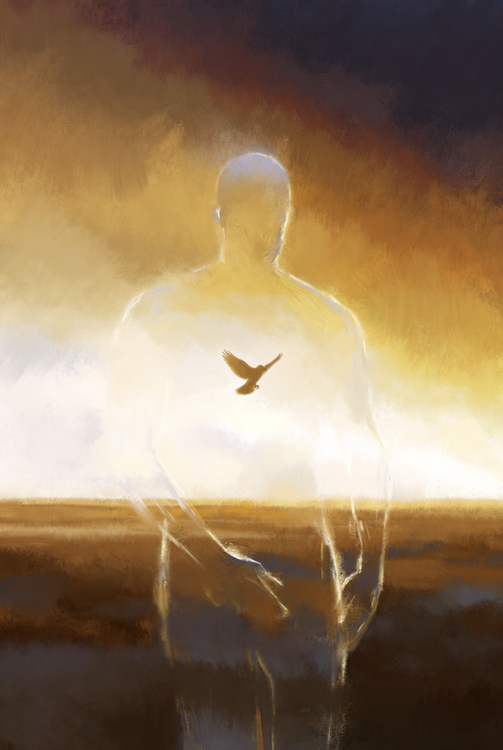
On the Soul’s Growing Transparency
Introduction
There comes a point in the inner life when something shifts — not dramatically, not with announcement, but quietly, the way light changes in a room when a cloud passes from the sun. The body is still present. The world still arrives through the senses. But something in the awareness has begun to hold it all more lightly, as though the hands that once gripped the fabric of physical existence have slowly, almost imperceptibly, begun to open.
This is not depression. It is not world-weariness, nor the gray exhaustion of someone who has lost the will to live. It is something else entirely — a kind of transparency that arrives not from subtraction but from depth. The soul, having traveled far enough inward, begins to recognize that it was never fully housed in the body to begin with. It was always larger. Always more porous. Always, in some essential way, already halfway home.
The mystics knew this. The contemplatives mapped it. The Vedantic sages named it with precision. And still, when it arrives in one’s own experience, it can feel disorienting — not because it is dark, but because it is so unexpectedly luminous.
This essay is an attempt to meet that experience with the language it deserves.
I.
Why does the pull toward leaving feel less like loss and more like recognition?
The first thing to understand is that the loosening is not something that happens to the spiritual life. It is something that happens because of it.
Every genuine turn inward — every hour of silence, every moment of genuine surrender, every encounter with beauty that cracked the ordinary open — has been doing something. It has been thinning the membrane between the personal self and the vast impersonal awareness that underlies it. Not erasing the person. Not dissolving the human being into abstraction. But clarifying. The way repeated washings clarify a cloth, until the light begins to pass through.
Vedantic teaching speaks of the kosas — the five sheaths or coverings of the soul. The physical body is only the outermost. Within it: the vital body, the mental body, the body of wisdom, and finally the body of bliss. The spiritual life, in this understanding, is not a movement away from the body so much as a progressive awareness of what lies beneath it. One does not abandon the outer sheath. One simply stops mistaking it for the whole.
When the concentration on leaving begins to arise — not as morbidity but as orientation — it is often because the inner sheaths have become more vivid than the outer one. The anandamaya kosha, the bliss-body, begins to assert its reality. The soul knows something it cannot yet fully articulate: that it belongs to a dimension that the physical alone cannot contain.
This is recognition. Not escape. The bird does not hate the cage. It simply becomes, for the first time, undeniably aware of the sky.
II.
What the traditions say about the soul’s growing transparency
Across the great lineages, there is a remarkable convergence on this experience — not as pathology, but as maturation.
In the Sufi tradition, Rumi returns again and again to the image of the soul as a reed cut from the reed bed, crying for its origin. The longing is not romantic abstraction. It is metaphysical memory. The soul in a body is genuinely displaced — not punished, not trapped, but temporarily far from its source — and the ache of that distance, once felt clearly, becomes a form of prayer. The concentration on leaving, in this light, is simply the reed beginning to hear the reed bed again.
Ibn Arabi speaks of the barzakh — the isthmus, the threshold space between worlds — as something the soul moves toward with increasing intimacy as it ripens. Not after death. Now. In life. The mystic begins to inhabit the threshold consciously, moving between the manifest and the unmanifest with growing fluency. The body becomes one shore of a river the soul increasingly knows how to cross.
In the Vedantic teaching of Ramana Maharshi, the question “Who am I?” leads inexorably to the recognition that the “I” which was believed to be lodged in the body is, in fact, the Self — unbounded, unborn, unlocated. When this recognition deepens from intellectual understanding into lived experience, the body continues to function, but the identification with it loosens. One does not leave the body. One simply stops believing that the body is where one lives.
Even in the Christian mystical tradition, Teresa of Ávila describes the interior castle — the soul’s movement through ever-deeper chambers — as a progressive releasing of the peripheral, a narrowing of attention toward the center that paradoxically opens into the infinite. The outer rooms of worldly concern grow quieter. The inner rooms grow luminous. What looks from the outside like withdrawal is, from the inside, arrival.
Sri Ramakrishna, whose life was a continuous oscillation between the embodied and the ecstatic, described samadhi not as a technique but as a tide. The soul, having tasted the ocean, finds the shore less absolute. It does not refuse the shore. It simply knows that the ocean is not far.
III.
The difference between escape and emergence
It is worth pausing here to name the distinction clearly, because it matters.
Escape is motivated by aversion. It wants to leave because the body, the world, the human experience is experienced as painful, intolerable, wrong. Escape is the soul trying to get away from something.
Emergence is different in its very texture. It does not push away. It is pulled toward. There is a quality of homecoming in it — not the relief of someone fleeing, but the recognition of someone who has seen, through the mist, a familiar shoreline. The body is not the enemy in emergence. The world is not a mistake. They are simply no longer mistaken for the totality.
Carl Jung, who spent his life mapping the psyche’s movement toward wholeness, described the second half of life as characterized by a natural turning inward — not withdrawal from life, but a reorientation of its center of gravity. The ego, which spent the first decades building itself, constructing a persona, establishing a place in the world, begins in maturity to serve something larger than itself. The Self — that vast ordering principle Jung considered the soul’s true center — begins to make its gravity felt. And in that felt gravity, the peripheral loosens.
What has sometimes been called the death drive in psychology, when stripped of pathology and held in the light of genuine spiritual inquiry, may be something far more sacred: the soul’s increasing orientation toward its own source. Not a wish to die. A wish to return. And increasingly, the recognition that the return does not require the death of the body — only the death of the misidentification.
This is what the loosening is. Not the end of life, but the end of a particular relationship to life — the one in which the physical was assumed to be primary, the soul secondary. That inversion, so long held in place by habit and culture and the sheer noise of the world, begins finally to right itself.
IV.
What it means to live gracefully in the loosening
The question that remains is not metaphysical but practical, and it is also deeply tender: how does one live well in this transparency? How does one inhabit the body graciously when the body no longer feels like the whole address?
The answer the traditions offer, with remarkable unanimity, is: with even greater presence, not less.
This seems paradoxical until it is felt. The soul that knows it is not only the body can inhabit the body with a freedom that the soul still grasping at it cannot. The hand that holds loosely can feel more. The eye that is not desperate to possess the beautiful can actually receive it. The person who knows they are passing through can be, at last, genuinely here — because they are no longer afraid of what here costs.
Mirabai sang with complete abandon precisely because she had released the social, familial, and physical securities that most people spend their lives protecting. Her songs were not the songs of someone dying. They were the songs of someone finally, completely, alive — alive to the Beloved who was always nearer than the body, always more real than the role.
To live in the loosening is to discover that presence deepens when it is not armored. That love becomes more available, not less, when it is no longer contracted around the fear of loss. That beauty lands more fully in a heart that knows beauty does not have to be held.
There may be a stillness that comes. A quieting of former urgencies. A natural withdrawal of energy from what no longer resonates. These are not symptoms of diminishment. They are symptoms of clarification. The soul is not shrinking. It is becoming more precisely itself.
And in that precision, in that growing transparency, something extraordinary becomes possible: to be in the world as a kind of blessing. To move through the days as one who knows, however imperfectly, that this life is not the whole of what one is — and therefore to give it, freely, without the desperation of someone who believes this is all there is.
Epilogue
The loosening is not a leaving. It is a coming to terms — with what was always true, what the noise of ordinary life made it possible to forget. The soul is older than the body. It will outlast it. And when, in the depth of quiet or the sudden opening of a particular afternoon, that truth becomes not a belief but a sensation — when the membrane thins and the awareness spreads beyond its usual borders into something vaster and more still — the appropriate response is not alarm.
It is gratitude.
The cage has not disappeared. The bird has simply remembered, with new certainty, what it is. And in that remembering, even the cage becomes luminous — not a prison, but a temporary gift, a particular angle of light, a brief and beautiful condensation of something that was never, in its essence, bound.
To feel the loosening is to be told, by the soul itself, that the journey is real. That the practice has gone somewhere. That what was once a teaching has become, at last, a texture.
Go gently with it. It is not the end of anything.
It is the beginning of knowing what you actually are.
Sources & References
Ramana Maharshi — Who Am I? and Talks with Sri Ramana Maharshi Sri Ramakrishna — The Gospel of Sri Ramakrishna, recorded by Mahendranath Gupta Rumi — The Masnavi and Divan-e Shams-e Tabrizi, translated by Coleman Barks and others Ibn Arabi — The Meccan Revelations and Fusus al-Hikam Teresa of Ávila — The Interior Castle Mirabai — Mirabai: Ecstatic Poems, translated by Robert Bly and Jane Hirshfield Carl Jung — Memories, Dreams, Reflections; The Structure and Dynamics of the Psyche (CW Vol. 8) Swami Vivekananda — Jnana Yoga and Raja Yoga Taimni, I.K. — The Science of Yoga (commentary on Patanjali’s Yoga Sutras) Feuerstein, Georg — The Yoga Tradition

 Numinous Waves