When the ego seizes the name of God, it does not feel like hubris — it feels like calling. This is Kali Yuga’s most refined inversion: the sacred language remains, the symbols proliferate, the certainty intensifies, while the interior substance — the genuine emptiness through which divine intelligence actually moves — quietly withdraws. The mystics offer the corrective not as argument but as embodied demonstration: the one through whom God truly acts is not the one who carves the commission into flesh, but the one who has become hollow enough to carry it.
Tag: dharma
The Age of the Falling Veil: The Kali Yuga and the Soul That Will Not Sleep
The Kali Yuga is not a metaphor. It is the cosmological address of the present moment — the fourth and darkest of the Vedic cosmic ages, in which dharma stands on a single leg, the divine presence has withdrawn behind its thickest veil, and the soul must navigate existence with three-quarters of its original light no longer ambient in the world around it. And yet the tradition’s most carefully guarded teaching is this: the Kali Yuga carries, embedded within its very darkness, a spiritual provision unavailable in any other age. Drawing on the Bhagavatam’s prophetic vision, the revolutionary Bhakti of Chaitanya, the absorbed God-consciousness of Ramakrishna, the cross-cultural witness of Hesiod, Guénon, and Jung, and the ascending arc mapped by Sri Yukteswar, this essay completes the Yuga series — not with despair, not with false comfort, but with the clear-eyed cartography the age demands.
The Age of the Dividing Veil: The Dvapara Yuga and the World at the Threshold
The Dvapara Yuga is the age of the dividing veil — the third great movement in the Vedic cosmological symphony, in which dharma stands on only two of its original legs, the Divine withdraws behind the curtain of paradox and play, and the human soul encounters for the first time the full, aching depth of sacred longing. Drawing on the Puranic vision of a world at moral twilight, the inexhaustible mystery of Krishna as the avatar perfectly calibrated to an age of complexity, the Mahabharata as the soul-map of a civilization at the knife-edge between remembering and forgetting, and the resonant echoes of Hesiod, Plotinus, Rumi, and modern consciousness research, this essay completes the trilogy of the Yugas yet to come — and in doing so, asks the question every sincere seeker must eventually face: what does it mean to love the Divine not because it is obvious, but precisely because it is not?
The Age of the Sacred Fire: The Treta Yuga and the Birth of the Seeking Soul
The Treta Yuga is the age in which the effortless gave way to the effortful — the first great turning of the cosmic wheel in which Truth, once simply what one was, became something one must consciously seek, practice, and protect. Drawing on the Puranic vision of dharma’s first diminishment, the fire sacrifices that arose in its wake, the avatar descent of Rama as the Divine made human and heroic, and the modern astronomical recalibration of Sri Yukteswar, this essay traces the Treta Yuga as more than ancient history. It is the interior landscape of every sincere seeker who has tasted the light of unity and must now do the daily work of sustaining the flame — the sacred fire that is lit not because the universe requires it, but because the soul does.
The Four Yugas: The Great Cycles of Human Consciousness
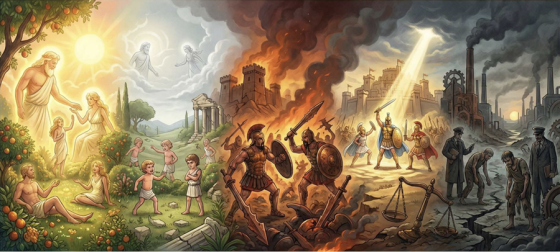
Time does not simply move forward — it turns. The ancient Yugas describe vast cycles of awakening and forgetting, mapping not only the rise and fall of civilizations but the inner seasons of the human soul. Even in the darkest age, the longing for truth becomes the doorway back to light.