

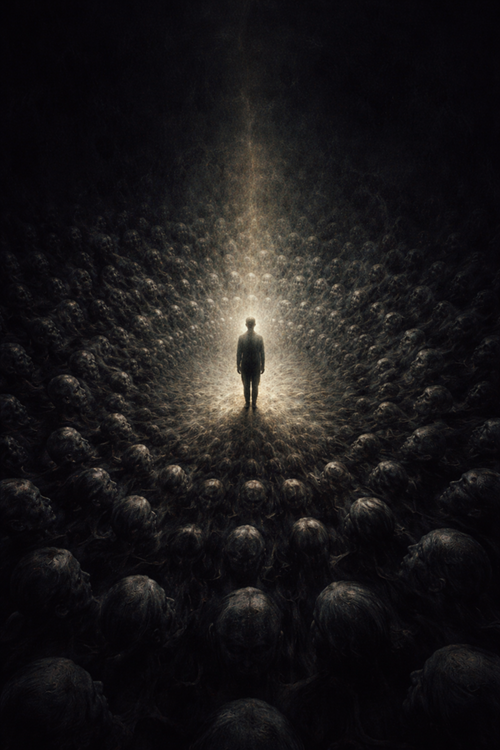
Introduction: Before You Enter
There is a question that lives beneath this series — one that most of us would rather not ask directly, because the honest answer implicates us in ways that are uncomfortable. The question is not how do people fall for it? That question keeps the phenomenon safely over there, in the territory of the credulous, the damaged, the desperate. The real question — the one worth six essays — is simpler and more unsettling:
What is it in us that wants to surrender?
Not the broken parts. Not the wounded or the weak. The whole of us. The intelligent, searching, wide-awake human animal that looks at the vastness of existence — its uncertainty, its loneliness, its refusal to yield final meaning on demand — and feels, in some quiet chamber of the self, the pull toward something that would simply take all of that off our hands. A voice that knows. A community that holds. A story so complete that the questions finally stop.
Cults did not invent this pull. They discovered it — the way a key discovers a lock that was already there, waiting. And the lock, it turns out, is not installed only in extraordinary people living through extraordinary circumstances. It is standard equipment. It came with the brain, with the body, with the particular ache of being conscious in a world that does not automatically make sense.
This series is an inquiry into that ache, and into the many forms — ancient and digital, intimate and institutional — that have learned to answer it. It moves through the psychology of the seeker and the leader, through the devastation of the exit and the discomfort of the spectrum, toward something that might be called the real thing: genuine belonging, genuine transcendence, genuine meaning — and what it actually costs to find them without surrendering the self in the process.
These essays are not a warning. They are a mirror. And what they reflect is not the face of the fanatic. It is something far more familiar than that.
Come in with your questions intact. That is the only entry requirement.
Part One: The Seeker
What draws the human mind into the architecture of the cult
There is a moment — quiet, almost imperceptible — when a person stops questioning and begins believing. Not the slow, earned belief that comes from years of wrestling with ideas, but something faster, more total. A kind of collapse into certainty. To the outsider, it looks like madness. To the person inside it, it feels like coming home.
This is the paradox at the heart of cult psychology, and it deserves more than dismissal. Because the mind that surrenders to a cult is not a broken mind. It is, in many ways, a deeply human one.
The Brain Was Built for Belonging
To understand the cult, we must first understand the organ it hijacks. The human brain is, before anything else, a social organ. It evolved not in isolation but in tribes, where belonging meant survival and exile meant death. The neurochemistry reflects this ancient arithmetic with brutal clarity. Oxytocin, the bonding hormone, floods us when we feel accepted. Cortisol, the stress hormone, spikes when we feel excluded. The body registers social rejection in the same neural pathways it registers physical pain. We are wired, at the deepest biological level, to need one another — and to fear being cast out.
Cults understand this, even when their leaders cannot articulate it in those terms. They offer, from the very first encounter, something the modern world is increasingly terrible at providing: unconditional welcome. The love-bombing that characterizes early cult recruitment is not accidental. It is the deliberate activation of every belonging circuit in the brain. You are seen. You are special. You have been found.
The Hunger Beneath the Search
But biology alone does not explain it. There is something else at work — something we might call existential hunger. The people most vulnerable to cult recruitment are not, as stereotype suggests, the weak or the stupid. Research consistently shows they tend to be intelligent, idealistic, and spiritually curious. They are people in transition: a recent loss, a move to a new city, a divorce, a crisis of meaning. They are people who have been asking the large questions — Why am I here? What is true? How should I live? — and have not yet found answers that satisfy.
The cult does not create this hunger. It finds it. And then it offers, with staggering confidence, a complete answer to every question the seeker has ever asked. The totalism that psychologist Robert Jay Lifton identified as a hallmark of cult thought — the idea that the group possesses the final, sacred Truth — is not a flaw in the system. It is the product being sold. Certainty, in a world drowning in ambiguity, is intoxicating.
The Architecture of Control
Once inside, the transformation deepens through mechanisms that neuroscience is only beginning to fully map. Sleep deprivation, dietary restriction, repetitive chanting, and information control are not merely tools of cruelty — they are tools of neurological reshaping. The prefrontal cortex, the seat of critical thinking and executive judgment, is metabolically expensive. Exhaust the body, flood the schedule, restrict outside input, and that rational governor begins to go quiet. What remains is more emotional, more reactive, more open to suggestion.
The group’s language becomes the only language. Loaded terms replace nuanced thought. Complex feelings are collapsed into approved categories: doubt becomes “spiritual weakness,” outside family becomes “suppressive influence,” the leader’s word becomes revelation. Linguist and cult scholar Alexandra Stein has written about how the attachment system itself gets captured — how cult leaders engineer precisely the anxious, disorganized attachment that keeps members cycling between fear and desperate need for reassurance. It is, at its core, a corruption of the parent-child bond, played out in adult bodies under fluorescent lights.
The Question We Must Sit With
It is comfortable to believe that we would never be susceptible. That we are too rational, too grounded, too self-aware. But this comfort is itself a kind of cognitive trap. Studies in social influence — Milgram’s obedience experiments, Asch’s conformity research, Festinger’s work on cognitive dissonance — demonstrate again and again that ordinary people, under the right conditions of authority and group pressure, will abandon what they know to be true. The cult does not recruit monsters. It recruits seekers. People who wanted something real, and were handed a beautiful, terrible counterfeit.
What protects us is not intelligence. It is connection — genuine, non-transactional human connection that exists outside of any single group’s orbit. It is the maintenance of what psychologists call epistemic autonomy: the right and the habit of forming our own conclusions. It is the cultivation of comfort with uncertainty, because the person who can tolerate not knowing is far less vulnerable to someone who claims to know everything.
The surrendered mind is not a foreign mind. It is our mind, under pressure, starved of the things it most needs, handed a story that finally seemed to make the pain make sense. Understanding this is not an act of sympathy for abusers. It is an act of honesty about what we are — and what we owe each other in a world where so many people are quietly, desperately searching.
Part Two: The Center of the Wheel
The psychology of the cult leader — belief, corruption, and the seduction of absolute devotion
Every wheel has a center. Every cult has a person standing there, at the still point around which all that frantic devotion revolves. We spend considerable energy studying the followers — their vulnerabilities, their hunger, their neurological surrender. But the figure at the center of the wheel deserves an equally unflinching examination. Because understanding what lives inside the cult leader is to understand something about power itself, and what it does to the human soul when it arrives without limit or accountability.
The Believer Who Became the Belief
It would be simpler if cult leaders were simply cynical architects of manipulation — cold strategists who built their systems of control from the outside, untouched by their own mythology. Some are. But the more psychologically interesting truth, and the more common one, is that many cult leaders begin as genuine seekers. They start with a real wound, a real vision, a real experience of something they interpret as revelation. Jim Jones began as a civil rights activist with a genuine passion for racial equality. L. Ron Hubbard began as a science fiction writer genuinely fascinated by the architecture of the mind. Many began in traditions of legitimate spiritual inquiry before something shifted — before the adoration of followers began to feel not like gratitude but like oxygen.
This is where the corruption typically takes root. Not in the original vision, but in what the response to that vision does to the visionary. Psychologists who study narcissistic personality structure describe a feedback loop that is almost mechanical in its inevitability: the leader’s pronouncements are met with uncritical adoration, which reinforces the sense of special destiny, which produces more grandiose pronouncements, which demand more total devotion. The self expands to fill the space the group creates for it. And the group, hungry for the numinous, keeps creating more space.
Grandiosity as Armor
What we recognize as narcissism in the cult leader is rarely simple vanity. It is almost always a defensive structure — grandiosity as armor over a wound that cannot be acknowledged. The psychoanalytic tradition has long understood that the most ferocious need for external validation tends to live in people for whom the early experience of being seen was conditional, painful, or absent. The child who learned that love was performance becomes the adult who must perform on an ever-expanding stage. The child who was never seen becomes the prophet who demands to be the only thing anyone looks at.
This is not offered as exculpation. Millions of people have difficult childhoods and do not build systems of control around their wounds. But it is offered as orientation — because understanding the inner life of the person at the center of the wheel helps us understand why these systems so rarely reform from within. The leader cannot tolerate the one thing that would break the spell: genuine accountability. Accountability requires the admission of fallibility. And fallibility, to the grandiose self, is existential annihilation.
The Intoxication of Absolute Devotion
There is something else worth naming, something that sits beneath the clinical language of personality pathology: the experience of being absolutely adored is, by most neurological accounts, profoundly intoxicating. Dopaminergic reward systems respond to status and social dominance in ways that parallel addiction. The cult leader who began by genuinely wanting to help people gradually, and then rapidly, becomes dependent on the devotion itself. Members who question are not merely ideological threats — they are threats to the neurochemical equilibrium the leader has come to require in order to function.
This is why former cult members so often describe a striking pattern: the leader’s increasing isolation over time, the narrowing of the inner circle, the escalating demands for proof of loyalty. The system must produce more and more devotion to sustain the same internal state. It is, in the most precise sense, a tolerance curve. And like all addictions, it tends to end either in catastrophic collapse or in the destruction of everything around the person at the center.
The Mirror We Would Rather Not Hold Up
The cult leader is an extreme. But the dynamics that produce and sustain them exist on a continuum that touches ordinary life. The boss who cannot be contradicted. The parent whose children must reflect their unlived dreams. The public intellectual who has mistaken the approval of their audience for the verification of their ideas. The mechanisms are the same; only the scale differs. To study the cult leader in earnest is to confront something uncomfortable about the universal human appetite for specialness, for certainty, for the relief of being told that we, specifically, have been chosen to understand what others cannot.
The center of the wheel is not as far from where we stand as we would like to believe. And that proximity — honestly faced — is perhaps the most clarifying thing the study of cults has to offer.
Part Three: The Exit Wound
What it costs to leave — identity, grief, and the terrifying gift of uncertainty returned
Leaving sounds like freedom. And eventually, for most who manage it, it becomes something like that. But in the immediate aftermath of leaving a cult — in the weeks and months and sometimes years that follow the exit — what survivors most commonly describe is not relief. It is a kind of annihilation. The self that walked out the door is not the self that walked in. And reassembling the pieces, in a world that largely does not understand what was lost, is one of the most underappreciated psychological ordeals a human being can face.
The Identity That Was Given Back
To understand what leaving costs, we must understand what joining replaced. When a person enters a high-control group, they do not simply adopt new beliefs. They adopt a new self. The cult provides, with extraordinary thoroughness, everything the individual previously had to construct alone: identity, purpose, community, cosmology, daily rhythm, moral framework, even language. The self that existed before — uncertain, searching, perhaps wounded — is not suppressed so much as dissolved and rebuilt in the group’s image. Members are often told, explicitly, that their previous self was broken, lost, incomplete. The group fixed them. The group is them.
When that structure is removed — suddenly, in the case of an escape, or gradually, in the case of a slow awakening — what remains is not the original self, waiting patiently to resume. That self has been gone for years. What remains is a person standing in the ruins of the only identity they have known for a significant portion of their adult life, holding a set of beliefs that no longer cohere, surrounded by a community that has either been left behind or has cast them out.
The Grief Nobody Talks About
Cult recovery literature tends to focus, understandably, on the abuse — the manipulation, the exploitation, the psychological damage inflicted by the system and its leaders. What receives less attention is the grief. Because alongside the anger, and the disorientation, and the PTSD symptoms that many former members experience, there is almost always profound mourning. For the community that felt, whatever its pathologies, like the most intimate belonging the person had ever known. For the certainty that is now gone. For the years spent inside. For the version of themselves that believed, and believed completely, and found in that belief a sense of meaning so total it could illuminate an entire life.
This grief is complicated and frequently misunderstood. Well-meaning friends and family, relieved that their loved one is out, often cannot comprehend why leaving feels like loss rather than rescue. They expect gratitude and find instead a person in mourning. The survivor may defend aspects of their time inside even as they condemn others. They may miss the leader they also recognize as an abuser. These are not signs of ongoing delusion. They are signs of a psyche doing the extraordinarily difficult work of integrating a chapter of life that contained real love and real harm simultaneously — as so many chapters of life do.
The Return of Uncertainty
Perhaps the most disorienting gift of the exit is the return of not knowing. Inside the cult, every question had an answer. Every discomfort had a framework. Every fear had a prescribed response. The world was total and legible, even when it was cruel. Outside, the world is once again vast and ambiguous and without guaranteed meaning. For someone who has spent years in the managed certainty of a high-control group, this can feel not like freedom but like standing in open ocean without a horizon.
Many former members describe an extended period of what psychologists call floating — a dissociative drift through ordinary life, unable to make simple decisions, uncertain of their own perceptions, unable to trust their own judgment precisely because that judgment was systematically dismantled. Learning to tolerate uncertainty again, to make a choice without divine authority confirming it, to hold a belief loosely and revise it in the light of new evidence — these are skills that must be painstakingly relearned. They are, in fact, the very skills the cult spent years destroying.
What Recovery Actually Looks Like
Recovery is not a return. There is nowhere to return to. It is, at its best, a construction — the slow, often painful building of a self that can hold the full complexity of the experience: the genuine seeking that led to the door, the real belonging that was found inside, the real harm that was done there, and the hard-won wisdom that now lives in the place where certainty used to be.
The former members who navigate this most fully tend to share certain qualities. They find communities — often of other survivors — where their experience is not minimized or pathologized. They locate therapists trained in cult recovery, ideally versed in the specific mechanics of high-control group psychology. They allow themselves, in time, to integrate rather than simply escape — to understand what they were seeking when they entered, and to find healthier paths toward those same essential hungers: meaning, belonging, transcendence, purpose.
The exit wound heals. But it leaves a mark that is not entirely regrettable — because on the other side of that particular darkness, the people who survive it often know something about the human need for meaning, and its betrayal, that the rest of us are only beginning to learn.
Part Four: The Spectrum
Where cults end and culture begins — ideology, institutions, and the uncomfortable continuum of control
At some point in every serious conversation about cults, someone asks the question that the conversation has been quietly circling all along: But where exactly is the line? And the honest answer — the answer that most cult literature is reluctant to give because of how far its implications reach — is that the line is not a line at all. It is a spectrum. And that spectrum passes directly through institutions, ideologies, and cultural systems that we regard not as pathological but as normal. As legitimate. As ours.
The BITE Model and Its Uncomfortable Reach
Cult researcher Steven Hassan developed what he calls the BITE model — a framework for identifying high-control groups through their management of Behavior, Information, Thought, and Emotion. In its most extreme form, the model describes organizations that control where members live, what they eat, whom they marry, what information they may access, which thoughts are permitted, and which emotions are acceptable to express. When all four dimensions are controlled completely, we recognize the result as a cult without hesitation.
But dial back the intensity along any single dimension, and the picture becomes more complicated. An organization that controls information without controlling behavior begins to resemble a political party, a media ecosystem, or an academic orthodoxy. One that manages emotion without restricting movement begins to resemble certain corporate cultures, or certain families. The mechanisms are not categorically different. They are differently calibrated. And the question of at what point on the dial the label changes from “culture” to “cult” turns out to have no clean answer — only a territory of increasing discomfort to move through honestly.
The Corporation as High-Control Environment
Consider the dynamics of certain high-performance corporate cultures — particularly in technology, finance, and the startup world. The total absorption of identity into the company mission. The language of family and tribe used to describe what is, structurally, an employment relationship. The subtle social punishment of those who express doubt or set boundaries. The elevation of founders to visionary status whose judgment supersedes ordinary accountability. The expectation that work is not something you do but something you are.
None of this is a cult in the classical sense. Members can leave. There are legal protections. There is no theological apparatus. And yet the psychological dynamics — the belonging contingent on performance, the identity fusion with the organization, the management of doubt through social pressure — are recognizable. Former employees of certain celebrated companies describe exit experiences that have surprising resonance with cult recovery literature: the loss of community, the crisis of identity, the disorientation of a world without the all-consuming mission to organize it.
Political Tribalism and Thought Management
Political ideology operates on the same spectrum. At its healthiest, political identity is a set of loosely held values, subject to revision, in dialogue with opposing views, held by a person who maintains a self outside of it. At its most pathological, it is a totalist system: the in-group has access to truth, the out-group is not merely wrong but evil, doubt is betrayal, and the media consumed is exclusively that which confirms what is already believed. The mechanics of information control, thought-stopping, and loaded language that Lifton identified in mid-century cult environments are entirely recognizable in contemporary political discourse — across the ideological spectrum, and with the specific intensity that digital amplification makes possible.
This is not a both-sides argument, and it is not an invitation to false equivalence. Some political positions are more aligned with evidence than others. Some are more dangerous than others. But the psychological mechanism by which any ideological tribe manages its members’ thought and emotion is structurally continuous with the cult. Recognizing this does not require treating all positions as equal. It requires treating our own positions with a degree of scrutiny we might otherwise reserve for theologies we already regard with suspicion.
Religion and the Continuum Question
Perhaps nowhere is the spectrum question more fraught than in the domain of religious practice, where the overlap between healthy spiritual community and high-control group can be genuinely difficult to navigate. Most religious traditions contain elements that, viewed through a cult-analysis framework, appear concerning: deference to authority, suppression of doubt, in-group/out-group distinctions, the management of existential fear through prescribed belief. And yet most religious practice does not produce the catastrophic identity destruction and psychological harm associated with cult membership.
The distinguishing factors, when researchers examine them carefully, tend not to be theological but structural. Does the tradition encourage or discourage questions? Does leadership have external accountability? Are members free to leave without social annihilation? Is the individual’s life outside the religious community valued and supported? These are not questions about the content of belief. They are questions about the architecture of power. And they apply as meaningfully to a megachurch as to a meditation center, to a seminary as to a compound.
The Mirror, Again
The spectrum, honestly examined, is not primarily a tool for identifying dangerous organizations at a safe distance. It is a tool for examining the groups we are already inside — the ideological communities, the institutional cultures, the family systems and national narratives that shape our thought and emotion in ways we largely do not choose and often do not see. The cult is the extreme case that illuminates the general principle. And the general principle is that human beings are always, to some degree, being shaped by the groups they belong to — always having their information filtered, their thoughts organized, their emotions managed by the collective structures they inhabit.
The question is never whether this is happening. It is always: how aware are we of it? How much room is there, inside the structures we inhabit, for the individual mind to move?
Part Five: The Counterfeit and the Real
What genuine transcendence, authentic community, and true meaning-making look like — and why they are harder to find than their imitations
Every counterfeit points toward a genuine. The fake Rembrandt exists because real Rembrandts exist, and people want them desperately enough to accept a convincing imitation when they cannot find the original. The cult exists for the same reason. It is a counterfeit of something real — something the human soul genuinely needs and is genuinely right to seek. And if we spend all our time studying the counterfeit without asking what it is a counterfeit of, we miss the most important question the cult raises: what does the real thing actually look like?
What the Cult Gets Right
This is uncomfortable to say, so it is worth saying clearly: the cult gets certain things right. Not in its methods, not in its ethics, not in its outcome — but in its diagnosis. It correctly identifies that human beings need belonging, and that modern secular life is doing a poor job of providing it. It correctly identifies that people need meaning — a sense that their lives are part of a larger story with moral weight and consequence. It correctly identifies that the hunger for transcendence is real, that the desire to be in contact with something larger than the individual self is not a pathology to be managed but a fundamental feature of human consciousness. And it correctly identifies that these needs, unmet, produce a suffering that ordinary consumer culture has neither the vocabulary nor the interest to address.
The cult’s crime is not in recognizing these needs. It is in exploiting them — in offering a designed imitation of their satisfaction that serves the power of the group rather than the flourishing of the person.
What Genuine Belonging Looks Like
Genuine belonging is not the same as feeling welcomed. The love-bombing of cult recruitment produces a feeling of welcome that is intense precisely because it is engineered, and because it is conditional on a compliance that has not yet been revealed. Real belonging is something quieter, sturdier, and far more demanding to build. It is the experience of being known — not the curated self, not the performing self, but the uncertain, contradictory, sometimes embarrassing actual self — and remaining in relationship anyway.
Psychologist Brené Brown’s research on belonging makes a distinction that is worth sitting with: the difference between belonging and fitting in. Fitting in requires the suppression of what makes you strange. Belonging requires the expression of it. The cult offers an intense version of fitting in — a total merging with the group’s identity — while systematically destroying the conditions for actual belonging, which require the preservation of the individual self as distinct and inviolable.
Real communities of belonging tend to be characterized by something cults systematically eliminate: the permission to leave freely, and the maintenance of relationships with people outside the group. When a community’s love is contingent on your staying, and severs when you go, it was not love. It was leverage.
What Genuine Transcendence Looks Like
The desire for transcendence — for experiences that dissolve the ordinary boundaries of the self and place the individual in felt contact with something vast and meaningful — is among the most persistent features of human consciousness across cultures and centuries. Mystical experience, aesthetic overwhelming, the dissolution of self in nature, in music, in prayer, in love — these are not delusional. They are, by most psychological accounts, among the most significant experiences available to human beings, associated with lasting increases in well-being, compassion, and sense of meaning.
The cult hijacks this desire by creating controlled, manufactured transcendence experiences — through rhythm, sleep deprivation, group emotional catharsis, and charismatic performance — and then tethering the experience to the group, so that the feeling of the numinous becomes inseparable from loyalty to the leader. The seeker learns to associate transcendence with submission. The experience that should open the self to the world is instead used to close it inside a system.
Genuine transcendence, by contrast, tends to expand rather than contract. The person who returns from a genuine mystical or peak experience typically reports greater compassion for others, greater comfort with uncertainty, a sense of connection that extends beyond any particular group or creed. It does not bind. It opens. And it does not require a human intermediary who controls your access to it.
What Genuine Meaning-Making Looks Like
Viktor Frankl, writing from inside the most extreme suffering the twentieth century produced, argued that meaning is not found but made — that it is the activity of a free consciousness in honest encounter with its actual life, not a product dispensed by an authority. The cult inverts this entirely. It provides meaning pre-made, pre-packaged, requiring only acceptance. The member does not make meaning; they receive it. And in receiving it, they surrender the very faculty — the free, searching, responsible self — that is the only thing capable of genuine meaning-making in the first place.
The real thing is harder. It requires sitting with questions that may not resolve. It requires building a sense of purpose through actual engagement with actual life — through relationships that cost something, work that matters to someone, a confrontation with mortality that is not managed away by the promise of a special destiny. It is, in every sense, more demanding than the counterfeit. It offers no guarantee of certainty. It provides no cosmic validation of one’s special status. What it offers instead is something the cult can never provide: a life that is genuinely, irreducibly one’s own.
Part Six: The Leaderless Cult
Algorithms, echo chambers, and how digital architecture replicates cult mechanics without a single prophet at the podium
There is no compound. There is no charismatic figure in linen robes dispensing revelation at the front of a room. There is no moment of recruitment, no love-bombing, no signed covenant. And yet the mechanics are recognizable — the information control, the loaded language, the thought-stopping, the management of doubt through social pressure, the total absorption of identity into the group. The cult, it turns out, does not require a cult leader. Given the right architecture, it assembles itself.
The Algorithm as High Priest
Recommendation algorithms were not designed to radicalize. They were designed to maximize engagement — to keep users on the platform longer by serving content that produces strong emotional responses. The problem is that strong emotional responses are most reliably produced by content that confirms existing beliefs, provokes outrage at designated enemies, and escalates in intensity to maintain the attention that familiarity erodes. The algorithm is not malicious. It is optimized. And what it is optimized for happens to be structurally identical to the information environment of a high-control group.
The result is a system that, without any central authority directing it, produces many of the same psychological effects as deliberate cult indoctrination. The user who begins exploring any strongly identity-laden content — political, religious, dietary, conspiratorial — finds themselves served an increasingly extreme version of that content over time. Outside perspectives are not blocked by an authority; they simply disappear from the feed, crowded out by content the algorithm has learned the user will engage with more. The information environment narrows. The sense that everyone the user encounters online shares their worldview intensifies. The emotional temperature rises.
Language, Identity, and the Digital Tribe
Every cult develops its own language — a specialized vocabulary that efficiently encodes the group’s worldview and creates an immediate marker of in-group membership. Online communities do the same, and with extraordinary speed. The specific terms, the particular memes, the coded references that signal tribal affiliation — these function in digital spaces exactly as loaded language functions in cult environments. They compress complex ideas into thought-stopping units. They mark the boundary between insider and outsider. They make certain thoughts thinkable and others unthinkable, not through explicit prohibition but through the social reward of belonging and the social cost of deviation.
Identity fusion — the process by which the individual self merges with the group identity — happens in online communities with a speed and intensity that physical communities rarely achieve. The anonymity that digital spaces provide, paradoxically, accelerates this: without the friction of embodied individuality, without the complexity of face-to-face relationship, the online persona can become entirely a function of group membership. The person disappears into the position. The self becomes the ideology.
Doubt as Social Death
In the classical cult, doubt is managed through a combination of explicit teaching (doubt is weakness, doubt is spiritual failure, doubt is the enemy’s influence) and social pressure (those who express doubt are isolated, shamed, or expelled). Online communities manage doubt through the same combination, without any authority having to direct it. The community itself enforces orthodoxy, through ratio, pile-on, cancellation, and the withdrawal of the belonging that has become the user’s primary social environment.
For people whose most significant social world has migrated online — and for significant portions of younger generations, this is not an exaggeration — the threat of digital exile carries the same existential weight as physical exile once did. The body still responds to social rejection as threat. The platform is new. The neurobiology is ancient. And the result is a population of users who have learned, viscerally and repeatedly, that expressing the wrong thought in the wrong community produces a pain they would very much like to avoid. The self-censorship this produces does not require a censor.
Radicalization Without a Recruiter
Perhaps the most significant departure from the classical cult model is that online radicalization requires no active recruiter, no deliberate targeting, no sophisticated psychological manipulation by a knowing human agent. The person who begins watching videos about political grievance, or dietary purity, or spiritual awakening, or historical revisionism, is not being sought out by a predatory organization. They are being served by a machine that has learned what keeps them watching. The radicalization happens in the gap between the algorithm’s indifference and the human hunger for meaning and belonging that the content, however extreme, temporarily satisfies.
This makes the digital cult both more and less frightening than the traditional model. Less frightening because there is no compound, no leader, no total control of physical life. More frightening because there is no single point of intervention, no organization to dismantle, no prophet to discredit. The architecture itself is the cult. And the architecture is everywhere.
What Inoculation Looks Like
The same qualities that protect against traditional cult membership offer partial protection against the leaderless variety: genuine offline community, epistemic autonomy, comfort with uncertainty, the maintenance of relationships across difference. But the digital version requires an additional layer of media literacy that earlier generations did not need — an understanding of how recommendation systems work, how engagement metrics shape content, how the feeling of being in contact with truth can be algorithmically manufactured.
More fundamentally, it requires a willingness to ask, of any information environment we find ourselves in: Who is not here? What am I not seeing? What would I have to believe to doubt this? These are not comfortable questions. Cult environments — leaderless or otherwise — are specifically designed to make them feel unnecessary, even dangerous.
But they are the questions of a free mind. And a free mind, in the end, is the only thing that has ever effectively resisted the architecture of surrender.
Epilogue
A Final Word to the Reader Who Has Come This Far
If you have read all six parts of this inquiry, something in it called to you. Perhaps you recognized a community you once belonged to. Perhaps you recognized yourself in the seeker, or felt an uncomfortable flicker of recognition in the portrait of the leader. Perhaps you are somewhere in the middle of an exit, still raw, still reassembling. Perhaps you simply felt, as so many of us do in this particular historical moment, that the forces shaping what you believe and who you are deserved a longer, more honest look than daily life typically allows.
Whatever brought you here, this epilogue is not a summary. The essays speak for themselves, and to summarize them would be to do what cults do — collapse complexity into a tidy, portable conclusion. Instead, this is simply a closing thought, offered in the spirit in which the whole series was written: not as authority, but as company.
The study of cults is ultimately the study of longing. Every system of control examined in these pages — from the desert compound to the digital feed — exists because human beings long for meaning, for belonging, for contact with something larger than the isolated self. These longings are not weaknesses. They are not pathologies to be overcome. They are among the most beautiful and most dangerous things about us. Beautiful because they reach toward what is genuinely numinous in existence. Dangerous because they can be found, and exploited, by those who understand them and feel no particular obligation to honor them.
The antidote is not the elimination of longing. It is the refusal to surrender the self that longs. To seek meaning without outsourcing the search entirely. To belong without disappearing. To reach toward transcendence while keeping one foot, always, on the ground of your own irreducible personhood — the self that questions, that doubts, that changes its mind, that cannot be fully captured by any group’s language or any leader’s vision.
That self is inconvenient. It is uncertain. It is sometimes lonely in its refusal to fully merge. But it is yours. And in a world that will always have new architectures of surrender to offer, the maintenance of that self — questioning, free, and honestly searching — may be the most quietly radical act available to any of us.
Keep asking. Keep looking. And be suspicious of anyone who tells you the search is over.
The Surrendered Mind is a six-part series on Numinous Waves exploring the psychology of cults, control, and the enduring human search for meaning. These essays are an invitation to inquiry — not final answers, but a sustained willingness to look clearly at the forces that shape what we believe and who we become.

 Numinous Waves