

Easter Sunday
On this day, across the world, candles are lit and bells are rung and a name is spoken with joy by hundreds of millions of human beings. Whatever history surrounds the resurrection — whatever the event was, or was not — something in that name has refused to die for two thousand years.
We live now in a time that has drifted far from what that name once pointed toward. The teacher who said love your enemy, blessed are the peacemakers, what you do to the least of these you do to me — his words hang in the air above a world that has largely chosen otherwise. The distance between his actual teaching and the world being built around us is not a small one. It is the distance between light and its absence.
This essay is an act of devotion to the man behind the name. To the dark-skinned Jewish teacher from Galilee whose words arrived before the legends did, and whose teaching has outlasted every institution built in his honor. May what is true in him find us today. May peace come. May the light he carried — particular, human, undefeated — find its way back into the hands of those willing to carry it forward.
Introduction
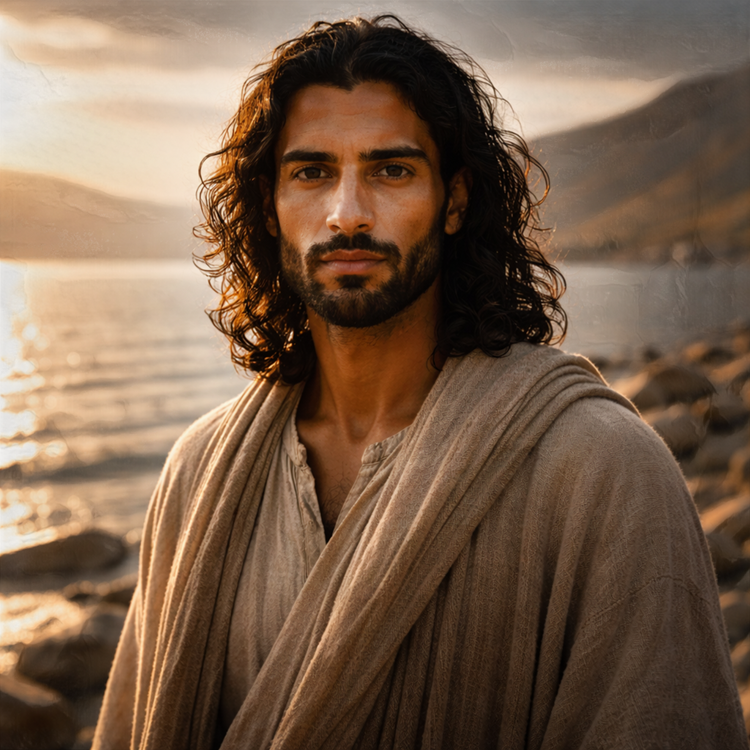
There is a man standing at the edge of the Sea of Galilee. The sun is already fierce by mid-morning. His skin is the color of the earth beneath his feet — dark olive, weathered, Semitic. His hair is black. His eyes carry the gravity of someone who has read the Prophets not as history but as living instruction. He is Jewish. He is poor. He is from Nazareth, a village so unremarkable that when his name first circulates, the response from a neighbor is recorded without embellishment: Can anything good come out of Nazareth?
This is the man.
Not the pale, luminous figure of the Sistine Chapel ceiling. Not the blue-eyed shepherd of a thousand Sunday school illustrations. Not the mascot of empires, the patron of conquest, the divine validator of whoever happened to be holding power in any given century. Those figures are constructions — layered carefully, generation by generation, onto a human being who lived, walked, argued, wept, and died in first-century Roman-occupied Palestine.
What follows is not an assault on faith. It is an act of devotion to the real — to the man before the legends grew, to the teaching before the institution arrived to manage it, to the flame before the walls were built around it and called a church.
To see him clearly is not to diminish him. It is, perhaps, the most honest form of reverence left to us.
The Man
Who was he, actually — not as doctrine declares him, but as history and earth and lineage can tell us?
Jesus of Nazareth was born into a Jewish family in the Roman province of Judaea, in a region called Galilee, sometime near the turn of the first millennium. The population of that region was predominantly Semitic — descended from the ancient Israelites, intermingled over centuries with surrounding Near Eastern peoples: Arameans, Phoenicians, the various peoples of the Levantine corridor. This was not a pale population. This was not a European population. This was the ancient Middle East, sun-drenched and ethnically continuous with what we would today recognize as Sephardic Jewish, Palestinian Arab, and broader eastern Mediterranean heritage.
Forensic anthropologists working with first-century Jewish skeletal remains from the region have produced facial reconstructions that bear no resemblance to the Christ of Western iconography. The face that emerges is broad, dark-complexioned, with the bone structure common to the Semitic Near East. Richard Neave, a medical artist who worked with the FBI and Scotland Yard, produced one such reconstruction in the early 2000s — a face that startled many simply because it looked like what the evidence demanded: a man of his time, his place, his people.
His language was Aramaic. He read and taught in Hebrew. He knew the Torah with the intimacy of someone who had absorbed it as a child, carried it as a young man, and was now pressing into it with the urgency of someone who felt the hour was late. His references are almost entirely drawn from the Hebrew scriptures — from Isaiah, from the Psalms, from Deuteronomy, from the Prophets. When he speaks of the Kingdom of Heaven, he is not inaugurating a new religion. He is speaking the language of Jewish apocalyptic tradition, the same stream that produced the Dead Sea Scrolls, the same current that ran through the Essene communities of his era.
He was, in the fullest sense, a Jew. Not a proto-Christian. Not the founder of a Western religion. A Jewish teacher, in the long line of Jewish teachers, whose encounter with the interior life of the Torah produced something so luminous and so destabilizing that the world has been arguing about it ever since.
The Myth-Making
If the man was this clear, this rooted, this particular — how did he become something else entirely?
The distance between the historical Jesus and the Christ of Western Christianity is not a short one. It was traveled in stages, each one serving the needs of whoever held the pen.
The first significant departure begins not with Jesus himself but with Paul of Tarsus — a man who never met Jesus during his lifetime, whose encounter was visionary rather than physical, and whose theological genius reshaped the teaching from a Jewish renewal movement into something portable across the Greek-speaking Mediterranean world. Paul’s Christ is cosmic — the pre-existent Son, the second Adam, the sacrifice whose death accomplishes what Torah alone could not. This is a profound theological construction. It is also a significant distance from the Galilean teacher whose recorded words focus overwhelmingly on how to live, how to love, how to treat the poor, how to locate the sacred within.
Then came the councils. The Council of Nicaea in 325 CE, convened by the Emperor Constantine, did not simply clarify doctrine — it fixed it by imperial authority. The full divinity of Christ, the precise nature of his relationship to the Father, the boundaries of acceptable belief — these were decided by committee, under political pressure, with dissenters exiled. The Nicene Creed that emerged is a political document as much as a theological one. What it established was not the teaching of Jesus. It was the teaching about Jesus, codified to serve the needs of an empire that had just adopted Christianity as its instrument of unity.
The iconography followed the politics. As Christianity spread through Europe, Christ was remade in the image of the peoples who adopted him. Byzantine mosaics gave him a stern, imperial bearing. Medieval European painters gave him Northern features. The Renaissance enshrined the pale, idealized Christ so thoroughly that he became indistinguishable from the European imagination of divinity itself. By the time colonial missionaries carried Christianity to Africa, Asia, and the Americas, they carried with them a blonde God — and the implicit message was not subtle. To convert was not merely to accept a teaching. It was to accept a civilizational hierarchy dressed in sacred clothing.
This is the deepest wound of the myth-making: not that it distorted a historical figure, but that it weaponized him. The dark-skinned Jewish teacher who said blessed are the poor, who touched lepers, who spoke to Samaritan women at wells, who reserved his harshest words for the religiously powerful — this man was conscripted into the service of exactly the forces he had spent his life standing against.
The tales we tell ourselves have consequences. And the tale of the European Christ, told long enough and loud enough, nearly erased the man it claimed to honor.
The Reclamation
What remains when the overlays are removed — what is left of him when we stop needing him to be something other than what he was?
What remains is extraordinary.
Strip away the Nicene formula and the Renaissance portrait and the colonial appropriation, and what surfaces is one of the most radical interior teachers in human history. A man who located the sacred not in the Temple, not in institutional observance, not in doctrinal precision, but within — the Kingdom of Heaven is within you. A man who reduced the entire architecture of religious law to two instructions: love the source of all being with everything you have, and love the person in front of you as you love yourself. A man who said the poor are blessed not as a consolation prize but as a metaphysical statement about where grace actually lives.
These are not Christian teachings in the institutional sense. They are human teachings. They belong to the Sufi who speaks of fana — the dissolving of the self into the Beloved. They belong to the Vedantin who traces every appearance back to the single Consciousness wearing ten thousand faces. They belong to the Bhakti devotee who understands that love is not a path toward the Divine but the very substance of it. Jesus, read without the institutional frame, is recognizable to every mystical tradition that has ever pointed inward and said: here, this is where it lives.
His Jewishness, properly understood, does not limit this universality — it deepens it. The Hebrew prophetic tradition from which he emerged was already insisting, centuries before his birth, that the Divine cannot be contained by any single nation, any single temple, any single people. Isaiah’s vision is global. The Psalms are cosmic. The wisdom literature of his tradition was already in conversation with Egyptian, Persian, and Babylonian streams of understanding. Jesus did not step outside this tradition when he spoke to Gentiles, healed Romans, honored Samaritans. He was living out its deepest impulse.
And his color — his dark Semitic face, his Galilean earth-toned skin — matters not because skin ever determines the quality of a soul, but because its erasure does. When we bleach the Christ, we do not merely distort history. We perform a spiritual operation that says: the divine looks like us, not like them. Reclaiming his actual face is a restoration of the truth that the sacred has no preferred ethnicity. It never did. The man from Nazareth knew this. The legends that grew around him forgot it entirely.
To reclaim the historical Jesus is not to diminish the mystical Christ. It is to find them, finally, in the same place — in the dark-skinned Jewish teacher standing at the edge of a lake, speaking words that have never stopped being true.
Epilogue
The legends were perhaps inevitable. Human beings have always needed their sacred figures to reflect something of themselves back — their face, their language, their cultural assumptions about where the holy resides. There is a tenderness in that impulse, even when it distorts.
But there is a greater tenderness in the willingness to let him be what he was.
A man. A Jew. A teacher of the interior life, who emerged from a lineage of prophets and spoke with the urgency of someone who had touched something real and could not stop pointing toward it.
The Christ before the legends grew is not a diminished figure. He is, if anything, more alive — more particular, more human, more genuinely available to every person who has ever stood at the edge of their own ordinary life and felt, against all evidence, that something sacred was near.
He was near. He said so himself.
And he said it in Aramaic, with a dark face, under a Galilean sun, to anyone willing to listen.
Author’s Note
As a Jewish man whose own spiritual path has carried him through Vedanta, Bhakti, Sufism, and the living fire of devotional practice, I find in the teachings of Jesus not a Christian inheritance but a human one. He belongs to no institution. The words he left behind — love your enemy, the kingdom is within, what you do to the least of these you do to me — are not the property of any creed. They are the voice of a tradition that knew, long before the legends arrived, that the sacred has no borders and the Divine plays no favorites among its children. I write this as a devotee — not of the constructed Christ, but of the luminous, particular, irreducible man before the legends grew.
Sources and References
Crossan, John Dominic. The Historical Jesus: The Life of a Mediterranean Jewish Peasant. HarperOne, 1991.
Ehrman, Bart D. Jesus: Apocalyptic Prophet of the New Millennium. Oxford University Press, 1999.
Neave, Richard, and others. Forensic facial reconstruction of a first-century Galilean Jewish male. Published in Popular Archaeology, 2001.
Pagels, Elaine. The Gnostic Gospels. Random House, 1979.
Sanders, E.P. The Historical Figure of Jesus. Penguin, 1993.
Vermes, Geza. Jesus the Jew: A Historian’s Reading of the Gospels. Fortress Press, 1973.
Wright, N.T. The Challenge of Jesus. InterVarsity Press, 1999.

 Numinous Waves