

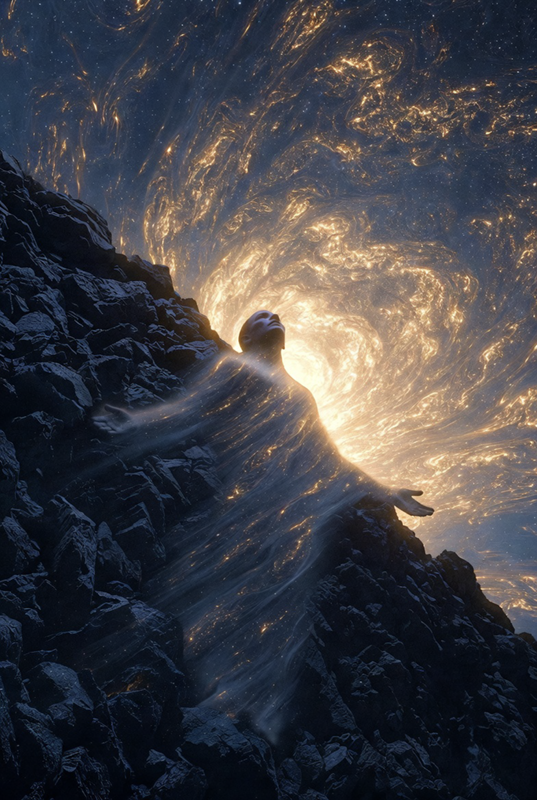
On the Awakening of the Inner Observer Across the Arc of the Yugas
— ✦ —
Something in you is reading these words. Something else is watching you read them.
This is not a philosophical riddle. It is an invitation to pause and notice what has always been present — a quality of awareness that does not think, does not judge, does not accumulate. It simply observes. The ancient teachers called it by many names: Sakshi in the Sanskrit of Advaita Vedanta, the Witnessing Presence in the Sufi tradition, the Imago Dei turned inward in the contemplative Christian stream. Carl Jung circled it carefully in his psychology and called it the Self — not the ego that performs and protects, but the deeper organizing intelligence that watches the ego with something like compassionate patience.
What is this Witness? Where does it come from? And why does it seem to stir into recognition precisely now, in this most contracted and turbulent moment of the cosmic cycle — the depth of Kali Yuga?
These are not small questions. They reach all the way back to the nature of Consciousness itself — not as a product of matter, not as a property of the biological brain, but as the primary ground from which all experience arises. And they reach forward, toward the possibility that the very density and confusion of this age is not a mistake but a necessary station — the nadir of an arc whose return has already, invisibly, begun.
— ✦ —
I. The One Who Watches
If I am always watching my thoughts, who is doing the watching?
Begin here, because this is where the path always begins — not in doctrine or cosmology, but in the immediate, undeniable fact of experience. Right now, as these words register in the mind, there is a movement of thought. And there is something aware of that movement. These are not the same thing.
The Advaita tradition is precise about this distinction. The mind — manas, the thinking instrument — produces an endless stream of impressions, reactions, preferences, fears, and stories. The Sakshi, the witness-self, is not part of that stream. It is the knowing principle behind it. It cannot be found by thought because it is what thoughts appear in. It cannot be doubted, because the doubting thought is itself witnessed.
Jung arrived at something structurally similar through a completely different route — through the depths of the unconscious, through dream analysis, through his own confrontation with the psyche’s interior. He discovered that behind the ego — that necessary but limited center of daily consciousness — there lay a larger intelligence he named the Self. The Self was not the ego’s creation. It pre-existed the ego. It watched the ego’s development the way a quiet river watches a boat navigate its surface.
In the Sufi vocabulary, muraqaba — often translated as meditation but more precisely meaning watchfulness — is the practice of training oneself to rest in this witnessing awareness rather than being continuously pulled into identification with the contents of experience. The mystic Rumi’s entire body of work can be read as one long instruction in the same art: stop running after the images in the mirror. Turn toward the light that makes the mirror possible.
What each of these traditions points toward is not a technique but a recognition. The Witness is not something to be constructed. It has always been present. What changes is not the Witness — it is our attention to the Witness. And that shift of attention, from content to the awareness that holds content, is what every genuine contemplative tradition means by awakening.
— ✦ —
II. The Ground Beneath the Ground
If Consciousness is not produced by matter, what is it, and where does it arise from?
The conventional modern view holds that consciousness is what the brain does — that awareness is an emergent property of sufficiently complex biological organization. On this account, the Witness is a kind of neurological illusion, a story the brain tells about itself.
But this view carries an increasingly heavy explanatory burden. It cannot account for why there is subjective experience at all — why the processing of information should feel like anything from the inside. This is what philosopher David Chalmers named the hard problem of consciousness, and decades of neuroscience have not dissolved it. The brain can be mapped in extraordinary detail, and still the question remains: why does this particular arrangement of matter produce the quality of being aware?
An older answer — one that precedes modern science by millennia and is now being revisited by thinkers like Bernardo Kastrup and Donald Hoffman — reverses the assumption entirely. Consciousness is not produced by matter. Matter arises within Consciousness. Awareness is not an output of the physical world; it is the medium in which the physical world appears.
In Kashmir Shaivism, this is stated with extraordinary precision. Shiva — not as a deity with attributes but as pure, undivided Awareness — is the one reality. Shakti is Shiva’s inherent power of self-expression, the creative impulse through which the One explores itself as the many. The universe is not created by consciousness the way a craftsman creates a table. It is an expression of consciousness the way a dream is an expression of the dreamer — arising within, sustained within, and ultimately resolving back within the same unbroken field.
The Vedantic term Brahman carries a similar resonance. Brahman is not a God who exists somewhere beyond the universe. Brahman is the Existence-Consciousness-Bliss — Sat-Chit-Ananda — that is the very nature of reality prior to any division. The personal, the impersonal, the formed, the formless — all of it is Brahman exploring its own infinite nature.
From this ground, the Witness Self is not a small, individual thing. When awareness witnesses your thoughts, something vast is looking through a small aperture. The light is the same light. The smallness is in the opening, not in the source.
— ✦ —
III. The Descent: How Light Becomes Stone
If we are luminous at the source, how did we come to be this — embodied, forgetful, and dense?
The Vedic Yuga system describes not a linear history of progress but a cyclical arc of consciousness — a vast breathing in and out of cosmic awareness across immense spans of time. At the peak of the cycle, the Satya Yuga, consciousness inhabits form lightly. The body is less a biological machine and more a vessel of light — sattva-dominant, transparent to the subtle, naturally aligned with the Source from which it arises. The Witness and the witnessed are not yet estranged. Awareness knows itself with little effort because the density that obscures it has not yet accumulated.
But the cycle turns. Treta Yuga brings the first thickening. Dvapara deepens the opacity further. And in Kali Yuga — the age in which we currently move — the contraction reaches its nadir. Matter has become maximally dense. The biological form asserts its urgency completely. The ego, which in earlier ages served as a transparent window, has become a wall. Memory of the Source grows faint, then mythological, then entirely unbelievable. God becomes a concept argued about rather than a reality lived within.
The crucial point — the one that separates genuine cosmology from simple pessimism — is this: the contraction is not a mistake. It is involution. Sri Aurobindo, drawing on both the Vedic and the evolutionary vision, described the descent of consciousness into matter not as a fall from grace but as a deliberate plunge — Consciousness choosing to explore the most extreme edges of its own creative range, to experience what it is to forget itself completely, and then to remember.
The Sufi tradition holds a similar recognition in the image of the drop that falls into the ocean not to be lost but to discover that it was always the ocean. The descent into density, into biological particularity, into the ache of embodied limitation — this is how Consciousness comes to know, from the inside, every register of its own spectrum.
Jungian psychology carries an echo of this in the concept of the unconscious. The Self does not disappear when the ego forms. It goes underground. The vast intelligence of the deep psyche continues its work beneath the threshold of awareness — in dreams, in symbols, in the strange synchronicities that periodically rupture the ego’s certainty that it is alone and in charge. The descent into the personal unconscious, Jung insisted, is not a regression. It is the necessary condition for genuine individuation — for the Self to be integrated rather than merely believed in.
— ✦ —
IV. The Witness Stirs
Why does the capacity to witness the self seem to awaken precisely in the midst of chaos and confusion?
Here is where the arc turns.
If the Kali Yuga is the age of maximum contraction — maximum density, maximum forgetting — then it is also, by the logic of the cycle, the moment of maximum pressure. And pressure, in the economy of Consciousness, is not always destructive. Sometimes it is the condition under which something crystallizes.
The Witness does not awaken in comfort. It awakens in the moment when the ordinary strategies of the ego — distraction, accumulation, the assertion of identity — fail completely. When the mind runs out of exits. When the suffering becomes too precise, too intimate, too undeniably real to be managed by ideology or entertainment. In that moment of genuine ground-lessness, something shifts. Not a new thought arrives. The thinker of thoughts is noticed.
This is the paradox that the great contemplative traditions have always carried: the descent into density is the very thing that makes the Witness possible in the way that matters — not as a philosophical idea held at a safe distance, but as a living, present, unmistakable recognition. In Satya Yuga, awareness knows itself because the veils are thin. In Kali Yuga, awareness knows itself because the pressure of not-knowing has become unbearable.
Jung saw this in the lives of individuals. The genuine encounter with the Self rarely happens in periods of smooth functioning. It happens in what he called the confrontation with the shadow — the moment when everything the ego has denied or suppressed returns, and the small organizing center of daily life is revealed as insufficient. This is not a breakdown. It is an opening. The crack through which the larger light enters.
In the Bhakti traditions of India, this same movement is recognized as the grace of yearning itself. When the heart breaks open with the longing for the Divine — not for a concept of the Divine but for the reality — something in that very longing is already the Witness becoming aware of itself. The devotee who cries out in the dark is not separated from the Source by that darkness. The crying itself is the recognition.
The Sufi masters speak of fana — the annihilation of the false self — not as an endpoint of the path but as its threshold. What dissolves in fana is not the person but the person’s identification with the small, defended, constructed version of themselves. What remains after that dissolving is baqa — subsistence in the Real — the Witness that has always been watching, now recognized as the only constant in every experience that has ever arisen.
— ✦ —
V. The Return: Remembering at the Bottom
If this is the nadir of the cycle, what does it mean that the Witness is awakening here?
The Yuga cycle does not end at its nadir. It turns.
Astronomical calculations place the current moment in the early ascent out of the deepest trough of Kali Yuga — not yet the golden light of Satya’s return, but the first increments of a movement that has already reversed direction. The density does not immediately dissolve. But something has shifted in the underlying momentum.
What does this mean in lived terms? It may mean precisely what is observable: that across cultures, traditions, and disciplines, the question of consciousness — not the philosophical question but the lived, experiential one — has become urgent in an unprecedented way. People who have never heard of Advaita Vedanta are sitting in silence and asking who is watching. People who have never studied Jung are encountering the shadow and discovering that something in them refuses to collapse. People whose religious tradition has no vocabulary for the Witness are nonetheless finding themselves, in the midst of ordinary life, pausing — and noticing the pausing.
This is not a mass awakening in the dramatic sense. It is quieter and more distributed than that. It is the Witness beginning to stir in millions of individual moments — an uptick in the signal, a gradual thinning of the veil, not because the world has become easier but because the cycle has turned and the pressure that was once purely crushing has begun, in some subtle register, to become clarifying.
The biological form is not left behind in this movement. The body that seemed to be the prison of awareness reveals itself, from the Witness position, as something more astonishing — a precision instrument for the exploration of density, a vehicle through which Consciousness has learned what it could not have learned in the lightness of Satya Yuga. The wound of embodiment becomes, in this light, a gift: the gift of knowing, from the inside, what it is to forget. And therefore, of knowing what it is to remember.
— ✦ —
Epilogue
The Witness has not arrived. It was never absent.
What the great traditions share — beneath their different languages, their different cosmologies, their different images of the Real — is this single insistence: awareness is the ground, not the product. The one who watches the mind is older than the mind. The one who watches the body is not contained by the body. The one who watches the Yugas turn has never entered the turning.
And yet — here is the mystery the descent makes possible — the Witness that watches from beyond all conditions also watches from within the most intimate, most personal, most seemingly ordinary moment of your experience. The light that illumined Satya Yuga is the same light reading these words. It contracted to find itself here. And finding itself here, in this confusion, in this density, in this beautiful and broken moment at the bottom of the world — it remembers what it is.
That remembering is not an achievement. It is a recognition.
Something in you is reading these words. Something else is watching you read them.
Rest there.
— ✦ —
Sources & References
Chalmers, David. The Conscious Mind: In Search of a Fundamental Theory. Oxford University Press, 1996.
Jung, C. G. The Archetypes and the Collective Unconscious. Princeton University Press, 1969.
Jung, C. G. Aion: Researches into the Phenomenology of the Self. Princeton University Press, 1959.
Kastrup, Bernardo. The Idea of the World: A Multi-Disciplinary Argument for the Mental Nature of Reality. Iff Books, 2019.
Muktananda, Swami. Play of Consciousness. SYDA Foundation, 1978.
Nisargadatta Maharaj. I Am That. Acorn Press, 1973.
Ramana Maharshi. The Collected Works of Ramana Maharshi. Weiser Books, 1972.
Rumi, Jalal al-Din. The Masnavi, Book I. Translated by Jawid Mojaddedi. Oxford University Press, 2004.
Shankara. Vivekachudamani (Crest-Jewel of Discrimination). Translated by Swami Prabhavananda. Vedanta Press, 1970.
Sri Aurobindo. The Life Divine. Sri Aurobindo Ashram Press, 1939.
Sri Yukteswar Giri. The Holy Science. Self-Realization Fellowship, 1949.
— ✦ —

 Numinous Waves