

Introduction
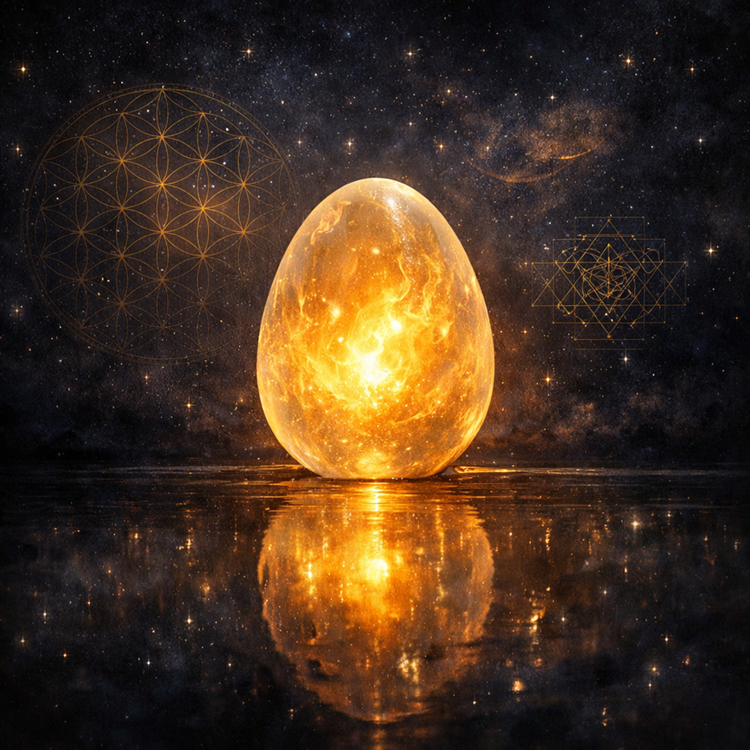
There is something the egg knows that the mind has almost forgotten. It knows how to hold the impossible — how to keep darkness warm, how to turn silence into a heartbeat, how to make a world inside a world. From the smallest insect egg pressed against a leaf in autumn to the golden orb of the cosmic egg suspended in the void before time began, life has always chosen this shape. Not the straight line, not the sharp angle, but the curve — the gentle, sealed, patient curve of the shell.
This is not merely a biological observation. It is a cosmological one. The universe thinks in eggs.
Why does life begin inside a shell?
Before there was science to describe it, there was myth to feel it. Across traditions separated by oceans and millennia, the world began the same way — with an egg. In the Vedic tradition, Hiranyagarbha, the Golden Womb, floated on the primordial waters before creation. From its interior, Brahma emerged, and with him, all of space and time. In the Orphic mysteries of ancient Greece, Phanes — the first god, the god of light itself — was born from a silver egg that drifted in the abyss. In Finnish cosmology, the world was shaped from the broken shell of a cosmic egg laid on the knee of a water goddess. Egyptian myth gave us the egg of the primordial goose, laid on the mound that rose above the waters of chaos, from which the sun itself hatched.
These are not coincidences. They are recognitions. Cultures that had no contact with one another arrived at the same image because the image was true — not factually, but archetypally, in the sense that Carl Jung meant when he spoke of the collective unconscious. The egg is a universal symbol not because ancient peoples agreed upon it, but because it rises naturally from the deep structure of human intuition. The psyche knows what the egg means before it is taught.
What does the shell protect, and what does it confine?
Here the biological and the sacred converge. The eggshell is calcium carbonate — brittle, porous, seemingly inadequate to the task it performs. And yet it is precisely adequate. It keeps the interior moist without sealing it entirely; it breathes. It holds the developing life in darkness and warmth, providing just enough boundary between the forming self and the unready world outside. Too soon, and the chick dies. At the right moment — which only the interior of the egg seems to know — the shell breaks from within.
This is the detail that stops the contemplative mind: the shell breaks from within. The life inside grows until it becomes the force that dismantles its own enclosure. The shell is not a prison broken open by an outside rescuer. It is a vessel that serves until it is no longer needed, then yields to the very life it nurtured.
The mammalian womb follows this logic in more elaborate form. The placenta is the shell — a temporary organ grown specifically for gestation, then released. The amniotic sac is the membrane. The body of the mother becomes the larger egg within which the smaller biological drama unfolds. One egg inside another, like a Russian nesting doll of protection and becoming.
Is it only physical life that gestates this way?
The Vedic understanding of Hiranyagarbha does not describe a biological event. It describes a cosmological one — and in doing so, it reveals something the sacred traditions have long maintained: that all creation, at every scale, follows the same pattern. The macrocosm and the microcosm are not merely similar. They are the same gesture, repeated across every order of magnitude with breathtaking fidelity.
This is the domain of sacred geometry — not geometry as measurement, but geometry as revelation. The sphere is the first form. Before differentiation, before direction, before the distinction between here and there, the universe expresses itself as a perfect, boundless curve. It is no accident that the egg approximates this form. The slight elongation of the ovoid is itself meaningful — it is the sphere in the act of becoming, the perfect circle leaning into time, making room for the movement from potential to actual.
In the Flower of Life, one of the oldest geometric diagrams known — found carved into the Temple of Osiris at Abydos and appearing in Leonardo da Vinci’s notebooks with the reverence of a man who recognized something he had not invented but only rediscovered — the first act of creation is the drawing of a circle. Then that circle moves to its own edge and draws another. From the overlap of these two circles is born the vesica piscis: the almond-shaped womb of space, the mother of all subsequent form. Every subsequent circle in the Flower of Life is another egg. Every overlap is another gestation. The entire diagram is, in its deepest reading, a cosmology of shells within shells, each one birthing the next.
Leonardo understood this not as abstraction but as living truth. He spent his life moving between the studio and the dissecting table, between the canvas and the notebook filled with mirror-script observations about water, birds, light, and the human body — and what he found, everywhere he looked, was the same grammar. The curve of a bird’s wing repeated in the arc of a river’s bend. The spiral of a nautilus encoded in the unfurling of a human fetus. The proportion of the egg present in the human skull, in the orbit of the eye, in the dome of the chest. He was not cataloguing coincidences. He was reading a single text written in the language of form — a text the universe had been composing long before human hands learned to hold a pen.
For Leonardo, the boundary between art and science did not exist because the boundary between the visible and the sacred did not exist. To study anatomy was to study the Divine’s preferred architecture. To paint the Madonna was to render in pigment what dissection had shown him in flesh — that life is cradled, always, inside a curve. His Vitruvian Man is often read as a diagram of human proportion, but it is also a cosmological statement: the human form inscribed within the circle and the square, held at the intersection of heaven and earth, the microcosm inside the macrocosm. A man inside an egg.
The Fibonacci sequence, which governs the spiral of a nautilus shell, the unfurling of a fern, the arrangement of seeds in a sunflower — this sequence is the mathematics of the egg’s logic extended into time. Leonardo traced these proportions obsessively, not because he sought to master nature but because he sensed that nature was trying to tell him something. Growth that remembers its own center. Becoming that carries its origin within it. The shell is not a container that happens to be curved. The curve is the message.
Does the soul gestate in the same way?
In Vedic understanding, the individual soul — the jivatman — is held inside layer upon layer of sheaths, the koshas, each one an egg within an egg. The physical body is the outermost shell. Within it, subtler and subtler layers nest inward: the vital body, the mental body, the body of wisdom, the body of bliss. The Atman at the center — pure awareness, unconditioned light — is what all the shells have always been protecting. The spiritual life is not the construction of something new. It is a hatching. Layer by layer, each shell is seen through, until what was always at the center is finally, fully known.
For Carl Jung, something parallel was visible through the lens of depth psychology. The alchemical vas hermeticum — the sealed vessel within which raw matter was heated and transformed — was understood by Jung as a symbol of the psyche’s own container during transformation. The egg and the alchemical vessel share the same logic: hold the heat, maintain the boundary, trust the darkness. What emerges will not resemble what went in. Transformation requires enclosure. The shell is not incidental to the process — it is the process. Without the held space, without the curve of protection, there is only dispersal. The universe understood this before the first cell divided.
And what of the galaxy itself? Modern cosmology has discovered that the earliest structures in the universe — the first gravitational condensations of matter — were not flat or angular. They were roughly spherical. The first stars formed inside roughly egg-shaped clouds of gas and dust, collapsing inward under their own gravity until the interior pressure ignited into light. Every star is, in this sense, a hatching. Every nova — the spectacular death-explosion of a dying star — scatters the material of that shell across space, seeding the next generation of worlds. The cosmos has been laying eggs and hatching them for thirteen billion years, and it has not yet stopped.
Does the egg hold something of the Divine?
In Bhakti, the devotional heart of the Indian traditions, creation is not a mechanical process — it is an act of love. The Divine does not manufacture the world from outside. It pours itself into the world, becomes the world, inhabits every form — including the smallest egg pressed to a leaf before the first frost.
Ramakrishna saw the Divine inside everything he touched. He wept before flowers, before the face of a child, before images he could not approach without trembling. His vision was not philosophical detachment but radical intimacy — the lover who cannot look at anything without seeing the Beloved concealed inside it. In this vision, every egg is a hiding place chosen by the Divine. Every shell is a veil the sacred drew around itself so that the joy of discovery would be possible. Every hatching is the moment the Beloved steps forward from behind the curtain and says: here. Here I was. I was here all along.
This is what the ancient cosmogonic myths were pointing toward when they placed the egg at the origin of all things. Not astronomy. Not biology. The nature of love — the way it works, the way it conceals itself inside limitation so that it may be found, the way the finite becomes the doorway into the infinite. Every shell is a temple. Every hatching is a theophany.
Epilogue
Hold an egg in your hand for a moment — not to crack it, not to use it, but simply to hold it. Feel the curve of the shell, the weight that seems too light for what it contains. Something is in there that was not there before. Something that was not anywhere before. The egg does not explain this. It simply does it.
All of life comes through this patience. All of becoming happens inside some version of this curve, this dark warmth, this sealed and breathing trust. The cosmos hatched. The soul is hatching. The shell will break from within, when the time is exactly right, when the interior life has grown large enough to require the open air.
Until then, the shell holds. As it has always held. As it was always meant to.
Sources and References
Chandogya Upanishad. Trans. Swami Nikhilananda. Ramakrishna-Vivekananda Center, 1949.
Chevalier, Jean, and Alain Gheerbrant. Dictionary of Symbols. Penguin Books, 1996.
Jung, Carl G. Psychology and Alchemy. Princeton University Press, 1953.
Kakar, Sudhir. The Inner World: A Psychoanalytic Study of Childhood and Society in India. Oxford University Press, 1978.
Nikhilananda, Swami. The Gospel of Sri Ramakrishna. Ramakrishna-Vivekananda Center, 1942.
Rg Veda. Hymn to Hiranyagarbha (10.121). Trans. Wendy Doniger. Penguin Classics, 1981.
Schwartz-Salant, Nathan. Jung on Alchemy. Routledge, 1995.
Selin, Helaine, ed. Encyclopaedia of the History of Science, Technology, and Medicine in Non-Western Cultures. Springer, 2008.
Zimmer, Heinrich. Myths and Symbols in Indian Art and Civilization. Princeton University Press, 1946.

 Numinous Waves