

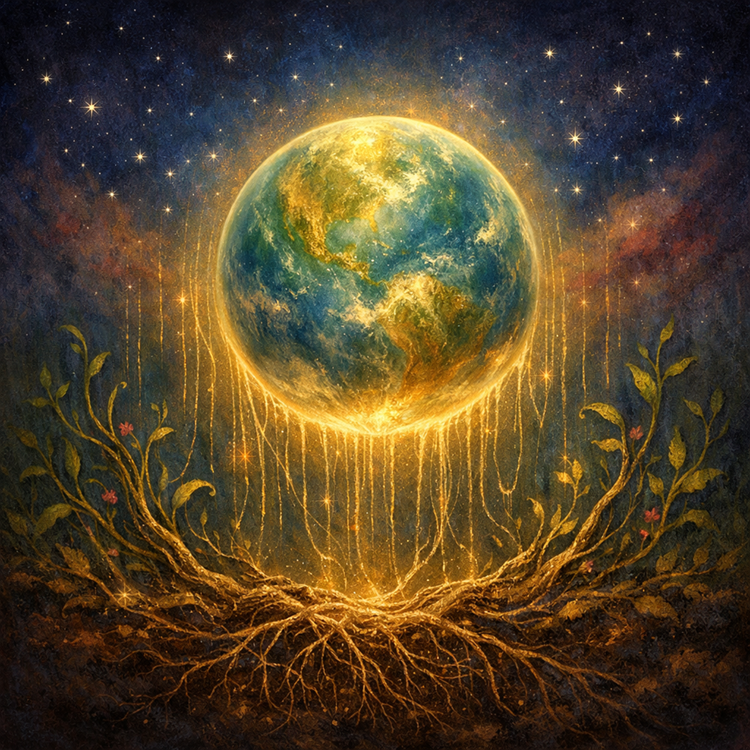
Earth, Soul, and the Sacred Duty of Caretaking
There is a moment — brief, easily missed — that some people experience when they press their palms against the bark of a very old tree. Something comes back. Not information, exactly. Not a thought. Something older than thought: a recognition, an answering, as if the tree were not merely a thing in the world but a presence within it. This moment is not superstition. It is not sentiment. It is the soul recognizing something it has always known but rarely been given permission to say aloud.
The Earth is alive.
Not alive in the way a houseplant is alive — not simply biological, not merely metabolizing. Alive in the way a mind is alive, in the way a love is alive: with interiority, with memory, with something that can only be called soul. The perennial traditions of the world — from the Vedic to the Indigenous, from the Greek to the Sufi — did not worship the Earth as a primitive error later corrected by science. They perceived the Earth with a precision that modern consciousness has largely lost: as a being, not a backdrop. As a subject, not a resource.
This essay is an invitation back into that perception. And it is also a question — asked honestly, without flinching — about what it costs the soul when it forgets.
— ✦ —
I. She Has a Name
Is the idea of a living Earth poetry, or is it perception?
Every great tradition that has stayed close to the Earth has given her a name. The Greeks called her Gaia — not a metaphor but a goddess, primal and real, from whom Ouranos (sky) was born, from whom the Titans came, the one who preceded the Olympians and will outlast them. The name points not to fiction but to a phenomenological fact: those who paid attention with the whole being, not just the analyzing mind, encountered something. They found personhood in the planetary.
In the Vedic world, she is Bhumi Devi — the Earth Mother, one of the most ancient and tender figures in the entire Sanskrit canon. She does not merely sustain life; she suffers its desecrations. The Bhagavata Purana contains a passage of startling beauty and sorrow: Bhumi Devi weeps under the weight of adharmic rule — not symbolically, but as a being who bears the burden of what is done upon her body. She calls out. She is heard. The cosmic order responds.
The Andean traditions speak of Pachamama — Earth not as a surface to stand on but as the living totality of time and space, mother and matrix simultaneously. In West African cosmologies, the Earth is one of the most sacred of all beings, to be addressed before any major undertaking, consulted before the dead are given back to her. The Lakota Sioux open prayer with Mitákuye Oyásʼiŋ — “All my relations” — a phrase that does not refer only to human family but to every living thread of the planetary web.
The medieval philosopher and mystic Marsilio Ficino, following Plato, wrote of the anima mundi — the world-soul — as the living intelligence that permeates and animates all material forms. This was not mystical excess. It was a rigorous claim about the nature of reality: that matter is not dead, that the cosmos is not a machine, that something like consciousness runs through the whole.
These are not coincidences of folklore. When independent traditions separated by geography and millennia arrive at the same perception, it is worth pausing. The convergence is itself a kind of evidence — not the evidence of the laboratory, but the evidence of sustained, careful, cross-cultural attention to the same phenomenon.
— ✦ —
II. Soul’s Address
Why does the soul feel more itself in nature than almost anywhere else?
There is a reason contemplatives have always sought the mountain, the forest, the desert, the sea. It is not merely that these places are quiet — cities can be quiet. It is not merely that they are beautiful — art can be beautiful. It is that in wild nature, something in the human soul recognizes its register. The frequency matches. The soul, in the presence of an ancient landscape, settles into itself the way a bell settles into silence after it has rung.
The Vedantic tradition would frame this as recognition of Brahman — the single, undivided consciousness that underlies all apparent multiplicity. The mountain does not merely remind the soul of the infinite; the mountain is an expression of it. When the seeker stands at a canyon rim at dawn and feels the boundaries of the self dissolve slightly — feels, for a moment, that there is no firm edge between self and sky — this is not illusion. In Vedantic terms, it is a glimpse of truth. The maya, the illusion, is the ordinary sense of separation. The canyon, in its indifference and its grandeur, temporarily dissolves that illusion.
The Sufi poets knew this intimately. Rumi’s reed flute yearns for the reed bed — the place of origin, of belonging, of return. The reed bed is not merely a metaphor for the Divine; it is the Divine encountered through the particular, the earthly, the material. For Rumi, the Earth was not an obstacle to the soul’s journey but a site of it. Creation does not separate us from the Creator. Creation is where the Creator becomes visible.
And then there is the simple, untheorized experience: the child who has not yet learned to abstract, who presses her face into the grass without apology and breathes. She is not performing communion. She is communing. The instinct comes first. The theology comes later — if it comes at all. What the child knows, and what the contemplative recovers after long practice, is that the Earth is not outside the soul’s world. The Earth is a dimension of it.
— ✦ —
III. The Forgetting and Its Price
What happened? How did a species that once spoke to the land come to treat it as raw material?
The philosopher David Abram has written with precision about what he calls the “eclipse of the animate Earth” — the slow, centuries-long process by which Western civilization withdrew its sense of aliveness from the natural world and relocated it exclusively in the human. The turning point was not one event but a confluence: the rise of abstract alphabetic literacy, the Cartesian split between mind and matter, the Industrial Revolution’s reframing of nature as standing reserve. Each shift narrowed the circle of perceived personhood a little further.
By the time the modern period arrived, the Earth had become property. The forests had become timber. The rivers had become routes. The mountains had become mineral deposits. And something deeply strange had happened inside the human being correspondingly: an inner aridity set in, a restlessness that no amount of produced pleasure could satisfy, a loneliness that technology could distract from but not heal.
The Vedic diagnosis is precise here. Avidya — ignorance, the fundamental misperception of the nature of reality — lies at the root. The soul that does not know itself does not know what it is looking at. The Earth, encountered through the lens of avidya, appears as matter only: inert, exploitable, mute. But avidya is not a permanent condition. It is a curable blindness. The Bhakti traditions in particular understood this: what heals avidya is not more information but more love. Not analysis but devotion. Not extraction but care.
The price of the forgetting is paid twice: once by the Earth, in degraded soil and poisoned water and vanishing species. And once by the human, in the low-grade dissociation — so normalized as to be nearly invisible — of a being that no longer knows where it belongs.
— ✦ —
IV. Caretaking as Spiritual Practice
If the Earth is a living being and not merely a habitat, what does that ask of us?
The word “caretaking” has been flattened by its association with obligation — with guilt, with environmental messaging, with the grimly responsible. But the original meaning of care is closer to love. To care is to attend with one’s whole being. To take care is to hold something in the field of one’s deepest attention and act from that holding.
In the Bhakti tradition, this is called seva — selfless service offered as worship. Seva is not duty in the legalistic sense; it is devotion in action. When the Vaishnavas clean the temple, they are not completing a chore. They are touching the sacred. When the Sufi dervish tends the garden of the tekke, he is not merely gardening. He is practicing presence. The form of the action is ordinary. The inner register is not.
What would it mean to tend the Earth in this spirit? To compost not because it is efficient but because returning to the soil is an act of recognition — an acknowledgment that what came from the Earth belongs to the Earth. To plant a tree not as a carbon offset strategy but as a gesture of relationship, an introduction, a small covenant. To stand at the edge of the ocean and feel gratitude before feeling any desire to use it.
The Indigenous traditions of North America speak of the seventh-generation principle: decisions made today should consider their effects on the seventh generation to come. This is not merely prudent governance. It is a practice of radical temporal empathy — of feeling oneself to be a link in a chain rather than an endpoint of history. It is also, when entered deeply, a practice of ego dissolution. The one who thinks in seven generations has had to loosen the grip of the personal, the immediate, the acquisitive self.
Teilhard de Chardin, the Jesuit mystic and paleontologist, wrote of the noosphere — the sphere of human thought — as a new layer of Earth’s being, as real and significant as the biosphere beneath it. In his vision, human consciousness was not separate from the Earth’s story but a new chapter within it: the moment when the Earth began, through us, to become aware of itself. This is a staggering reframe. Humanity is not the Earth’s conqueror. Humanity is the Earth’s experiment in self-reflection. And an experiment that destroys its own laboratory has not yet understood the assignment.
— ✦ —
V. The Return That Is Already Happening
Is it too late? Or is the very asking of this question a sign of something stirring?
There is a paradox at the center of this moment: the same technological civilization that has most aggressively severed humanity from the living Earth is also the one producing the instruments — the satellite images, the ecosystem monitoring, the climate science — that have made visible, for the first time in history, the full scope of what the Earth is and what it is undergoing. The Earth’s image seen from space — the photograph known as Earthrise, taken by Apollo 8 astronauts in 1968 — did something to the collective human psyche that no previous millennium had managed. It made the wholeness of the planet visible. For a moment, the abstraction became concrete. And something shifted.
The environmental movement, the growth of ecological spirituality, the resurgence of Indigenous land-based traditions, the quiet return of millions of people to gardens and forests and rivers — these are not unrelated phenomena. They are movements of the same underground stream breaking surface in different places. Something in the human being, suppressed but never extinguished, is reaching again toward the Earth. The reaching is uneven. It is partial. It is often confused. But it is real.
Ramakrishna, whose devotion to the Divine Mother was the center of his entire being, reportedly wept at the sight of green grass. Not in sentiment — in recognition. He saw the Mother there. He saw consciousness wearing the form of a blade of grass, and it undid him with tenderness. This is the model: not a relationship to the Earth built on guilt or obligation but on love. On seeing. On the willingness to look at the ground beneath one’s feet and understand that it is not beneath one at all — that it is, in the most precise sense, the ground of being.
The soul that has truly met the Earth does not need to be convinced to care for it. The caring becomes natural — inevitable — an extension of love into form. This is the shift that no policy alone can produce. It must happen inside the human being first. It is a spiritual event before it is an ecological one.
— ✦ —
Epilogue
The Earth has been patient. She has absorbed catastrophe before — ice ages, meteor strikes, volcanic winters that blotted out the sun for years. She is not fragile. She is ancient. But the species that currently inhabits her surface is young, and youth can destroy what it does not yet understand it needs.
The invitation of this moment — the invitation that the Earth herself seems to be extending, through every storm and drought and species gone silent — is to grow up. To mature into the relationship that the soul has always been capable of but has rarely sustained. To become, at last, the caretakers the traditions always said we were meant to be: not the owners of the Earth but her conscious children. Not her masters but her most attentive students.
The path back is not complicated. It begins where the child began: with the grass, with the bark, with the press of bare feet on soil and the slow return of something that was never really lost — only buried under the noise of a civilization that forgot, for a time, how to listen.
The Earth is still speaking. She has not stopped.
The question is only whether enough of us will go quiet enough, long enough, to hear.
— ✦ —
Sources & References
Abram, David. The Spell of the Sensuous: Perception and Language in a More-Than-Human World. Pantheon Books, 1996.
Bhagavata Purana (Srimad Bhagavatam). Various translations, including the Bhaktivedanta Book Trust edition.
de Chardin, Pierre Teilhard. The Phenomenon of Man. Harper & Row, 1959.
Ficino, Marsilio. Commentary on Plato’s Symposium on Love. Trans. Sears Jayne. Spring Publications, 1985.
Hesiod. Theogony. Trans. M. L. West. Oxford University Press, 1988.
LaDuke, Winona. All Our Relations: Native Struggles for Land and Life. South End Press, 1999.
Narada Bhakti Sutras. Trans. Swami Tyagisananda. Sri Ramakrishna Math, 1943.
Plato. Timaeus. Trans. Donald Zeyl. Hackett Publishing, 2000.
Rumi, Jalal ad-Din. The Masnavi. Trans. Jawid Mojaddedi. Oxford University Press, 2004.
Sahtouris, Elisabet. Gaia: The Human Journey from Chaos to Cosmos. Pocket Books, 1989.
Swami Vivekananda. Complete Works. Advaita Ashrama, Mayavati, 1907.
— ✦ —

 Numinous Waves