

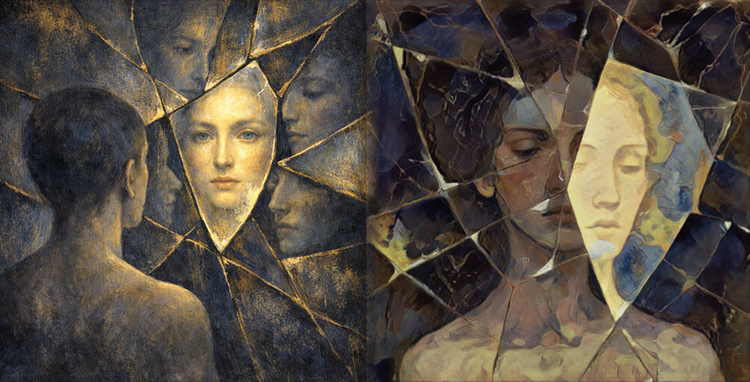
On the Wound Beneath the Wish
I want to be clear about what drew me to this subject — and what it is not. This is not an essay about vanity, nor is it a judgment of the deeply human wish to present oneself well to the world. The soul has always expressed itself through form. Adornment, care, the attention we bring to how we inhabit our bodies — these are ancient and often sacred acts. Even the lines that time draws on a face can be worn with a kind of grace, a dignity that speaks of a life actually lived.
What concerns me here is something else entirely. It is the moment when that natural relationship between soul and body breaks — when the mirror becomes not a place of recognition but of verdict, and when the response to that verdict is the progressive erasure of the original self in favor of a constructed one. Not beautification. Replacement. The soul’s authentic expression traded for an attachment to an image that was never truly its own.
That is the wound this essay tries to witness. Not with judgment, but with the kind of attention that genuine suffering deserves.
Introduction
There is a particular quality of grief that attaches to the person who no longer recognizes themselves in the mirror — not because time has altered them, but because the alterations they sought have compounded beyond recovery into something that no longer belongs to them. The jaw restructured beyond its original architecture. The musculature inflated past the body’s natural range. The face stretched or filled or reshaped until the expression it carries is no longer quite the expression of the person who lives behind it.
This is not an essay about cosmetic refinement. It is not concerned with the subtle adjustments that restore what illness, time, or injury have taken. It addresses something more extreme and more telling: the progressive replacement of natural form with constructed form, until the person who once inhabited that body becomes a kind of archaeological ghost beneath a surface they have engineered and re-engineered, each intervention feeding the hunger the last one failed to satisfy.
The compulsion presents differently across the spectrum of human experience. It shows up in the woman whose face has been rebuilt procedure by procedure toward an ideal that keeps receding. It shows up in the man whose body has been chemically and surgically escalated toward a physical dominance that no amount of mass seems to secure. The instruments differ. The cultural scripts differ. The wound beneath them is the same.
To look at this phenomenon spiritually — honestly, without condescension, and without the comfortable distance of moral judgment — is to encounter one of the most concentrated expressions of modern suffering available to us. The body altered beyond nature is not a vanity tale. It is a wound narrative. And the wound it speaks of is very old.
I. The Verdict That Moved Inside
What does the person who goes under the knife — or the needle, or the syringe — again and again actually believe about themselves, about their body, about what is missing?
Carl Jung understood that the psyche, when it cannot find what it needs in the depths of the soul, projects its longing outward. The person who submits to repeated transformation is not, at the root, making an aesthetic choice. They are enacting a theology — a belief system, however unconscious, about where value resides, about who confers it, and about whether they themselves, in their natural form, possess it.
The belief did not originate within them. It was installed. From earliest childhood, the culture surrounding them offered a consistent verdict: that to be seen was to be valued, that to be valued one must present correctly, and that correct presentation had a specific geometry — one that shifted with fashion, with media, with the market — but that always, without exception, lay slightly beyond what nature had actually provided. That message did not stay outside. It migrated inward. It became the judge that sits behind the mirror.
What makes the extreme cases so instructive is their transparency. The person who has had thirty procedures, or who has pharmacologically and surgically rebuilt their physique past the threshold of recognition, is doing in physical matter what every psyche under sufficient cultural pressure eventually attempts: negotiating with a standard that was designed to be unnegotiable. The standard is not a fixed target. It is a moving one. Every procedure that approaches it reveals that it has already moved. This is not a failure of the individual. It is the mechanism of the wound itself.
Naomi Wolf identified this mechanism in its cultural dimension — the systematic deployment of impossible aesthetic standards as a means of keeping human attention and energy focused inward and downward, away from questions of meaning, authority, and genuine self-knowledge. But the mechanism does not feel like a mechanism when you are living inside it. It feels like truth. It feels like the only honest account of what you are worth.
II. The Temple Under the Knife
What does it mean, in sacred terms, to alter the vessel the soul arrived in — to refuse, at the level of flesh and bone, the form that was given?
In the Vedic understanding, the body is not the self — but neither is it an obstacle to the self. The Sanskrit term sharira, often translated simply as body, carries within it the sense of something that is worn, inhabited, and ultimately released — but while it is worn, it is sacred. It is the instrument through which consciousness meets the world, through which the divine plays in matter. The body, in this understanding, is not a mistake requiring correction. It is a specific configuration of cosmic intelligence, shaped for purposes that the surface mind may not fully comprehend.
When the Bhakti saints spoke of the body, they spoke of it as the dwelling place of the Beloved — not in spite of its particularity, but by means of it. Mirabai understood herself as the habitation of Krishna within the specific form she carried. The ache she felt was not for a different body. It was for a deeper recognition of what the body she already possessed actually contained. That recognition — the discovery of the sacred within the given form rather than the constructed one — is the movement that extreme cosmetic transformation cannot make, precisely because it is moving in the opposite direction.
To subject the sharira to progressive industrial transformation — to excise, inflate, restructure, and reconstruct until the original form is archaeologically buried — is, from this perspective, not merely a psychological act. It is a theological one. It is the material expression of a belief that the soul arrived in the wrong vessel. And behind that belief, always, is the prior wound: that the soul itself — the one who inhabits the vessel — is not sufficient as it is.
The tragedy is not the alteration. The tragedy is that the alteration does not cure the belief. Every procedure is a negotiation with an impossible standard. Every result, no matter how technically accomplished, eventually confirms the original verdict — because the verdict was never about the body in the first place.
III. The Shadow Beneath the Wish
Is there something darker here — something that goes beyond individual wounding into cultural pathology?
Yes. And it must be named without flinching.
What is being enacted in the most extreme cases of bodily transformation is not merely the expression of personal insecurity. It is the physical manifestation of a culture that has successfully colonized the human interior. The colonization began, as most do, with a set of images — idealized, relentless, and commercially motivated — installed in the psychic environment so early and so completely that they came to feel not like external impositions but like internal desires. The woman who cannot stop altering her face and the man who cannot stop escalating his physical mass are, at the level of mechanism, doing the same thing: attempting to satisfy from the outside a hunger that has its source within.
Jung’s concept of the shadow is helpful here not only in its personal dimension but in its collective one. A culture carries a shadow as surely as an individual does. The collective shadow of a civilization that has systematically reduced human worth to productivity, appearance, and competitive display does not simply disappear. It goes underground, and it surfaces in precisely these extremities — the person who cannot stop because stopping would mean confronting the wound directly, without the anesthesia of another intervention.
Ramakrishna taught that the Divine is present in every form — the beautiful and the plain, the young and the aged, the decorated and the unadorned. To see the sacred in every human form, as he saw it, is to encounter a category of vision that the culture of extreme transformation cannot sustain. That culture requires a hierarchy of form. The sacred requires no such thing.
When Rumi wrote that the wound is the place where the light enters, he was not recommending suffering. He was describing a metaphysical law: that the undefended opening — the place that has not been sealed, reconstructed, or armored — is precisely the passage through which grace moves. The person who has surgically sealed every vulnerability, who has armored themselves in constructed symmetry or engineered mass, has, by the logic of the mystics, made themselves more difficult to reach — not by the world, but by the depth within themselves that is actually seeking connection.
IV. The Beloved Who Was Already There
Is there a way back? And if so, what does it actually require?
Teresa of Avila, who wrote with devastating clarity about the soul’s journey inward, described the interior castle — the mansiones — as a structure already fully built, already complete, already radiant, requiring not construction but discovery. The soul does not build itself into worthiness. It uncovers the worthiness that was always there, buried under the accumulated sediment of fear, shame, and the world’s verdict.
The path back from extreme bodily alteration is not primarily surgical. No amount of revision — whether toward or away from previous interventions — addresses the interior vacancy that the procedures were attempting to fill. What is required is something the culture of surgical transformation has almost no framework for: the direct confrontation with the original wound, in the presence of something that can hold it.
In the Bhakti tradition, that something is the Beloved — however one names the divine. The practice of Bhakti does not begin with the premise that the devotee must first become beautiful enough, powerful enough, or sufficiently transformed before the Beloved will receive them. It begins with the exact opposite premise: that the devotee is already received, already seen, already known in their original form — and that the entire movement of spiritual practice is the gradual dawning of that recognition within the devotee themselves.
Vivekananda, speaking from the same current, taught that the human being is not a sinner struggling toward divinity but a divine being who has forgotten. The forgetting is real. The suffering it generates is real. But the solution is not the improvement of the surface. It is the recovery of what lies beneath it.
The person who has gone under the knife twenty times in search of the self that will finally be acceptable is not the enemy of this understanding. They are, in the most acute sense, its subject. They are doing, in physical matter, what every soul in spiritual emergency does: seeking, with the instruments available to them, the recognition that their tradition, their culture, and too often the people closest to them have failed to provide.
Epilogue
What the extreme case reveals — the face rebuilt beyond nature, the body escalated past its own thresholds, the form that no longer belongs to the person who carries it — is not a failure of personal willpower or aesthetic judgment. It is a record. A record of what happened to the human soul in a culture that taught people their bodies were problems to be solved rather than vessels to be inhabited. A record of a wound that was never properly witnessed, and so went looking, again and again, for the corrective procedure that would finally close it.
The body that was never enough was never the problem. It was always the messenger.
The mystics who spoke of the sacred vessel, the dwelling of the Beloved, the interior castle already complete — they were not offering a consolation prize to those who failed the world’s standard of form. They were pointing to a register of reality in which that standard has no jurisdiction. In which the soul, in its original and unaltered state, is not merely acceptable but is, precisely in its particularity, irreplaceable.
To recover that understanding — for oneself, or to offer it to another — is one of the most radical acts available in this particular historical moment. It requires nothing more, and nothing less, than the willingness to look at what is already there, and to call it, without qualification, enough.
Sources & References
Wolf, Naomi. The Beauty Myth: How Images of Beauty Are Used Against Women. William Morrow, 1991.
Jung, Carl G. The Archetypes and the Collective Unconscious. Collected Works Vol. 9, Part 1. Princeton University Press, 1959.
Jung, Carl G. Aion: Researches into the Phenomenology of the Self. Collected Works Vol. 9, Part 2. Princeton University Press, 1959.
Mirabai. Mirabai: Ecstatic Poems. Translated by Robert Bly and Jane Hirshfield. Beacon Press, 2004.
Rumi, Jalal al-Din. The Essential Rumi. Translated by Coleman Barks. HarperOne, 1995.
Ramakrishna. The Gospel of Sri Ramakrishna. Recorded by Mahendranath Gupta (M). Ramakrishna-Vivekananda Center, 1942.
Vivekananda, Swami. Jnana Yoga. Advaita Ashrama, 1899. (Revised edition, 1907.)
Teresa of Avila. The Interior Castle. Translated by Mirabai Starr. Riverhead Books, 2003.
Phillips, Katherine A. The Broken Mirror: Understanding and Treating Body Dysmorphic Disorder. Oxford University Press, 2005.
Grogan, Sarah. Body Image: Understanding Body Dissatisfaction in Men, Women and Children. Routledge, 2008.
Pope, Harrison G., Katharine A. Phillips, and Roberto Olivardia. The Adonis Complex: The Secret Crisis of Male Body Obsession. Free Press, 2000.

 Numinous Waves