

Introduction
What does it mean to reshape the world without having first reshaped oneself?
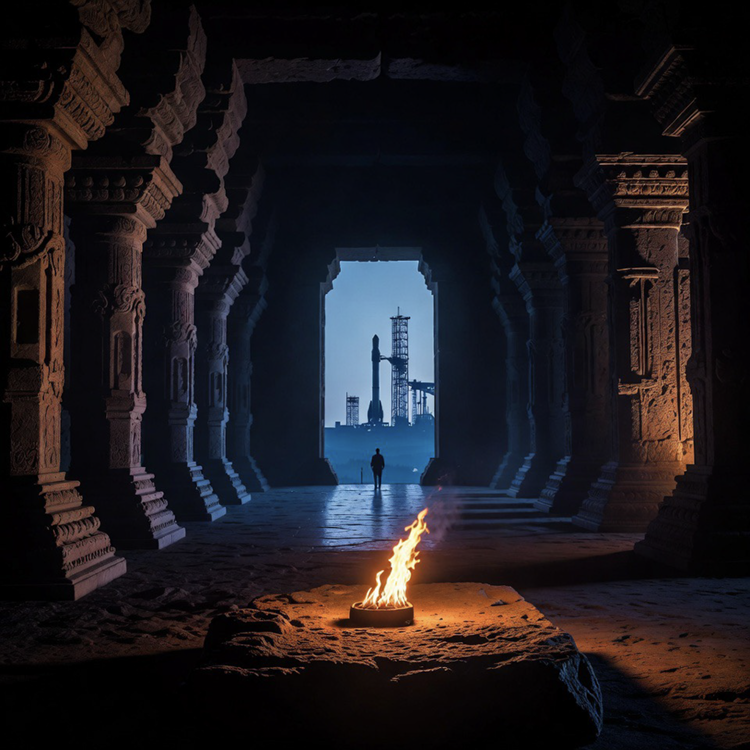
There is a particular kind of genius that the modern age produces with startling regularity — a mind of such ferocious capability, such restless inventive fire, that it seems almost cosmically appointed to remake the surface of things. Elon Musk is perhaps the most visible embodiment of this phenomenon alive today. He has built rockets that return from space, threaded neural interfaces into living tissue, electrified the automobile, and spoken openly of seeding human civilization across other planets. By any measure of external accomplishment, the scale is staggering.
And yet, something is missing.
Not from his intelligence. Not from his ambition, his technical fluency, or his capacity to hold impossibly complex systems in mind. What is missing is harder to name, and perhaps harder still to notice in a culture that has largely forgotten to look for it. What is missing is the interior dimension — the quiet, cultivated, often painful work of turning inward, of meeting oneself honestly in the dark, of allowing wisdom, not merely knowledge, to govern one’s hand.
This essay does not seek to diminish a remarkable human being. It seeks, rather, to ask a question that the age itself seems reluctant to pose: Can a civilization be carried forward by brilliance alone? And in asking it, to hold Elon Musk not as a villain, but as a mirror — a vivid and clarifying reflection of what our world celebrates, and what it has quietly ceased to require.
I. The Architecture of Genius
Is there a form of intelligence that builds cathedrals outward while leaving the inner sanctuary empty?
The yogic and Vedantic traditions have long distinguished between two modes of knowing. Vijnana — often translated as technical or analytical knowledge — is the intelligence that maps, measures, dissects, and constructs. It is the intelligence of the engineer, the systems thinker, the one who sees the mechanism behind the phenomenon. Prajna, by contrast, is wisdom in the deeper sense: the knowing that arises not from accumulation of data, but from a certain quality of presence, of stillness, of having sat long enough with one’s own nature to recognize something essential about the nature of all things.
Musk operates, by all visible evidence, almost entirely within the domain of vijnana. His genius in this register is almost without precedent in the modern era. He can hold the thermodynamic constraints of rocket reusability and the regulatory timelines of the FAA in the same mental field while simultaneously iterating on battery chemistry. This is extraordinary. The contemplative traditions would not deny it for a moment.
But vijnana without prajna is, in the Vedantic framing, a lamp without a wick. It produces light of a kind — tremendous, blazing, capable of illuminating entire industries — but it burns without direction from a deeper source. It can tell you how to go to Mars. It cannot tell you whether one should, or for whom, or at what cost to the soul of the endeavor.
Carl Jung identified a related phenomenon in his mapping of the psyche. The figure he called the puer aeternus — the eternal youth — is characterized by soaring vision, boundless energy, an intolerance for limitation, and a deep resistance to the slow, grounding work of genuine individuation. The puer builds upward, always upward, toward the light. What he avoids is descent — into shadow, into grief, into the humbling encounter with one’s own unconscious material. Jung was careful to note that the puer is not weak. Often, the opposite. But the very ferocity of the upward movement can become a flight from depth.
II. Power in the Absence of Interiority
When the hand that holds the hammer has never learned to be still, what does it build — and what does it, without knowing, destroy?
The contemplative traditions are unanimous on a particular point: that power, when it outpaces inner development, becomes dangerous — not necessarily through malice, but through a kind of spiritual blindness that is all the more consequential for being unrecognized. Ramakrishna spoke of the need to purify the vessel before filling it. Rumi’s entire poetic corpus is an extended meditation on the ego’s tendency to mistake its own noise for divine signal. Patanjali, in the Yoga Sutras, places ahimsa — non-harming — as the very first ethical foundation, before any discussion of power or attainment.
What one observes in Musk’s public comportment — in the impulsive declarations, the weaponization of enormous platforms, the apparent indifference to collateral human consequence — is not the behavior of an evil man. It is the behavior of a man who has never been asked, or never asked himself, to undergo the slow crucible of inner transformation. There is, in the contemplative sense, no tapas visible — no disciplined fire turned inward, no sustained encounter with the shadow, no evidence of the humility that genuine self-knowledge produces almost as a byproduct.
This is not unusual. It is, in fact, the norm for persons of great worldly power. What makes Musk singular is the sheer scale at which this unexamined interiority now operates. When a man of his reach acts from unprocessed psychological material — from wound, from grandiosity, from the need to win that has never been metabolized into something wiser — the effects are not personal. They are civilizational.
The Bhakti traditions offer a particularly poignant lens here. In the path of devotion, the great transformation is not the expansion of capability, but the softening of the self-referential center. The heart, in Bhakti, is not a seat of sentimentality — it is the organ of genuine perception, the faculty by which one feels the reality of another, the faculty by which power becomes compassion rather than force. A heart that has not been opened by love — by genuine surrender, by encounter with something vaster than the ego’s project — remains, however brilliant, essentially sealed.
III. The Civilizational Mirror
If we built our temples to genius alone, what god would we find waiting inside?
The deeper provocation of the Musk phenomenon is not really about Elon Musk. It is about the civilization that made him its avatar. We live in an age that has elevated a specific and narrow bandwidth of human intelligence — the measurable, the productive, the scalable — to the status of the highest human virtue. We fund it, we celebrate it, we build our institutions around it, and we grant it, increasingly, the power to determine the future.
What we have defunded, with equal consistency, is the interior life. Contemplation is not a line on a résumé. Wisdom does not scale. Compassion cannot be A/B tested. The mystic, the saint, the one who has undergone genuine transformation — these figures have no place in our current architecture of value. And so we should not be surprised when the individuals who rise to the apex of that architecture are, however brilliant, spiritually unformed.
The Vedic cosmological framework, particularly within the context of the Kali Yuga — the age of fragmentation and materiality through which, by traditional reckoning, we are now moving — anticipates exactly this condition. It is the nature of this age, the tradition holds, that tamas and rajas — inertia and frenetic activity — predominate, while sattva, the quality of clarity, harmony, and wisdom, recedes. The Kali Yuga does not produce sages in positions of worldly power. It produces Titans. And Titans, however magnificent, build worlds that eventually must be dismantled by something they cannot manufacture: grace.
None of this forecloses the possibility of transformation. The traditions are unanimous here as well. The soul does not arrive with an expiration date. Ramakrishna himself insisted that even the most armored ego, under the right conditions — the right encounter, the right moment of genuine suffering, the right opening — can be touched. Musk is, by any reckoning, still in motion. Life has a way of providing exactly the initiation that the soul requires, often precisely through the consequence of its own unlived depth.
Epilogue
There is an old image in the contemplative traditions of the sword and the lamp. The sword can cut through darkness with tremendous force. The lamp illuminates it from within. The greatest civilizations, and the greatest human beings, have always needed both. What the present moment seems to be asking — with a particular urgency — is whether we might remember, before the sword swings too far, to tend the lamp.
Elon Musk will likely continue to build things that astonish. The question the soul of the age is quietly posing is not whether he will reach Mars, but whether, in reaching it, something essentially human — something that no rocket can carry — will have been left behind.
The stars are patient. The interior life is not.
When the Flame and the Forge Were One

History is not without its witnesses to a different possibility. There have been those — rare, perhaps, but undeniable — in whom the outer fire of creative genius and the inner fire of self-knowledge burned with equal intensity, each feeding rather than diminishing the other. They are worth remembering, not as reproach to anyone, but as proof that the integration is not merely a spiritual ideal. It has been lived.
Leonardo da Vinci remains perhaps the most startling example the Western tradition has produced. His notebooks reveal not merely the restless invention of an engineering mind — the flying machines, the anatomical studies, the hydraulic systems — but a contemplative sensibility of extraordinary depth. Leonardo observed the world with what can only be described as devotional attention. For him, the curve of a river and the curve of a human muscle were revelations of the same underlying intelligence. Genius, in his hands, was inseparable from wonder — and wonder, the traditions tell us, is the beginning of the interior life.
Nikola Tesla, whose contributions to electrical science reshaped civilization as thoroughly as anything Musk has attempted, spoke late in his life of the universe as a living field of consciousness, of the self as continuous with something vast and unnameable. He worked in solitude, in states that those around him sometimes described as trance-like, as though the inventions arrived from somewhere deeper than calculation. Whatever one makes of his cosmology, the interiority was real, and it shaped the quality of his attention in ways that pure technical ambition cannot replicate.
Albert Einstein, whose restructuring of space, time, and gravity remains the most consequential scientific achievement of the modern era, was explicit and unambiguous about the role of what he called cosmic religious feeling in his work. He did not mean religion in any institutional sense. He meant the direct, felt sense of participating in a mystery larger than the human mind — the same sense that Ramakrishna pointed to, that Rumi sang toward, that the Upanishads called Brahman. Einstein’s genius was not separate from this sensibility. It flowed from it.
Rabindranath Tagore — poet, philosopher, composer, educator, and the first non-European to receive the Nobel Prize in Literature — carried the full weight of the Bhakti tradition into every domain he touched. His school at Santiniketan was not merely an educational institution but an embodied philosophy: that beauty, nature, silence, and devotion are not ornaments to learning but its very ground. Tagore corresponded with Einstein, and their conversations — two of the most penetrating minds of the twentieth century circling the relationship between truth and beauty, science and the sacred — remain among the most luminous documents of that age.
What these figures share is not sainthood in any conventional sense. They were complex, sometimes contradictory, occasionally wounded human beings. What they share is the evident presence of an interior axis — a place within from which their outer work was generated and to which it was, in some essential way, accountable. Their genius was not self-referential. It pointed beyond itself. And in pointing beyond itself, it touched something that merely technical brilliance, however astonishing, has never quite reached: the feeling, in those who encountered it, of having been reminded of something they already knew in their deepest nature.
That is what the lamp does, when it burns alongside the sword. It does not diminish the cutting edge. It reveals what is worth cutting toward.
Sources & References
- Patanjali. The Yoga Sutras of Patanjali. Trans. Sri Swami Satchidananda. Integral Yoga Publications, 1978.
- Jung, C.G. The Archetypes and the Collective Unconscious. Princeton University Press, 1969.
- Von Franz, Marie-Louise. The Problem of the Puer Aeternus. Inner City Books, 2000.
- Nikhilananda, Swami (Trans.). The Gospel of Sri Ramakrishna. Ramakrishna-Vivekananda Center, 1942.
- Rumi, Jalal al-Din. The Masnavi. Trans. Jawid Mojaddedi. Oxford University Press, 2004.
- Vivekananda, Swami. Jnana Yoga. Advaita Ashrama, 1907.
- Yukteswar, Sri. The Holy Science. Self-Realization Fellowship, 1949. (On Yuga cycles and the nature of the Kali Yuga)
- Easwaran, Eknath. The Upanishads. Nilgiri Press, 2007. (On prajna and vijnana)
- White, Michael. Leonardo: The First Scientist. St. Martin’s Press, 2000.Cheney, Margaret. Tesla: Man Out of Time. Simon & Schuster, 1981.Einstein, Albert. The World As I See It. Philosophical Library, 1949.Dutta, Krishna and Andrew Robinson. Rabindranath Tagore: The Myriad-Minded Man. St. Martin’s Press, 1995.

 Numinous Waves