


On the Difference Between Seizing the Sacred and Being Seized by It
—–There are moments when history hands us a mirror so clear, so unsparing, that to look away from it is itself a spiritual failure. This is one of those moments.
In the early months of 2026, reports emerged from military installations across the United States — over two hundred documented complaints, from service members at more than fifty bases — describing military briefings framed in explicitly theological terms. That God has anointed this conflict. That the war is holy. That the Book of Revelation itself is unfolding in real time through American military power. In the same season, it became widely known that the nation’s most senior military official bears on his body the Crusader battle cry Deus vult — God wills it — inscribed as sacred conviction. These are not isolated curiosities. They are symptoms of something ancient, something the mystic traditions have tracked across centuries with precise and urgent clarity.
I want to be precise about what this essay is and is not. It is not a partisan brief. It is not written to prosecute any individual. It is written because this confluence of events is a profound and instructive spiritual phenomenon — one that illuminates, with unusual clarity, one of the oldest and most dangerous traps on the inner path. The confusion of ego-will with divine will does not begin in politics. It begins in the unexamined interior. And when that confusion is scaled to the level of state power and military command, it does not simply endanger lives. It desecrates the very sacred it claims to serve.
What follows is an attempt to see this pattern clearly — to trace it through history, through the mystical traditions, through the Vedic understanding of this age — and to hold it against the light of genuine spiritual intelligence.
I. The Architecture of Sacred Hubris
What does it look like when the ego seizes the name of God — and why is it so difficult to recognize?
There is a particular variety of spiritual error that is nearly impossible to detect from the inside, precisely because it wears the costume of its opposite. It does not announce itself as ego. It announces itself as faith. It does not recognize itself as hunger for power. It experiences itself as divine commission. Mystics across traditions have identified this as among the most dangerous traps on the inner path — not because it is rare, but because it is seductive, and because it often attracts the most energetic, most ambitious, most outwardly convinced personalities.
Jung called it inflation — the state in which the ego appropriates the luminosity of the Self, the deeper transpersonal ground of being, and mistakes that borrowed radiance for its own light. The inflated individual does not feel grandiose in the way the word suggests. They feel called. They feel certain. They feel themselves to be the instrument of something larger — and they are not entirely wrong. There is something larger. The error lies in the belief that the ego has captured it, rather than that the ego must be emptied to serve it. The difference between those two orientations is the difference between Caesar and the mystic. And it is everything.
The Vedic tradition is equally precise. In the cosmology of the gunas, the three fundamental qualities of nature, this variety of inflated devotion belongs to rajas — the quality of passionate drive, fiery will, and restless assertion. Rajasic spirituality is real spirituality; it contains genuine heat, genuine force. But untempered by sattva — the quality of clarity, receptivity, and luminous discernment — it mistakes its own fire for the divine flame. It reaches outward rather than inward. It conquers rather than surrenders. And in Kali Yuga, the age in which the light of dharma burns lowest, rajasic spirituality wears sattvic robes most convincingly of all.
This is not a new danger. Every tradition has named it. The Hebrew prophets thundered against it — the king who claimed to speak for YHWH while oppressing the widow and the orphan. Jesus himself reserved his most scorching words not for the Roman occupiers but for the religious authorities who had confused their institutional power with divine favor. The Sufi poets wrote elaborate warnings about the difference between the one who talks about God and the one through whom God speaks. Ramakrishna demonstrated it in every breath — a man so dissolved in the divine presence that he could not always distinguish where he ended and the Mother began, and who never once used that dissolution to accumulate power over others.
What, then, does sacred hubris look like in practice? It looks like this: the language of anointing without the character of surrender. The invocation of God’s name without the quieting of the self. The claim of holy commission to justify what the ego already wanted to do. It looks like Crusader iconography worn as personal identity by those who command armies — the ancient battle cry carried forward not as historical warning but as living creed, without the contemplative reckoning that would ask, in silence and genuine openness: Does God will this? Does God will me — this particular, unexamined self — in this role? And is what burns in me sacred fire, or simply fire?
These are not rhetorical questions. They are the precise questions that every authentic mystical tradition places at the threshold of any genuine commission. The failure to ask them — or the assumption that one’s own certainty already answers them — is the signature of inflation. Not disbelief. Certainty. The most dangerous spiritual condition is not doubt. It is unexamined conviction.
The Crusades themselves are the historical object lesson. Deus vult — “God wills it” — was not the conclusion of mystics who had prayed themselves into transparency. It was the battle cry of armies mobilized by a church entangled with power, wealth, and territorial ambition. What followed was not the flowering of divine will on earth. It was massacre, plunder, the burning of Jewish communities across Europe, the sacking of Constantinople — a Christian city — by the Fourth Crusade. The cry of God’s will sanctified what God, by any honest accounting, could not have willed. And yet the conviction with which it was uttered never wavered.
The tragedy is not that these men disbelieved. The tragedy is that they believed so completely — and had no interior discipline, no contemplative depth, no genuine self-knowledge — to distinguish between the voice of God and the voice of their own unexamined desire.
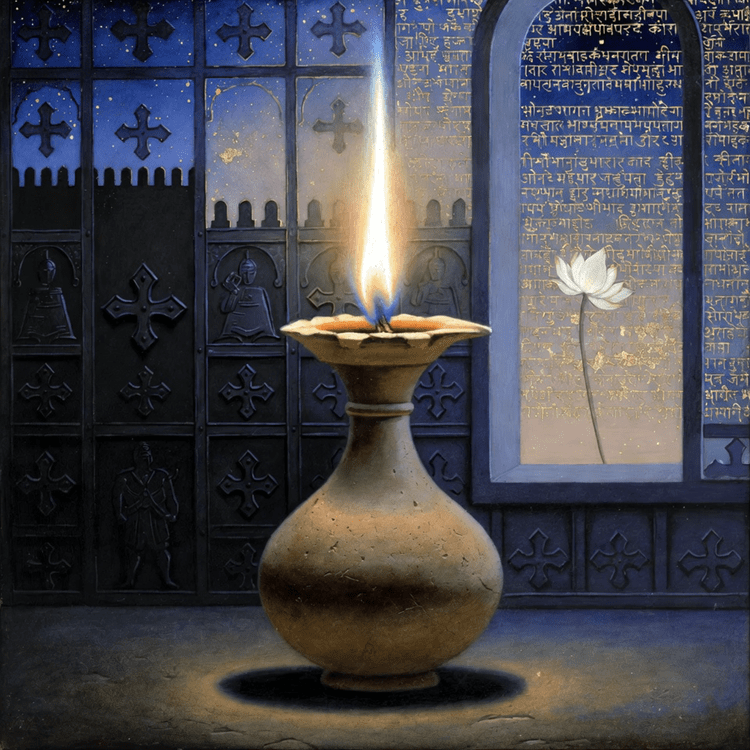
II. The Intelligence That Moves Through the Emptied Self
What does it actually look like when a human being becomes transparent to divine grace — and what does that transparency require?
The mystical traditions do not claim that divine anointing is impossible. They claim it is real — and they are very specific about what it looks like and, crucially, what it requires of the one through whom it moves.
The Vedic concept of abhisheka — sacred anointing — is not a conferral of power. It is a ritual of consecration, a formal acknowledgment that the one being anointed has already undergone an interior process of purification sufficient to make them a vessel for something beyond their personal will. The Sanskrit root of the word suggests being “sprinkled” — not crowned, not enthroned, but washed. The imagery is water, not fire. Yielding, not seizing.
In the Bhakti tradition, the great saints — Mirabai, Tukaram, Ramakrishna, Rumi — offer the clearest possible portraits of what genuine divine alignment looks like in a human life. And the pattern is unmistakable: in every case, the movement is downward before it is outward. Mirabai did not rise to power. She was stripped of it — her royal status, her social belonging, her safety, her reputation. And in that stripping, in that elegant poverty of self, she became so transparent to the Beloved that her poetry still moves human hearts five centuries later. Not because she seized the sacred. Because she allowed the sacred to seize her.
Ramakrishna, the nineteenth century Bengali mystic whose life overflows with documented instances of genuine divine communion, is perhaps the most instructive of all. Here was a man through whom something unmistakably numinous moved — and he spent his life in a small room, in a state of near-constant ecstasy, entirely uninterested in power, influence, or the validation of authority. His spiritual authority was irresistible precisely because he claimed none of it. The divine intelligence that moved through him had room to move because there was no ego architecture blocking the channel.
This is the pattern. This is what the saints show, again and again, across cultures and centuries. The one through whom divine will genuinely moves is characterized not by certainty but by availability. Not by conquest but by consent — a radical, repeated, non-negotiating consent to be used by something larger than the personal will. And this consent, crucially, does not produce grandiosity. It produces the opposite. Teresa of Avila described the interior castle of the soul as a journey inward, not upward. The deepest chambers of the soul are characterized by a quality she called nada — nothing, emptiness — the ground zero of self from which genuine love and genuine intelligence can operate unimpeded.
In the Human Design framework, this wisdom is encoded in the concept of authority — the recognition that genuine intelligence does not originate in the thinking mind but in the body’s deeper knowing: the solar plexus, the sacral center, the splenic awareness. The mind, according to this framework, is for navigation and communication, not for making decisions about sacred commission. When power operates from the mind alone — from the intellect’s ability to construct a compelling narrative about divine destiny — it is almost always in service of the ego’s agenda, however sincerely the ego believes otherwise. The body knows. The heart knows. The thinking mind, left to its own devices, will construct whatever story serves its existing desire.
Jesus himself, as a Bhakti archetype, embodies this pattern with devastating clarity. Every invitation toward worldly power — from the temptations in the desert to the crowd that wanted to crown him king — was refused. Not reluctantly. Decisively. The divine intelligence that moved through him operated precisely because he had undergone a complete interior emptying, what the Christian mystical tradition would later call kenosis — self-emptying, the voluntary relinquishment of ego-claim. This is what made his words carry the force they carried. This is why, two thousand years later, they still land in the heart rather than the mind. They came from the emptied place. They carried no agenda beyond love.
The enlightened body — and this is the phrase that matters — is not a body armored with sacred symbols. It is a body so thoroughly inhabited by its own depth that it has become, as the Sufis say, a flute cut from the reed bed, hollow enough for the Beloved’s breath to move through it and make music. The intelligence that moves through such a body is unmistakable precisely because it bears no fingerprints of personal desire. It does not seek to dominate. It does not require an enemy. It does not carve its commission into its own flesh as a declaration to the world. It simply acts — from the ground of stillness, with the precision of love, toward the good of the whole.
III. Kali Yuga and the Inversion of the Holy
Why does this particular confusion — power dressed as sacred calling — appear with such force at the end of an age?
The Vedic understanding of time does not progress in a straight line. It moves in cycles — the yugas — vast epochs of cosmic unfolding in which the qualities of consciousness available to humanity wax and wane. In Kali Yuga, the final and most degraded of these ages, one of the defining features is precisely this: the inversion of dharma. The sacred language remains. The outer forms of religion persist — the rituals, the symbols, the institutional structures. But the interior substance, the living flame of genuine realization that gives those forms their meaning, has largely withdrawn.
What remains is the husk. And the husk is extraordinarily dangerous, because it looks exactly like the seed.
This is why Kali Yuga produces not an absence of religious language but an excess of it — and an excess of religious certainty, religious violence, religious justification for everything the uninvestigated ego already wants to do. The tattoo of Deus vult on the body of the most powerful military officer in the world is not an anomaly in this age. It is a symptom. It is what happens when the sacred is divorced from interiority, when faith becomes ideology, when devotion becomes weapon.
The Vedic seers were not pessimistic about this. They were precise. They identified Kali Yuga not as an accident or a failure but as a necessary phase — the composting moment of the cosmic cycle, in which what is inauthentic must fully reveal itself before it can be released. The darkness that becomes visible is darkness that can be named. And what is being named in this historical moment, with unusual clarity, is the ancient confusion between the ego’s will and the divine will — played out now at a scale, and with a technological capacity for violence, that the medieval Crusaders could never have imagined.
The Bhakta’s response to this recognition is not despair. It is discernment. The same Kali Yuga that produces the counterfeit also creates, for those with eyes to see, an extraordinary pressure toward genuine interiority. When the outer forms of the sacred are this thoroughly compromised, the only refuge is the inner sanctuary — the place in the self where God cannot be appropriated by power, where the divine flame cannot be tattooed onto skin or deployed in a briefing room. The great saints have always flourished most vigorously in the most corrupt ages, precisely because the contrast clarifies the stakes. Mirabai sang her most luminous songs in a royal court that wanted her dead. Ramakrishna lived in ecstasy during the height of British colonial violence in Bengal. The light is most visible against the darkness.
And this is the enduring teaching of this moment: the way to respond to the seizure of the sacred by power is not to counter-seize it. It is to embody it — to become, in whatever small, unspectacular way one is capable of, the thing that is being counterfeited. To be, even briefly, even imperfectly, a person through whom something genuine moves. To let the divine intelligence that requires nothing — no enemy, no conquest, no inscription on the body — operate through the ordinary, surrendered, emptied circumstances of a single life.
That is the crusade that requires no battle cry.
Epilogue
There is an old question in every mystical tradition, asked in different ways but always pointing to the same interior reckoning: Who is doing this? Not as theology. As practice. As the quiet, repeated inquiry that cuts through the ego’s most elaborate narratives about its own nobility and divine mission.
Who is doing this? Is it the One — the vast, undivided intelligence that needs nothing, lacks nothing, moves always toward the good of the whole? Or is it the self — the small, frightened, hungry self that has learned to dress its desires in the luminous language of the sacred?
The saints knew the difference because they had sat with the question long enough to feel the answer in the body. Not as concept. As lived reality. The divine intelligence does not announce itself with battle cries. It moves quietly, precisely, like water finding its level — toward what is needed, through whoever is empty enough to carry it.
May we, in this bewildering hour, develop the interior silence to hear the difference. May the genuine fire — the one that purifies rather than destroys, that illuminates rather than consumes — find in us a body hollowed enough to hold it.
Deus vult — if God wills anything, it is this: the dissolution of every barrier between the human heart and love. That is the only crusade the saints have ever recognized. And it is waged entirely within.
Sources & References
Military Religious Freedom Foundation: Documented complaints from service members across more than 50 U.S. military installations regarding theologically framed military briefings, 2025–2026.
Religion Dispatches: Scholarship on Crusader symbolism and Christian nationalist iconography in contemporary political and military contexts, 2024–2025.
New Lines Magazine: Reporting on Crusader symbolism and far-right religious identity, November 2024.
C.G. Jung: Aion: Researches into the Phenomenology of the Self (1951). Princeton University Press.
Teresa of Avila: The Interior Castle (1577). Translated by Mirabai Starr, Riverhead Books, 2003.
Swami Vivekananda: Bhakti Yoga (1896). Advaita Ashrama.
Patanjali: Yoga Sutras (c. 400 CE). Commentary by Swami Satchidananda, Integral Yoga Publications.
Rumi: The Masnavi, Book I. Translated by Jawid Mojaddedi, Oxford University Press, 2004.
Thomas Lecaque: Scholarship on Crusader symbolism in contemporary far-right movements, Religion Dispatches, 2025.

 Numinous Waves