

Introduction
There is a moment in every spiritual life — and perhaps in the life of every civilization — when the effortless gives way to the effortful. When the light that once simply was must now be reached for. When love, which once moved as naturally as breath, becomes a discipline, a practice, a path. This moment is not a failure. It is a birth. And in the vast cosmological calendar of the Vedic tradition, it has a name: the Treta Yuga.
The second of the four great ages, the Treta Yuga follows the primordial wholeness of the Satya Yuga not as its collapse but as its first differentiation — the moment the one note begins to resolve into a chord, and with that resolution comes both beauty and tension. This is the age in which the sacred fires were lit for the first time. The age in which the gods and human beings, once indistinguishable in their shared luminosity, began to occupy distinct zones of existence. The age in which the great hero-avatars walked the earth, and in which devotion — Bhakti — was born not as a luxury of the heart but as a spiritual necessity.
To understand the Treta Yuga is to understand something essential about the nature of longing itself: that it is not a sign of distance from the Divine, but the first conscious movement of return.
What is lost when truth becomes something one must practice rather than something one simply is?
The name Treta means “three” in Sanskrit — and the scriptures offer several interlocking explanations for this designation. The most cosmologically significant is that in this age, dharma stands on three of its four legs. One leg — and with it one quarter of the total cosmic virtue available to humanity — has been withdrawn. The Srimad Bhagavatam identifies the quality lost as tapas in its absolute form: the effortless, inherent austerity of beings who are constitutionally aligned with the Real. In the Treta Yuga, austerity must now be undertaken consciously. It must be chosen. What was once the natural posture of existence has become a spiritual undertaking.
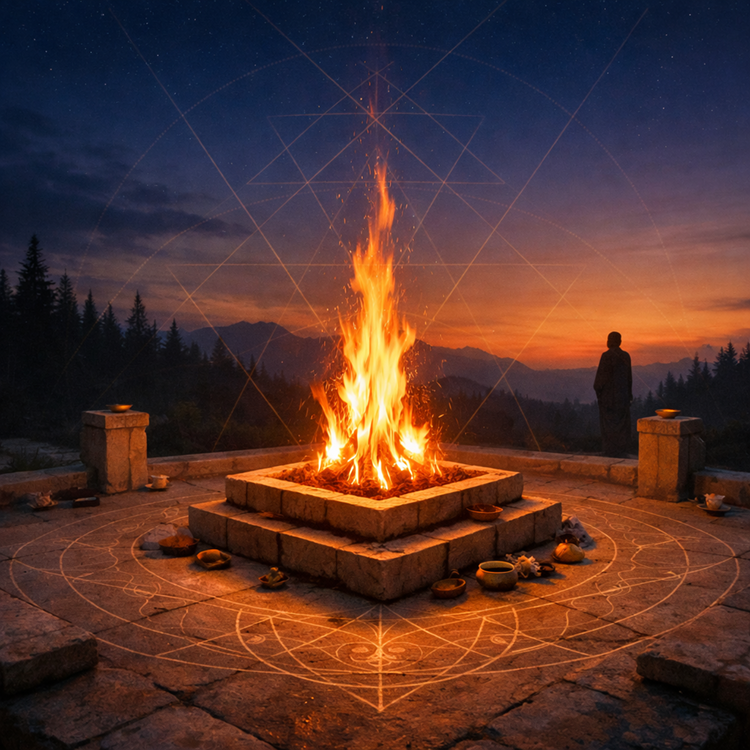
This is not a small shift. It signals the first emergence of what we might call the religious impulse — the recognition, dawning in the collective soul of humanity, that something has moved away, and that effort is now required to close the distance. The Vishnu Purana records that in the Treta Yuga, the Vedic fire sacrifices — the yajnas — came into being as the primary means of maintaining cosmic order and connection with the divine powers. The sacred fire was not merely a ritual convenience. It was, in the understanding of the age, a technology of reunion: a way of sending the material world, transformed into flame and smoke and mantric vibration, back toward its source.
Across the ocean of time and culture, this same threshold appears in other civilizations’ memories. In Hesiod’s schema, the Silver Race — successor to the Golden — lives a long but diminished childhood, followed by a brief adulthood marked by pride and the first neglect of the gods. They are “not like” the Golden Race in mind. The Zoroastrian tradition similarly recalls a second cosmic era defined by the emergence of fire worship as the central sacred act — a convergence that is difficult to dismiss as coincidence. The Egyptian tradition, moving through its own cycles from Zep Tepi, begins to show the elaboration of complex ritual temple practice precisely as the direct divine presence becomes more mediated, more distant. In each case, the pattern is the same: the loss of effortless proximity generates, as its compensatory gift, the birth of conscious worship.
How does the Treta Yuga shape the great avatar descents — and what do those descents reveal about what humanity needed in that age?
The Treta Yuga is inseparable from the figure of Rama — the seventh avatar of Vishnu and perhaps the most beloved single expression of the divine in human form across the entire Hindu tradition. The Ramayana, the ocean-like epic attributed to the sage Valmiki, is not simply a story set in the Treta Yuga. It is the Treta Yuga’s spiritual autobiography. Every element of the narrative encodes the consciousness of the age: the reign of dharmic kingship at its most luminous, the first full emergence of devotional love between the human soul and its divine counterpart, and the titanic struggle against the forces of adharma — embodied in Ravana — that such an age makes possible and necessary.
Rama is the Treta Yuga’s answer to the question that the age itself posed: what does the Divine look like when it chooses to descend not as effortless light but as a being who must suffer, strive, grieve, and ultimately prevail through righteousness rather than omnipotence? In the Satya Yuga, no avatar of this kind was needed — the Divine was already fully present in all things. But in the Treta Yuga, the Divine must come in disguise, must walk the dusty road of limitation, must demonstrate — not merely declare — that dharma is worth everything it costs. Rama does not merely model virtue. He pays for it, in the currency of exile, separation, and loss.
Valmiki understood this. His Rama weeps. His Rama carries grief that no omnipotent being should need to carry. And this is precisely the point: the Treta Yuga needed a God who could be seen to suffer without being diminished by suffering, who could be separated from what he loved most and still not break, who could walk into darkness carrying the light of righteousness and emerge not triumphant in the worldly sense but truthful in the cosmic one. Rama’s life is a love story between the Divine and dharma itself — and it is this love that the age required as its central teaching.
Vivekananda, commenting on the progressive avatar descents, observed that each incarnation responds to the specific spiritual deficit of its age. In the Treta Yuga, the deficit was the newly emerging experience of separation from the Divine — and so the avatar came as one who demonstrated how to live fully, beautifully, and righteously within that separation, without being destroyed by it. He came as a king, as a husband, as a son, as a warrior — fully human in form, fully divine in essence, navigating every dimension of the human world with the precision of a being who understood that each dimension was sacred, even the broken ones.
What does the Treta Yuga’s shift from being to seeking look like in the interior life — and why does it matter to the modern seeker?
Sri Yukteswar Giri, in his remarkable work The Holy Science, proposed a recalibration of the traditional Yuga durations based on an astronomical model — one in which the solar system’s movement through space relative to a companion star creates the actual mechanism of cyclical consciousness change. In his reckoning, the ages are considerably shorter than the Puranic figures, and humanity may already be ascending back through the Treta Yuga period in the current ascending half of the cycle. Whether one accepts his specific chronology or the traditional Puranic one, his underlying insight is cosmologically profound: the Yugas are not arbitrary periods of time but actual shifts in the quality of consciousness available to human beings, driven by the proximity of cosmic forces that either expand or contract the soul’s perceptual range.
This reframing transforms the Treta Yuga from historical backdrop to present spiritual cartography. The condition it describes — the soul that has tasted effortless unity in meditation, in deep prayer, in moments of grace, and must then return to ordinary contracted awareness and do the work of sustaining the connection through practice — is not alien to any sincere practitioner. It is, in fact, the central challenge of the spiritual life as it is actually lived. The Satya Yuga condition is available in glimpses. The Treta Yuga condition is the daily reality: the sacred fires must be lit, again and again, and the mantras offered into them, and the discipline sustained, even when the flame feels small and the smoke seems to disappear into an indifferent sky.
Ramakrishna, whose spiritual genius encompassed every tradition and every mood of the Divine, once said that God is like a magnet and the devotee like a needle — but if the needle is covered in rust, the magnet cannot draw it near. The practices of the Treta Yuga — the fire, the mantra, the sacrifice, the striving — are precisely the process of removing rust. They do not create the magnetic pull. They clear away what is obscuring the soul’s response to a pull that has never stopped.
This is the Treta Yuga’s deepest offering: not the effortless light of the Satya Yuga, but something in some ways more instructive — the dignity of the soul that chooses, in the face of forgetting, to remember. The sacred fire is lit not because the universe requires a fire, but because the soul requires the act of lighting it.
Epilogue
The Treta Yuga holds a particular tenderness for the contemporary spiritual heart — because it is the age that most resembles the interior landscape of the serious seeker. Not the absolute luminosity of the Satya Yuga, which most of us can only approach in the most extraordinary moments of grace. Not the near-total obscurity of the Kali Yuga, in which even the desire for the Divine can feel like an eccentricity. But the middle passage: the age of fire, of effort, of heroism, of the great avatars who show us that divinity and humanity are not enemies but partners in a story that loss cannot ultimately defeat.
Rama’s footsteps still echo in the forests of the soul. The sacred fires of the Treta Yuga burn, however quietly, in every meditation, every prayer, every moment of deliberate surrender. We carry that age within us as surely as we carry the memory of the Satya Yuga — and in some ways, its lessons are more immediately applicable. We are beings who must seek. The question the Treta Yuga puts to every generation is whether we will seek with the wholeness that the age demands: with discipline and devotion, with grief and grace, with the willingness of Rama to pay the full price of righteousness and still call it a worthy life.
The ascending arc of the Yugas — if Sri Yukteswar’s astronomical model holds, and the tradition’s deepest intuition agrees — suggests that the fires lit in this age are not futile. They are preparatory. Every soul that lights the sacred fire in the middle of darkness is, in some small but cosmologically real way, tilting the wheel toward morning.
Sources & References
- Srimad Bhagavatam (Bhagavata Purana), Books 1, 3, and 12 — on the nature of dharma across the Yugas and the avatar descents
- Vishnu Purana — on the Treta Yuga, the emergence of yajna, and Parashara’s cosmological account
- Valmiki Ramayana — the primary textual source for Rama’s life and the Treta Yuga’s spiritual autobiography
- Mahabharata, Vana Parva — on the Yuga descriptions and the progressive loss of dharma
- Hesiod, Works and Days — on the Silver Race and the second cosmic age
- Mary Boyce, Zoroastrians: Their Religious Beliefs and Practices — on Zoroastrian fire worship and its cosmological context
- Jan Assmann, The Search for God in Ancient Egypt — on the elaboration of ritual as divine proximity recedes
- Sri Yukteswar Giri, The Holy Science — on the astronomical basis of the Yuga cycle and the ascending arc
- Swami Vivekananda, Inspired Talks and Lectures from Colombo to Almora — on the avatar principle and progressive incarnation
- Mahendranath Gupta (M), The Gospel of Sri Ramakrishna — on the soul’s need for practice and the metaphor of rust and magnet
- A.C. Bhaktivedanta Swami Prabhupada, Srimad Bhagavatam commentary — on the dharma-legs and cosmic virtue

 Numinous Waves