

A Note from the Author — On Beginning at the Beginning
There is a particular kind of spiritual vertigo that comes from living in the Kali Yuga with eyes open. The news of the world, the quality of public discourse, the fracturing of communities, the epidemic of meaninglessness that runs beneath the surface of an age saturated with information and starved of wisdom — none of this requires elaborate explanation. We feel it. Most of us, if we are honest, have felt it for a long time.
It was precisely this feeling that drew this series into being.
For some time now, the question that has occupied the deeper currents of this publication has not simply been what is wrong with the world — that question, important as it is, tends to generate heat without light. The more generative question, the one that the great sages and seers of the Vedic tradition spent lifetimes mapping, is where are we in the story. Not politically. Not historically. Cosmologically. Because the tradition insists, with the calm authority of those who have seen very far, that we are not simply living through a bad period of history. We are living through a specific phase of a vast and recurring cycle — one that has its own logic, its own spiritual demands, and its own relationship to the ages that preceded it and the ages that will follow.
The Vedic cosmological framework identifies four such ages — the Yugas — each one a distinct quality of consciousness, a distinct relationship between the human soul and its divine source. The Satya Yuga, the Treta Yuga, the Dvapara Yuga, and the Kali Yuga. The first is the most luminous; each subsequent age carries less of the original light, like a fire moving through its phases from full flame to ember. We are, by every traditional account, deep in the fourth and darkest of these ages. The Kali Yuga is not a metaphor. It is the cosmological address of the present moment.
The choice to begin this series not with the Kali Yuga — not with where we are — but with the Satya Yuga, the Age of Truth in its fullness, was deliberate. It came from a conviction that has deepened through years of study and practice: that the soul cannot navigate where it is without first recovering a sense of what it came from. Orientation requires a point of origin. The Kali Yuga, examined in isolation, can produce only diagnosis — accurate, perhaps, but ultimately dispiriting. Examined against the backdrop of the Satya Yuga, it becomes something else entirely: a chapter in a story whose arc is larger than any single age can contain.
And so this series moves from the greatest to the least — from the primordial light of the Satya Yuga, through the sacred fires and heroic dharma of the Treta, through the twilight complexity and divine paradox of the Dvapara, and finally to the present moment of the Kali — not to catalog a tragedy, but to hand the reader a map. A map drawn by minds that were, by every account, considerably closer to the source than most of us are now. Minds that looked at the full sweep of cosmic time and did not despair, because they understood that descent and ascent are not opposites but partners in a movement the soul has always been making — however slowly, however painfully, however beautifully.
What you will find in these three essays is not consolation. It is something the tradition values more: viveka — discernment. The clear-eyed capacity to see where one stands. The Kali Yuga is what it is. The light has not gone out. These are both true simultaneously, and it is in the tension between them that the serious spiritual life is actually lived.
Begin, then, at the beginning. Before the forgetting. Before the fire had to be lit. Before the veil descended. Begin where the world was made of light — and let that memory, however distant, do what memories of origin always do to a soul that is paying attention.
Introduction
There is a memory embedded in the human soul — not biographical, not cultural, but cosmological. It surfaces in the myths of every civilization that has ever looked upward and inward at the same time: a memory of wholeness, of a time before fracture, when the world and the divine were not two separate things. The Vedic tradition names this memory with precision. It calls it the Satya Yuga — the Age of Truth — and it does not treat it merely as legend. It treats it as cosmic fact, as the opening note of a vast and recurring symphony whose other movements we are still living through.
To understand the Satya Yuga is not an exercise in nostalgia. It is an act of orientation. The soul that knows where it came from holds within it a compass for where it is going — and in the present age, when darkness, confusion, and spiritual fragmentation define the outer landscape, that compass is not a luxury. It is everything.
What does it mean to live in an age where Truth is not sought — because Truth is simply what one is?
The Satya Yuga — also called the Krita Yuga, meaning “the accomplished age” or “the age of the fulfilled act” — is the first and most luminous of the four cosmic cycles described in the Vedic and Puranic scriptures. According to the Vishnu Purana and the Srimad Bhagavatam, the full cycle of a Maha Yuga spans 4,320,000 human years. Of that total, the Satya Yuga claims the lion’s share: 1,728,000 years, or nearly forty percent of the entire cycle. This alone is a cosmological statement — that the natural condition of conscious existence leans toward light, not toward darkness.
The great sage Vyasa, through the Mahabharata and the Puranas attributed to his transmission, describes the Satya Yuga as a time when dharma — cosmic order, righteous law, the structural principle of existence — stands on all four of its legs. The symbol is precise. In each subsequent age, dharma loses a leg: in the Treta Yuga, three legs; in the Dvapara, two; in the present Kali Yuga, one — limping, burdened, barely upright. But in the Satya Yuga, dharma is not practiced or pursued. It is the very nature of being. No injunctions are needed. No scriptures must be consulted. The being of that age does not choose virtue any more than water chooses to be wet.
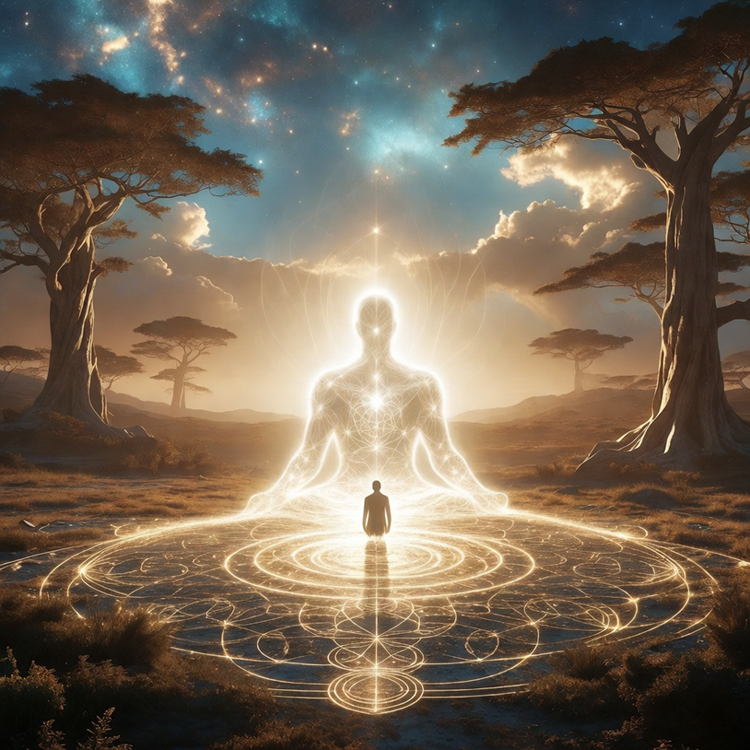
Human beings of the Satya Yuga — if “human” is even the right word for what they were — are described in the Bhagavatam as beings of immense spiritual stature. Their lifespans are given variously as 100,000 years. Their bodies are said to have been luminous, not constituted of the same dense matter we inhabit now but something closer to light itself — sattva in its purest material expression. They did not require food in any conventional sense; the tradition speaks of sustenance arriving through prana alone, through direct absorption of cosmic vitality. Disease, aging in the corrupted sense, and death by suffering were unknown. The body completed its arc and dissolved, not in collapse, but in conscious release.
How did the beings of that age relate to the Divine — and what does their relationship reveal about the nature of spiritual effort itself?
Here the Satya Yuga poses its most radical teaching. In all subsequent ages — including our own — spiritual life is defined by striving: by meditation, by devotion, by renunciation, by the long and often painful work of the soul attempting to re-member itself to its Source. But in the Satya Yuga, this striving simply did not exist — not because beings were spiritually lazy, but because they had not yet forgotten. The Bhagavatam describes the beings of that age as living in continuous, unbroken meditation. Not as a practice. As a state. The Absolute was not something they reached toward; it was the atmosphere they breathed.
Parashara Muni, father of Vyasa and one of the great seers of the tradition, describes this condition in the Vishnu Purana with extraordinary simplicity: in the Satya Yuga, people were content, long-lived, and possessed of the four virtues — truth, compassion, austerity, and charity — in their complete form. There was no inequality of class or caste in the existential sense; all beings were, by nature, Brahmin — not in the hereditary meaning, but in the original one: all were knowers of Brahman. The hierarchies that would later solidify into social structures were, in that age, purely functional differentiations within a unified field of consciousness.
This resonates across traditions in ways that cannot be accidental. Hesiod, the ancient Greek poet and near-contemporary of the early Upanishadic period, describes his own Golden Race — the first humanity — in terms that mirror the Vedic account with striking fidelity. They lived, he writes, like gods, free from toil and grief, without the weariness of old age. The earth gave its gifts freely. When this race passed from the world, they became, in his telling, holy daimons — guardians and watchers of the living. The Egyptian concept of Zep Tepi — the “First Time,” the primordial moment when the gods walked openly among humanity and creation was fresh and undivided — holds the same cosmological conviction: that the original condition of the world was sacred proximity, not sacred distance.
What does modern consciousness science, however tentatively, begin to suggest about these ancient descriptions of expanded human capacity?
The tradition is not asking to be taken metaphorically. But it is worth noting — carefully, without forcing the correspondence — that modern neuroscience and consciousness research have begun to gesture, however imperfectly, toward something the Vedic sages mapped in full. The work of researchers exploring non-ordinary states of consciousness, the studies emerging from contemplative neuroscience, the theoretical frameworks of figures like Bernardo Kastrup arguing for consciousness as the fundamental substrate of reality rather than its accidental byproduct — all of these represent the leading edge of a paradigm that is, in slow motion, turning back toward what the rishis declared from the beginning: that matter does not produce consciousness; consciousness produces matter.
If this is so — and the internal evidence of deep meditative experience across every tradition strongly suggests it is — then the Satya Yuga is not a fairy tale about a simpler time. It is a description of what consciousness looks like when it is not occluded. The dense, contracted, self-referential awareness that characterizes the Kali Yuga mind is not the baseline of human experience. It is the deviation. The Satya Yuga is the baseline. And the soul, in its deepest knowing, has never entirely forgotten that.
Sri Ramakrishna, whose entire life was a lived demonstration of what Satya Yuga consciousness might feel like in a Kali Yuga body, once described the natural state of the liberated soul as one of continuous intoxication in the divine — not metaphorically drunk, but literally saturated with the Presence. Vivekananda, transmitting this vision to the West, insisted that the purpose of all religion was not to make human beings pious but to make them God-conscious — to restore, in the individual life, the condition of the Satya Yuga regardless of what the outer cosmic clock declares.
This is perhaps the most radical implication of the teaching: that the Yugas are not merely external cosmic weather. They are also, and perhaps primarily, internal states. The Satya Yuga can be inhabited — at least provisionally, in the interior life — even now. The great saints and mystics of every age have demonstrated this. They are, in a very real sense, anachronisms of a higher time.
Epilogue
The Satya Yuga will return. This is not wishful thinking but cosmological mathematics — the wheel turns, and what has been will be again. The Srimad Bhagavatam is unambiguous: after the full dissolution of the Kali Yuga, the great cycle resets, and once more the world will be constituted of truth, of light, of beings who carry the Divine not as belief but as breath.
But the sober voice must also speak. We are not near that return — not by any traditional reckoning. The Kali Yuga, by most Puranic accounts, has thousands of years yet to run its course. The task before the sincere soul is not to wait for a golden age to descend from the sky. It is to carry within this darkened world a quality of consciousness that refuses the Kali Yuga’s fundamental lie: that separation is real, that matter is primary, that the sacred has gone elsewhere.
The Satya Yuga is a destination, yes — but it is also, for those willing to look, an interior landscape available right now, in the silence beneath the noise, in the love that moves beneath the fear, in the moments when the heart opens so fully that time itself seems to pause and something ancient and luminous looks through these human eyes.
That something is what the sages saw. That something is what they recorded. And that something, however dimly, however briefly, is what calls in every serious seeker who has ever looked at this fractured world and felt, without being able to explain it, that it was not always this way — and will not always be.
Sources & References
- Srimad Bhagavatam (Bhagavata Purana), particularly Books 3, 11, and 12 — Translated by A.C. Bhaktivedanta Swami Prabhupada; also the translations of Swami Tapasyananda
- Vishnu Purana — Translated by H.H. Wilson; commentary by Parashara Muni
- Mahabharata, Shanti Parva and Vana Parva — attributed transmission of Vyasa
- Manusmriti — on the nature and duration of the Yugas
- Hesiod, Works and Days — on the Five Ages of Man / the Golden Race
- Jan Assmann, The Search for God in Ancient Egypt — on the Egyptian concept of Zep Tepi
- Swami Vivekananda, Raja Yoga and Jnana Yoga — on consciousness as the substratum of existence
- Mahendranath Gupta (M), The Gospel of Sri Ramakrishna — on the liberated state and divine intoxication
- Bernardo Kastrup, Why Materialism Is Baloney — on consciousness-first cosmology
- Sri Yukteswar Giri, The Holy Science — on the Yuga cycle and its astronomical basis

 Numinous Waves