

Darkness, Deviation, and the Soul’s Unfinished Crossing
Introduction
There is a question that has haunted the contemplative, the scientist, and the grieving parent alike — one that no single tradition has fully answered, and perhaps none was meant to. Why does the human form, shaped over millennia by forces both biological and divine, sometimes arrive broken? Why do certain minds shatter under the weight of their own chemistry, while certain souls descend into darkness so complete that they become instruments of devastation rather than devotion?
This is not an abstract philosophical question. It is pressed upon the world daily in the wards of psychiatric hospitals, in courtrooms where crimes of unimaginable cruelty are catalogued, in the quiet grief of families who watch someone they love disappear behind the veil of schizophrenia or psychosis. The question is urgent. And it deserves a response that honors both the rigor of science and the depth of spiritual wisdom.
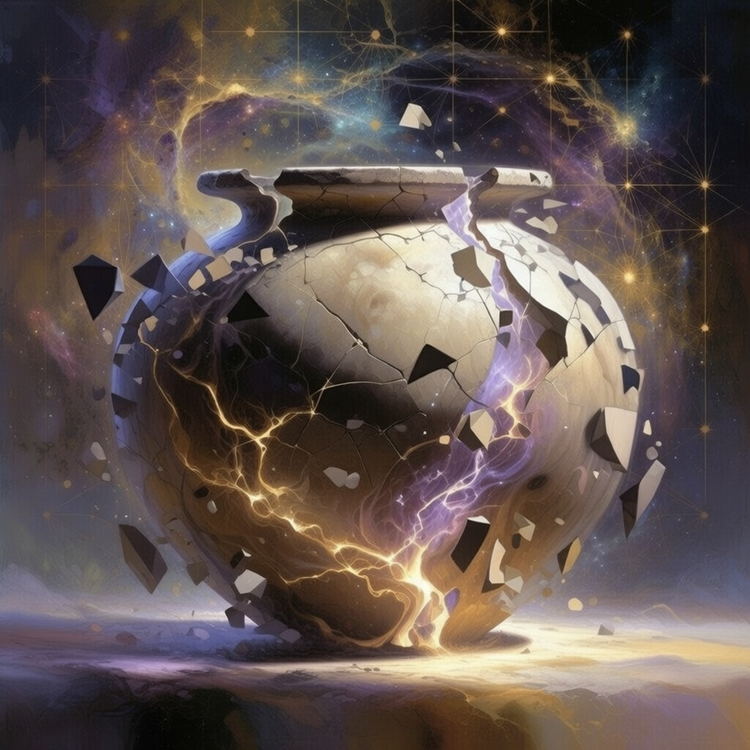
What follows is an exploration — not a verdict. The fractured vessel is real. The flame that was meant to inhabit it is also real. The distance between the two is where the inquiry begins.
I. The Misalignment of Form: What Neuroscience and Karma Both Witness
If the Divine breathes into every being, what happens when the vessel itself cannot hold the breath?
The neurological sciences have established what mystics long suspected in a different language: that the human brain is extraordinarily complex, and that complexity always carries the risk of deviation. Schizophrenia, bipolar disorder, and psychosis emerge not from moral failure but from the intricate machinery of neurochemistry misfiring — dopaminergic pathways dysregulated, synaptic pruning gone awry, genetic switches tripped by a confluence of heredity and environment that no individual chose. In this sense, the person afflicted is a victim of form, not function of will.
Vedic cosmology offers a parallel framework. The doctrine of the koshas — the layered sheaths through which consciousness inhabits the physical world — suggests that the innermost Self (the Atman) is always pure and undiminished. What suffers, what distorts, is the instrument through which that Self must express itself in time and space. When the mental sheath (manomaya kosha) or the vital sheath (pranamaya kosha) is compromised, the light of consciousness is not extinguished — it is obscured, bent, refracted into shapes that neither the individual nor the world can easily recognize as divine.
Karma, too, offers not a punitive explanation but a structural one. The karmic view holds that souls arrive in particular configurations — physical, psychological, neurological — as expressions of accumulated tendencies across lifetimes. This is not to say that mental illness is punishment; it is to say that the soul may be navigating extremely complex terrain, perhaps doing so as part of a long arc of learning that transcends the single lifetime. The afflicted mind may be, in its own way, completing something.
None of this erases the suffering. But it reframes the question — away from ‘why did God allow this defect?’ and toward ‘what is moving through this form, and what does it require?’
II. The Shadow Made Flesh: When Darkness Becomes Action
How does the untended shadow of one person — or one civilization — become the wound in the body of another?
Carl Jung wrote of the Shadow as the repository of everything the conscious personality refuses to acknowledge — the rage, the hunger, the capacity for cruelty that every human being carries within the deeper strata of the psyche. In the healthy individual, the Shadow is integrated over time through honest self-encounter: through dreams, through relationships, through the slow and sometimes painful work of becoming whole. But when that integration is refused — when the Shadow is perpetually denied, projected outward, or inflamed by pathology — it does not disappear. It waits.
Crimes against humanity — murder, torture, sexual violence, genocide — are, in Jungian terms, the ultimate eruption of unintegrated Shadow. They are not aberrations of human nature so much as its most catastrophic failure modes. And they are made more likely not by any single cause, but by the convergence of neurological vulnerability, early trauma, cultural permission, and the absence of the kind of inner life that might serve as a containing vessel for the darkness.
The Kali Yuga provides the cosmic frame for this understanding. In Vedic reckoning, the present age is characterized precisely by the diminishment of dharma — of the natural ordering principle that aligns human action with the sacred. In the Kali Yuga, adharma proliferates not because evil has conquered good, but because the instruments of consciousness — human minds, human institutions, human relationships — have grown thin and opaque. The light reaches the world, but less of it gets through.
This is why crimes against humanity feel, to the spiritually sensitive, like a scar on the Divine message — because they are. They are evidence of what happens when the human form becomes so encrusted with darkness, so untethered from its original nature, that it can no longer serve its primary purpose: to be a vehicle for love, for dharmic action, for the recognition of the sacred in the other. The criminal does not lack a soul. The criminal has lost access to it.
III. Science, Evolution, and the Limits of the Secular Remedy
Can the instruments of reason ultimately repair what the fracture in consciousness has broken — or does the wound require a different order of medicine?
The promise of progressive science is real and should not be dismissed. Advances in psychiatric medicine, in genetic research, in the neurobiology of trauma, in early intervention for at-risk children — these represent genuine expansions of humanity’s capacity to reduce suffering. CRISPR technologies inch toward the possibility of identifying and mitigating genetic predispositions to severe mental illness. Psychopharmacology, despite its limitations, has returned functional lives to millions. Trauma-informed therapeutic models are slowly transforming how societies understand and treat the roots of violent behavior.
Evolution, too, moves in the direction of greater complexity and — at least in the biological record — greater capacity for social cooperation, empathy, and what might cautiously be called moral refinement. The arc of human biological evolution is long, measured in tens of thousands of years rather than decades, but it does appear to bend, however slowly, toward more sophisticated social and cognitive functioning.
And yet — and this is the crucial and honest caveat — neither science nor biological evolution can reach the ground where the deepest fractures originate. They can modify the vessel. They cannot, by themselves, ignite the flame. The neuroscientist can repair the dopamine pathway; the geneticist can reduce the heritability of psychosis; the evolutionary process can select for greater empathy over time. But none of these interventions addresses the question of why consciousness chooses the forms it does, or what is being worked out in the long karmic unfolding of a soul across many lifetimes, or how a civilization reconnects with the dharmic impulse that prevents Shadow from becoming violence.
For that, a different order of medicine is required: the cultivation of inner life, the practice of contemplation, the transmission of wisdom traditions that have always known how to hold darkness without being consumed by it.
Epilogue
If the Divine has not abandoned the fractured vessel, what does its continued presence within darkness ask of those who can still see?
Ramakrishna taught that God dwells even in the wicked — that the Divine is present not only in the saint but in the murderer, not only in clarity but in confusion. This is not a permissive teaching. It does not say that evil is acceptable or that suffering should be tolerated without response. It says something more radical and more demanding: that the work of reconciliation cannot be done from a position of separation from the fallen. It must be done from within the recognition of shared nature.
Vivekananda extended this into a social ethic: to see the Divine in the suffering and the broken, and to serve that Divine through concrete action — education, healing, the elevation of those whom circumstance has pushed furthest from the light. This is not sentiment. It is a spiritual technology for closing the distance between what the human form is and what it was meant to be.
Science participates in this reconciliation by reducing unnecessary suffering and expanding the instruments available to consciousness. Evolution participates by slowly selecting for greater moral capacity. But neither can reach the ground where the deepest fractures originate. They can modify the vessel. They cannot, by themselves, ignite the flame.
The fractured vessel is not the final image. It is the middle of the story. The very complexity that allows for schizophrenia is the complexity that allows for samadhi. The very depth of shadow that produces violence is the depth of interiority that produces saints. This does not make the suffering beautiful. It makes it meaningful — which is a different and more demanding thing. The meaning is not given automatically. It must be drawn out through the labor of those who refuse to look away, who bring to the wound both the instruments of science and the lamp of contemplative wisdom, and who trust — not naively, but with eyes open — that the crossing, however long and however difficult, is not without its destination.
The flame has not gone out. It is searching, through the crack in the vessel, for a way to reach the world.
Sources & References
Jung, C.G. Aion: Researches into the Phenomenology of the Self. Princeton University Press, 1959.
Jung, C.G. The Archetypes and the Collective Unconscious. Princeton University Press, 1969.
Vivekananda, Swami. Karma Yoga and Bhakti Yoga. Ramakrishna-Vivekananda Center, 1982.
Nikhilananda, Swami (trans.). The Gospel of Sri Ramakrishna. Ramakrishna-Vivekananda Center, 1942.
Patanjali. The Yoga Sutras of Patanjali. Various translations, including Swami Satchidananda, Integral Yoga Publications, 1978.
Yukteswar, Sri. The Holy Science. Self-Realization Fellowship, 1949. (On Yuga cycles and cosmic progression.)
Insel, Thomas R. ‘Rethinking Schizophrenia.’ Nature 468 (2010): 187–193.
Kandel, Eric R. In Search of Memory: The Emergence of a New Science of Mind. W.W. Norton, 2006.
van der Kolk, Bessel. The Body Keeps the Score: Brain, Mind, and Body in the Healing of Trauma. Viking, 2014.
Wilber, Ken. A Brief History of Everything. Shambhala, 1996. (On the evolutionary arc of consciousness.)
Pinker, Steven. The Better Angels of Our Nature. Viking, 2011. (Secular counterpoint on moral evolution.)

 Numinous Waves