

On Bhakti, Political Disturbance, and the Grace of Being Human
Introduction
There is a certain expectation — quiet, persistent, sometimes self-imposed — that the spiritually sincere person ought to have risen above the noise of the world. That the one whose heart beats in the rhythm of devotion, whose inner life has been touched by the sweetness of Bhakti, should somehow be insulated from the agitations that beset ordinary minds. Neutrality, in this view, becomes the gold standard of spiritual progress. And yet, here is the Manifesting Generator — Solar Plexus Authority burning through every wave of emotion, Bhakti as the marrow of the practice — and still, the spectacle of public servants who neither serve nor awaken, and of the masses who cheer their own diminishment, manages to land with an unsettling sting.
This inquiry does not promise resolution. It does not offer a technique to seal oneself off from the world’s provocations. What it offers, instead, is something more honest: a careful examination of whether the aspiration toward neutrality is, in certain forms, itself a subtle spiritual bypassing — and what a more integrated understanding of equanimity might look like for a being whose very design is to feel deeply before acting wisely. And it draws its witnesses not from one tradition alone, but from the full breadth of the devotional world — including the figure that the Western heart knows most intimately: Jesus of Nazareth, whose life, when seen clearly, is one of the most complete expressions of Bhakti the human story has ever produced.
— ✦ —
The Romanticization of Neutrality
If my practice is genuine — if Bhakti is truly the center of my life — shouldn’t I have moved beyond being stirred by the failures of public figures and the blindness of those who follow them?
Much of what passes for spiritual neutrality in contemporary discourse is actually emotional suppression dressed in luminous language. The idea that a truly awakened person feels nothing in the face of injustice — that they move through the theater of human folly with perpetual serenity — is a notion more rooted in aesthetic fantasy than in the testimony of the great devotees themselves, across every tradition that has ever taken the interior life seriously.
Ramakrishna wept. He wept for the suffering of others, for the beauty of the Divine Mother, for the blindness of those who could not see what was so blazingly obvious to him. Mirabai sang not with the cool equanimity of detachment but with the burning ache of one who could not bear separation from the Beloved. Rumi’s poetry is not the poetry of a man unmoved — it is the poetry of a man on fire. And Jesus wept at the tomb of Lazarus — openly, without apology, in full view of those who watched and wondered why the one they called the Son of God had not prevented the death of his friend. The tradition of Bhakti is, at its very heart, a tradition of radical feeling, not the transcendence of feeling. The devotee does not ascend above emotion; the devotee aligns emotion with its highest Source.
It is worth pausing here to ask: where did the idea originate that spiritual maturity means emotional absence? Partly it emerges from a misreading of the Advaitic tradition, where the dissolution of the ego-self is sometimes conflated with the dissolution of care. Partly it emerges from a projection of Eastern philosophical concepts through a Western lens that equates stoicism with wisdom. And partly — perhaps most importantly — it emerges from the very human wish to not feel the discomfort of being alive in a world that is, in so many of its expressions, carelessly cruel.
The Manifesting Generator in the Political Current
But isn’t the whole point of Human Design to understand how I’m wired — and if I’m wired for emotional authority, shouldn’t that eventually bring me to a place of clarity rather than continued reactivity?
Human Design does not describe the Manifesting Generator as a being built for detachment. The Manifesting Generator is designed to respond, to initiate once the response has clarified, and to generate enormous creative force through its engagement with what is alive in the world. The Solar Plexus Authority adds another layer entirely: this is a being for whom emotional truth is not instantaneous but arrives in waves, in cycles, through a process that cannot be rushed. Clarity, for this type, comes after the emotional weather has moved through — not before, and not by bypassing the weather altogether.
What this means, in practical and spiritual terms, is that when the world presents something that strikes the Solar Plexus — a public official whose corruption is barely concealed, a citizenry that mistakes theater for governance, a culture that has learned to applaud its own exploitation — the wave will come. The disturbance is not a sign of spiritual failure. It is the system working exactly as it was designed to work. The question is never whether the wave arrives; the question is always what one does once it has crested.
There is an important distinction to be made here between reactivity and response. Reactivity is the wave carrying the self away from its center, into identification with the disturbance, into the illusion that the agitation is the self’s permanent condition. Response, by contrast, is what becomes available after the wave has been met with awareness — when the initial swell of feeling has been allowed to move through without being either suppressed or amplified, and something clearer can emerge. For the Solar Plexus Authority, this is the whole art: to wait, to feel, to let the emotional intelligence complete its arc — and then, from that more settled place, to discern what, if anything, wants to be done.
When Bhakti Meets the Broken World
So the feeling itself isn’t the problem — but what do I do with it? How does a heart oriented toward the Divine hold the reality of people in power who seem entirely oriented away from it?
Consider what Jesus did when he entered the Temple in Jerusalem and found it converted into a marketplace — money changers at their tables, merchants selling doves, the sacred space of his Father’s house reduced to a theater of commerce and exploitation. He did not respond with detached observation. He did not offer a calm teaching on the nature of impermanence. He overturned the tables. He drove out the merchants. He acted from a place of such fierce, embodied feeling that those present scattered before him. This was not a loss of spiritual composure. This was Bhakti in its most active form — love for the sacred refusing to accommodate its desecration, the heart of the devotee unable to remain passive in the face of what it recognized as a profound wrong.
Swami Vivekananda understood this register of the devotional life with equal intensity. His love for Ramakrishna was absolute, his surrender unmistakable — and yet he walked through the poverty of India, the indignities of colonialism, the willful ignorance of those in power, and he burned. He did not experience his outrage as a contradiction of his spiritual nature; he experienced it as an expression of it. The insight both Jesus and Vivekananda embodied — and that the broader tradition of engaged devotion affirms across every lineage — is that love for the Divine necessarily includes love for those in whom the Divine is present, however obscured. And love, when it encounters the willful degradation of human dignity, does not respond with indifference. It responds with feeling.
The public servant who does not serve — who instead cultivates a theater of service while advancing private agendas — is not merely a political problem. From the perspective of the devotional path, this person is a being estranged from their own deepest nature, from the ground of love that moves beneath the ego’s machinations. The frustration that arises in witnessing this estrangement is, at its root, the grief of love meeting obstruction. It is the same grief that moves through the bhakta when the Beloved seems absent. It is not separate from the devotional life. It is woven into it.
The Trap of Spiritual Superiority
That makes sense — but I’ll be honest. Sometimes what I feel isn’t just grief. There’s something that almost feels like contempt. Like I can see clearly what others can’t, and I’m exhausted by the gap. Is that Bhakti too, or is that something else entirely?
That is the most honest question in this entire inquiry — and it deserves the most honest answer. The same impulse that generates genuine spiritual sensitivity can, if left unexamined, curdle into a subtler form of ego: the position of the awakened observer, looking down from a hard-won spiritual altitude at the unenlightened masses who cannot see what seems so obvious. This is the shadow side of discernment. Where discernment says, ‘this is not in alignment with truth,’ spiritual superiority says, ‘and therefore I am above it and those who participate in it.’
Even Jesus navigated this edge. His sharpest words — the denunciations of the Pharisees as whitewashed tombs, his impatience with the disciples who could not yet understand — carry the unmistakable heat of a being who could see clearly and found the gap between that clarity and the world’s blindness genuinely painful. What kept those moments from collapsing into contempt was the underlying current that never left him: the love that wept for Jerusalem even as it condemned her, the prayer from the cross for the forgiveness of those who did not know what they were doing. The fire was real. So was the mercy beneath it.
The Human Design chart is illuminating here as well. The 5/1 profile — the Heretic and the Investigator — carries a specific relational dynamic. The Fifth Line is projected upon: others see in it a problem-solver, someone with answers, a being who carries a kind of natural authority. This projection can be quietly intoxicating. And when the Fifth Line acts from that projection rather than from genuine inner authority, it slips into a performance of wisdom rather than wisdom itself. The corrective is always the same: return to honest self-inquiry. Is the frustration pointing to genuine injustice that the soul cannot witness in silence? Or is some portion of it rooted in the deep desire to see the world organized more intelligently — and the pain of its not being so? Both can be true simultaneously. Holding them both with equal rigor and equal compassion is the practice.
Gethsemane and the Completion of the Wave
But what about the moments when the feeling isn’t indignation — when it’s something closer to despair? When the weight of the world’s unconsciousness feels like too much to carry and even the practice doesn’t seem to be enough?
This is where Gethsemane becomes the most intimate teaching in the entire devotional canon — not just for the Christian, but for any sincere practitioner who has ever sat with a feeling too large to resolve through will or prayer alone. On the night before his crucifixion, Jesus withdrew into the garden and asked, with complete vulnerability, whether the cup could be taken from him. He was not performing anguish. The Gospels record that his sweat became like drops of blood — a physiological detail that speaks to the totality of what he was carrying. This was a being in the full depth of a wave, not above it, not managing it from a safe spiritual distance, but inside it completely.
And yet the wave completed. Not through suppression, not through spiritual bypassing, not through the pretense of a serenity he did not feel — but through surrender. Not my will, but Thine. That single movement — from the fullness of human feeling into the fullness of divine trust — is Bhakti at its absolute summit. It is samatvam not as the absence of feeling but as the ground that holds feeling without being destroyed by it. The Solar Plexus Authority recognizes this intuitively: the wave must be ridden to its completion. What waits on the other side is not numbness. It is clarity. It is the open hand that has stopped gripping and can now receive.
Ramakrishna taught that one could not renounce what one did not first fully experience. The movement toward divine love is not a bypass of human feeling but a journey through it. The devotee who claims neutrality without having passed through the fire of genuine feeling has not achieved samatvam; they have achieved numbing — which is an entirely different thing, and far less useful on the path.
Equanimity: The Real Meaning
Then what does real equanimity actually look like — not the performed version, not the pretense of being unmoved, but something genuinely integrated with both the devotional life and the design?
The Sanskrit word often rendered as equanimity is samatvam — from the Bhagavad Gita’s luminous formulation, samatvam yoga uchyate: equanimity is called yoga. But samatvam does not mean blankness. It does not mean the absence of response. It means sameness — the capacity to meet the pleasant and the unpleasant, the beautiful and the ugly, the inspiring and the degraded, without losing the thread back to one’s own center. It is not the flatness of someone who no longer cares. It is the steadiness of someone who cares profoundly and has learned not to be swept away by that caring.
Jesus at the Temple, Vivekananda in the streets of Calcutta, Mirabai singing through exile and rejection — none of them were unmoved. All of them remained rooted. The devotional path, in every tradition that has taken it seriously, does not promise immunity from the world’s provocations. It offers something far more useful: the capacity to be fully present to what is happening, to feel it without flinching, and to let it move through into a response that comes from love rather than from wound.
For the Bhakti practitioner, this steadiness has a particular flavor. It is not achieved through will or discipline alone, but through surrender — through the ongoing practice of offering the disturbance itself back to the Beloved. The feeling is not denied; it is consecrated. The wave of political grief or indignation moves through, and rather than holding it as a verdict on the world’s hopelessness or one’s own spiritual inadequacy, it is placed at the feet of the Divine. This is the alchemy that the devotional path makes available across every lineage, in every century, to every sincere heart willing to feel fully and surrender completely.
— ✦ —
Addendum
A note on the universality of Bhakti: the word itself belongs to the Sanskrit tradition, but the reality it names belongs to no single religion. It is the orientation of the heart toward the Divine as the primary relationship of one’s existence — an orientation expressed with equal intensity by Jesus weeping over Jerusalem, by Rumi’s aching for the Reed’s homeland, by Ramakrishna’s ecstasies before the Divine Mother, by Mirabai’s songs that cost her everything she owned. What the Hindu tradition offers is not the exclusive possession of this experience but an extraordinarily precise map of its terrain. For the reader who comes from a deep Christ calling, the invitation is not to adopt a foreign framework but to recognize — perhaps with some surprise, perhaps with a quiet joy — that what they have always known in their own tradition has always been this: the devotee, burning with love, fully human, fully surrendered, fully alive to the world’s beauty and the world’s pain.
The more productive inquiry, then, is not ‘how do I stop feeling this?’ but ‘what does this feeling want to move through into?’ For some it will move into engaged action — writing, speaking, organizing, overturning tables when the sacred demands it. For others it will move into prayer, into a deepened surrender to the One who holds all of this — the corrupt servant and the mesmerized citizen alike — within a compassion so vast it cannot be fully comprehended from within the human frame. Most often, for the deeply sincere practitioner, it will move through both.
— ✦ —
Epilogue
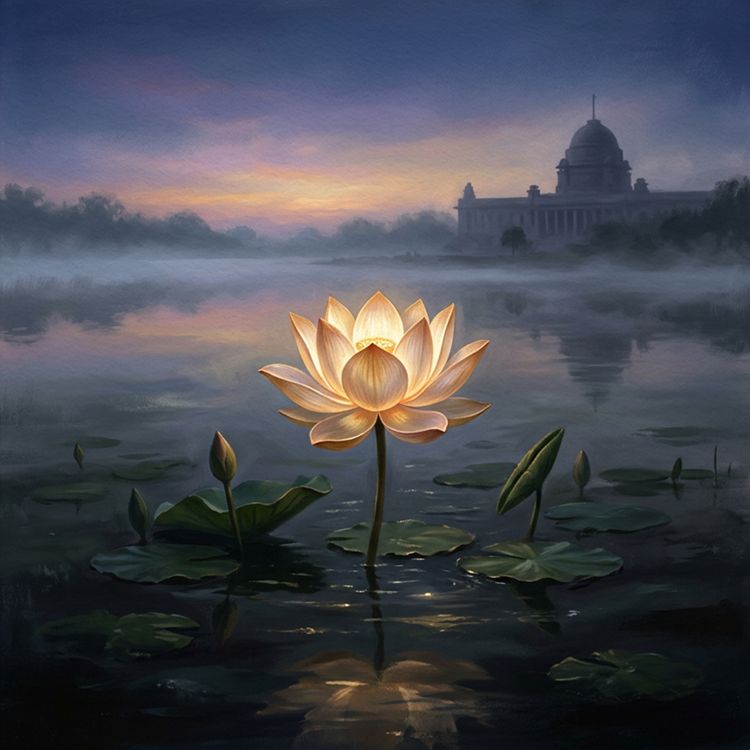
The lotus does not grow despite the mud. It grows through it, because of it, fed by precisely what would seem to choke it. The bhakta who finds the world disturbing has not failed to awaken. They have simply not yet learned to let the disturbance itself become the prayer — to let the grief of witnessing human diminishment open downward into something deeper than grief, into the ache of a love that has not stopped believing in the light it sees buried beneath the performance of power. Jesus knew this ache. Ramakrishna knew it. Mirabai sang it into the dark. Vivekananda carried it across oceans. The ache is not weakness. It is the sound of the Divine longing for Itself through every form that has, for now, forgotten what it is.
— ✦ —
Sources & References
The Holy Bible — Gospel of John 11:35 (Lazarus); Gospel of Matthew 21:12–13 (Temple); Gospel of Luke 22:39–44 (Gethsemane). New Revised Standard Version (NRSV).
Bhagavad Gita, Chapter 2, verse 48 — trans. Swami Vivekananda (Advaita Ashrama, 1916)
Narada Bhakti Sutras — trans. Swami Tyagisananda (Sri Ramakrishna Math, 1943)
The Gospel of Sri Ramakrishna — M. (Mahendranath Gupta), trans. Swami Nikhilananda (Ramakrishna-Vivekananda Center, 1942)
Complete Works of Swami Vivekananda, Vol. 3 — Lectures from Colombo to Almora (Advaita Ashrama, 1947)
Rumi: The Masnavi, Book I — trans. Jawid Mojaddedi (Oxford University Press, 2004)
Human Design: The Definitive Book of Human Design — Ra Uru Hu (HDC Publishing, 2011)
Songs of Mirabai — trans. A.J. Alston (Motilal Banarsidass, 1980)
— ✦ —

 Numinous Waves