

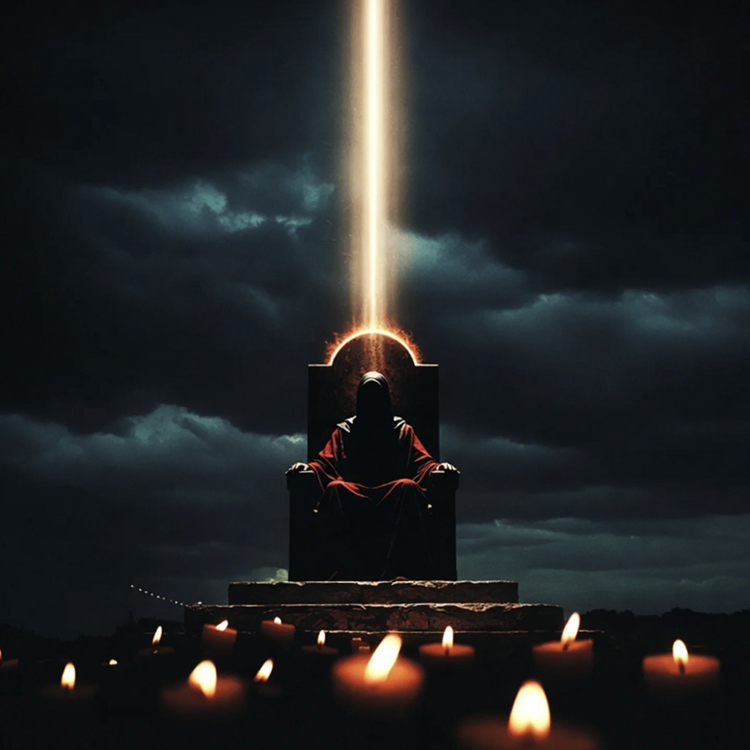
When the Archetype of the Antichrist Walks Among Us
I have spent a great deal of my life oriented toward the light — toward the luminous, the devotional, the current of grace that moves beneath all things. Bhakti has been my home, the place where the heart opens past its own defenses and finds, in that opening, something inexhaustible. And yet the longer I walk this path, the more I find myself unable to accept a spirituality that looks only upward, that speaks only of ascent, that keeps its language clean by refusing to descend into the more difficult registers of human experience.
The truth I have come to — and it is not a comfortable truth, though it is a liberating one — is that Divine Consciousness does not play only in the light. The Source, in its totality, moves through both poles of existence with equal sovereignty. This is the Tantric understanding of Shakti: that the same creative power which pours itself into beauty, into devotion, into the rising flame of the heart, also pours itself into dissolution, into the terrifying face of Kali, into the dark and necessary unraveling of what has outlived its form. Brahman, as the Vedantic tradition insists, is beyond both light and darkness — and yet, through the veil of maya, both light and darkness are its expression, its play, its lila. Non-dual awareness does not erase the polarity. It holds it, without flinching, as the full spectrum of what the Real permits itself to become.
I write this essay from that understanding. To name the archetype of darkness — to trace its features with care and without sensationalism — is not a deviation from the devotional path. It is, I would argue, one of its most demanding expressions. The Bhakta who has truly loved the light knows its quality too intimately to be deceived by its imitation. And it is precisely that intimacy — that rootedness in what is genuinely luminous — that makes it possible to turn, without fear, and look clearly at what is not. What follows is that kind of looking: contemplative, archetypal, and offered in the spirit of discernment rather than condemnation.
— ✦ —
Introduction
There is a figure that recurs throughout human mythology, scripture, and now — it seems — through the living theatre of world events: the figure of the Adversary, the one who rises clothed in light while carrying darkness at the core. This is not a figure of cheap horror. It is one of the most ancient and psychologically profound archetypes in the human story — appearing as Set in Egyptian cosmology, as Ahriman in Zoroastrian thought, as the Antichrist in Christian eschatology, and in the secular mythology of cinema as Damien Thorn, the child of an unknown dark genesis who ascends, step by calculated step, to the highest seats of earthly power.
What strikes the contemplative observer is not that such a figure exists in myth or on screen — it is that mythology may be the most accurate map the human soul has ever drawn of its own shadow. Carl Jung spent a lifetime arguing that the archetypes are not merely literary devices; they are structural patterns within the collective unconscious, templates that find embodiment again and again through history. When a particular archetype crystallizes in visible form within the collective — when someone seems to carry that template in their very persona — it is an invitation not to fear, but to discernment.
This essay does not deal in names. Names are the province of journalism. Here, the terrain is the soul — its patterns, its temptations, its ancient struggles. What is examined is the archetype itself: the specific constellation of qualities that define the figure of the dark regent, the one who arrives at the convergence of power, spectacle, and spiritual inversion. And to do this clearly, the mythology as rendered in Gregory Peck’s cold sweat across three films bears revisiting — because that story, however melodramatic on its surface, is a precise symbolic diagram of a recognizable human type.
— ✦ —
The Seed of the Dark King: Origin Without Roots
The Antichrist archetype is distinguished, first of all, by its obscured origin. In the Omen mythology, the child Damien is born of a jackal — symbol of liminality, of the threshold between worlds, of what cannot be easily classified. He is adopted into a powerful family not by organic belonging but by design — placed there by forces working in shadow. The symbolic meaning is clear: the dark regent does not arise from genuine roots. There is no traceable line of inheritance that leads honestly to the throne. The origin story is borrowed, performed, constructed.
This absence of genuine rootedness is one of the most reliable markers of the archetypal dark king across traditions. In Zoroastrian theology, Ahriman is the principle of non-being masquerading as being — a kind of cosmic imitation. In Christian eschatology, the Antichrist is specifically a counterfeit Christ, one who mimics the form of divine authority while being hollow at its source. Power is seized rather than organically born from. Identity is performed rather than embodied. The origin story — when pressed — fractures under examination.
The contemplative traditions are unanimous on this point: genuine spiritual authority arises from depth, from tapas, from the long refining fires of self-surrender. What the dark king archetype offers instead is the simulacrum of authority — sheer force of will, theatrical command, the bellowing certainty of one who has never genuinely questioned himself, mistaken throughout his life for strength.
— ✦ —
The Anointing of the Crowd: Democracy as Instrument
One of the most unsettling dimensions of the Omen narrative is that Damien does not conquer — he is elevated. The adults around him, the powerful men and women of institutions, conspire — consciously or unconsciously — to lift him higher. His very helplessness as a child, his seeming normalcy, his carefully managed surface of ordinariness, functions as the mechanism of his ascent. The crowd adores what it cannot see through.
The psychologist Erich Fromm, in his study of authoritarian personality, identified what he called the ‘escape from freedom’ — the mass psychological impulse to surrender individual discernment to a strong, certain, father-like figure who promises to resolve the unbearable anxieties of modern existence. The dark king archetype does not only require willing henchmen at the top; it requires a collective at the base that has abdicated its own inner authority. It rises, paradoxically, through democratic mechanisms — through the very instruments designed to prevent tyranny.
In this sense, the emergence of the dark regent is not an external event. It is a collective mirror. The Jungian reading is inescapable: the Antichrist is the shadow of the collective made manifest, the externalization of everything a society has refused to integrate — its cruelty, its appetite for dominance, its terror of the other, its bargain with comfort over conscience. The people do not merely tolerate the dark king. For a time, they love him.
— ✦ —
The Sign of the Beast: The Body That Betrays the Spirit
In the Omen mythology, Damien carries a physical mark — the number of the Beast, hidden beneath his hair, an outward symbol of his inner nature for those with eyes to discern it. The symbolism is more subtle than it first appears. The mark is not obvious; it must be searched for. It requires that someone risk proximity to the one carrying it in order to see it at all. And those who look closely enough, who are willing to name what they find, are typically destroyed.
In archetypal terms, the ‘mark’ represents the particular quality of presence that attends those in whom the shadow is dominant: an energy of transgression, of boundary violation, of the sacred turned inside out. Those who are spiritually sensitive have always reported a specific quality of unease in the presence of such figures — not the ordinary discomfort one might feel around a powerful person, but something that touches the roots of the nervous system, something that resembles desecration.
The tradition of Bhakti — the path of devotion, of the open heart — offers a particular diagnostic tool here. In devotional consciousness, every encounter is felt in the heart-center before it is processed by the mind. The dark king archetype reliably produces a closing, a contraction, a subtle sickness in those whose hearts are open. The devotee of Ram, of Krishna, of the Divine Mother, does not need to analyze the theological credentials of a figure to know that something is missing at the center. The heart simply knows.
— ✦ —
The Court of Enablers: Those Who Know and Serve Anyway
Among the most psychologically rich elements of the Omen mythology is the figure of the enabler — the Thorn Corporation executives, the political handlers, the domestic servants, the journalists, the priests who fall silent. Damien does not operate alone. The dark king never does. Around every figure of this archetypal type there accumulates a court of enablers: some who know, some who suspect and look away, and some who have genuinely convinced themselves that proximity to power is the same as participating in something sacred.
The mystic traditions have a word for this confusion: avidya — the fundamental ignorance that mistakes the conditioned for the eternal, the powerful for the divine, the overwhelming for the transcendent. In the Bhagavata Purana, the asuras — the dark forces — are not simply evil in a cartoon sense. They are beings of tremendous power and even certain kinds of discipline, who have mistaken dominance for liberation, conquest for realization. Those who serve them partake of the same confusion.
What the enabling court around the dark king universally shares is a transactional relationship to truth. Truth becomes something that can be selectively applied, delayed, suspended when inconvenient. The small compromises accumulate. The enabling becomes structural. And when the figure at the center finally oversteps the boundary that even they had not anticipated, it is almost always too late — the institutions have been hollowed, the counter-forces have been weakened, and what remains is a system shaped around the preservation of one singular, all-consuming ego.
— ✦ —
The Inversion of the Sacred: Power as Liturgy
Perhaps the most theologically precise dimension of the Antichrist archetype — and the one that distinguishes it most sharply from mere political tyranny — is its specifically religious character. The dark king does not merely want power. He wants worship. He stages himself as a sacred figure, uses the language of divine appointment, surrounds himself with the symbols of cosmic authority. In the Omen mythology this is explicit. In history, it is rarely less so.
The philosopher René Girard observed that political violence is always in some sense a religious act — a sacrificial mechanism by which the community attempts to discharge its accumulated tensions by projecting them onto a scapegoat, or, in the case of the authoritarian figure, by channeling them through a charismatic center who promises to turn the violence outward, toward enemies. The rallies of the dark king are not political events in any ordinary sense. They are liturgical gatherings — complete with repetition, call and response, symbolic vilification of the outsider, and the collective intoxication that attends any ritual space.
Swami Vivekananda, speaking of maya, described it as not merely illusion in the sense of hallucination, but as the power by which the real is hidden beneath the seductive appearance of the unreal. The dark king archetype is a supremely maya-saturated phenomenon. The authority is theater. The strength is performance. The sacred claim is inversion. And yet the hypnosis it produces in those under its spell is, at least temporarily, as total as any genuine spiritual experience. This is why discernment — viveka — is the central spiritual competency required in such a time.
— ✦ —
The Wound That Is Never Addressed: The Absent Interior Life
There is one quality that all genuine spiritual traditions agree marks the true seeker, the genuine devotee, the one in whom grace can take root: the capacity for inner poverty, for self-examination, for the acknowledgment of woundedness. The Sufi poets called this the tavern of ruin — the place where the ego’s pretensions dissolve and the heart becomes transparent to the divine. Ramakrishna wept for the Mother without ceasing. Mirabai gave up everything the world calls security and ran barefoot into the devotional fire. The genuine masters are defined, above all else, by a quality of radical interiority.
The dark king archetype is defined by its precise and total opposite: an impenetrable exteriority. There is no inner life on display, because — structurally, archetypally — there can be none. The Antichrist figure is all surface, all spectacle, all projection. When wounded — and the archetype is perpetually wounded, perpetually aggrieved — the response is never inward. It is always outward: blame, revenge, escalation, the naming of enemies. The wound is never integrated because integration would require an interior to integrate into. And that interior is what the archetype most fundamentally lacks.
This is perhaps the most compassionate reading available from a spiritual perspective: the dark king is not evil in the cartoonish sense of one who has chosen darkness after tasting light. The archetype represents, in its purest form, the tragedy of a soul that has never found its way home to itself — that has compensated for this homelessness with accumulation, domination, and performance. The spiritual traditions would not deny such a figure the possibility of grace. But they would note that grace, in such a case, would require a devastation that no earthly power can provide.
— ✦ —
Addendum
It should be said clearly: the purpose of this archetypal analysis is not to demonize any individual. The contemplative traditions are unanimous that every soul — without exception — is a vessel of the divine, however obscured the light may become. The Antichrist archetype, as an analytical lens, is useful precisely because it strips away the personal and reveals the pattern — the recurring shape that power can take when the inner life is absent and the collective shadow is ready to be activated.
The question this archetype ultimately poses to each of us is not about the figure it describes, but about ourselves: Where within the collective field — and within each individual heart — does the appetite for this kind of power still live? Where does the shadow speak in the seductive language of certainty, of belonging, of enemies finally named and vanquished? The dark king does not appear from outside the human community. He is summoned from within it.
Spiritual practice — whether the devotional surrender of Bhakti, the discriminative inquiry of Jnana, or the still witnessing of deep meditation — functions, among other things, as a prophylactic against precisely this kind of collective enchantment. The one who knows their own shadow cannot project it onto a savior-destroyer. The one rooted in genuine interiority cannot be entirely captured by the liturgy of the spectacle. This is why the mystics have always insisted: self-knowledge is not a luxury. In times like these, it is a necessity of the first order.
— ✦ —
Epilogue
In the final act of the Omen mythology, the attempts to destroy the dark child are thwarted not by lack of courage but by structural impossibility — the institutions themselves have been compromised, the weapons have been turned, and the sacred spaces have been desecrated. The mythology does not end in triumph. It ends in the dark child ascending to earthly power. And then, the story holds — it ends.
The contemplative traditions do not offer easy comfort about this ending. The Bhagavata Purana, the Mahabharata, the Book of Revelation — all agree that there is a phase of dissolution, of Kali Yuga’s full expression, that cannot be avoided by human cleverness alone. What they offer instead is something more radical: the assurance that the dark king’s reign, however total it appears from within it, is not the final word of the cosmos. The wheel turns. The age completes itself. The light that the archetype of darkness can never finally extinguish continues, in every genuine heart, to burn.
The Bhakta — the devotee of the heart — knows this not as an intellectual proposition but as a living certainty. The current moves through every age, through every apparent catastrophe of history, through every dark regent who mistakes his moment for eternity. The wave rises. The wave breaks. The ocean remains.
— ✦ —
Sources & References
• The Omen (1976), Damien: Omen II (1978), Omen III: The Final Conflict (1981). Dir. Richard Donner, Don Taylor, Graham Baker. 20th Century Fox.
• Jung, C.G. Aion: Researches into the Phenomenology of the Self. Princeton University Press, 1959.
• Jung, C.G. The Archetypes and the Collective Unconscious. Princeton University Press, 1959.
• Fromm, Erich. Escape from Freedom. Farrar & Rinehart, 1941.
• Girard, René. Violence and the Sacred. Johns Hopkins University Press, 1977.
• Vivekananda, Swami. Jnana Yoga. Advaita Ashrama, 1899.
• Bhagavata Purana. Trans. A.C. Bhaktivedanta Swami Prabhupada. Bhaktivedanta Book Trust, 1972.
• Mahabharata. Trans. Kisari Mohan Ganguli. Pratap Chandra Roy, 1883–1896.
• Narada Bhakti Sutras. Trans. Swami Tyagisananda. Sri Ramakrishna Math, 1943.
• Rumi, Jalal al-Din. The Masnavi. Trans. Jawid Mojaddedi. Oxford University Press, 2004.
• Patanjali. Yoga Sutras. Trans. Georg Feuerstein. Inner Traditions, 1989.
— ✦ —

 Numinous Waves