

Introduction
There are moments when something in us begins to notice…
That our life doesn’t feel entirely random.
That certain struggles repeat.
That certain longings don’t belong only to us.
And quietly, almost without announcement, a question forms:
Am I living my life… or am I living a pattern?
This is where names like Carl Jung and Joseph Campbell begin to appear—not as authorities, but as those who stood near this same question and listened long enough for something to respond.
And what they found…
was not just psychology.
Not just myth.
But a structure beneath experience itself.
The Dialogue
Is there something beneath my personal story that is shaping how I live and experience the world?
Yes—but not in the way the mind first imagines.
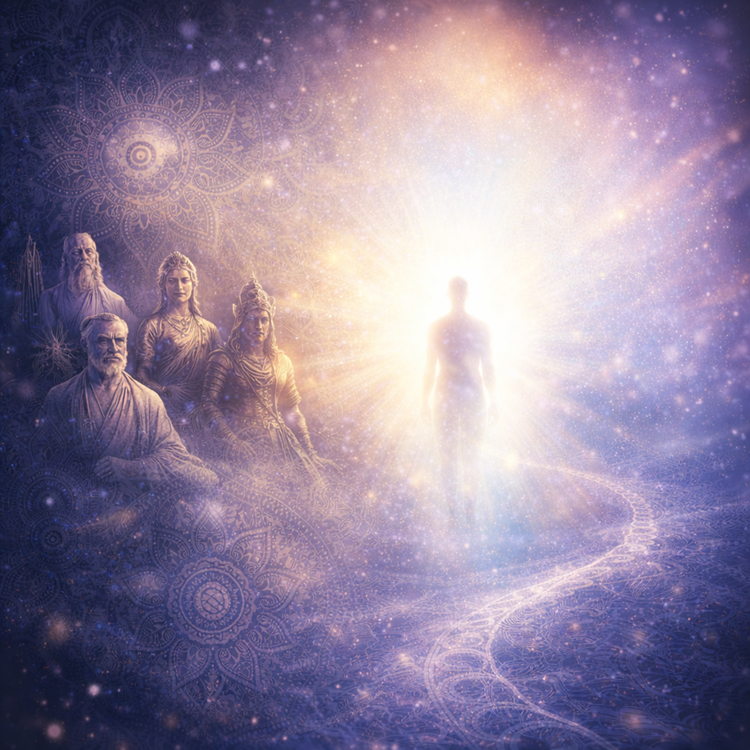
Jung began to notice that beneath personal memory, beneath biography, there were patterns that did not originate in the individual. He called this the collective unconscious—a shared field of human experience containing archetypes that shape perception, emotion, and meaning.
These were not ideas we learn.
They were forms we recognize.
The Hero.
The Mother.
The Shadow.
They appear in dreams, in art, in crisis, in love—as if something ancient is speaking through a modern life.
Campbell encountered the same phenomenon—but not through introspection.
He found it in myth.
Across continents, across centuries, stories emerged that mirrored each other in uncanny ways. Different cultures, different languages—but the same unfolding:
A call.
A departure.
A trial.
A transformation.
A return.
He called it the Hero’s Journey.
And suddenly, what Jung saw inside the psyche…
Campbell saw written across the human story.
So are these archetypes real forces within us… or are they just patterns we project onto stories?
This is where the question deepens.
For Jung, archetypes are real—though not in a physical sense. They are organizing principles of the psyche, shaping how experience is structured before we even become aware of it.
For Campbell, whether they are “real” is almost beside the point.
What matters is that they move us.
They give shape to chaos.
They allow suffering to become meaningful.
They transform life from a sequence of events into a journey.
So the same archetype can be seen two ways:
- As a structure within you
- As a story you are living
And perhaps both are true simultaneously.
If I am living a pattern like the Hero’s Journey… do I have any freedom at all?
This is the subtle tension.
At first, it can feel like limitation:
Am I just acting out something pre-written?
But look closer.
The pattern does not dictate your life—it offers a possibility of meaning within it.
Two people can face the same loss:
- One experiences only collapse
- Another experiences descent… and transformation
The external event is the same.
The archetypal participation is not.
Freedom, then, may not be in escaping the pattern…
…but in how consciously it is lived.
Why do these patterns feel so deeply familiar… even when I’ve never studied them?
Because they don’t belong to memory.
They belong to recognition.
When something archetypal appears, it carries a strange quality:
It feels both new… and already known.
This is why a myth can move someone who has never heard it before.
Why a dream can feel more real than waking life.
Why certain moments carry a weight that cannot be explained.
Jung would say:
→ You are touching the collective unconscious.
Campbell would say:
→ You are inside the story humanity has always told.
And both point to the same feeling:
This is not just happening to me.
This is something larger… happening through me.
And yet… something in me feels like even this is not the final layer. Is there something beyond archetypes themselves?
This is where the ground begins to shift.
Because both Jung and Campbell, in their own ways, stop at the level of meaning.
They reveal the structure.
They illuminate the story.
But they do not fully step outside of it.
And here, another voice quietly enters—the voice you’ve already been leaning toward:
The one that doesn’t want to understand the pattern…
but to see what is aware of it.
From a deeper lens—what Vedanta points toward—
Even the Hero…
Even the Shadow…
Even the entire unfolding of a meaningful life…
is still appearing within awareness.
So the question changes:
Not “What story am I living?”
But—
What is aware of the story?
Then what becomes of the journey… if I am not the one inside it?
Nothing is lost.
But something relaxes.
The journey can still unfold—
but without the same weight of identification.
You can still feel the call, the fear, the transformation…
…but there is a subtle knowing that none of it defines what you are.
Jung helps you see the depth of the psyche.
Campbell helps you live the meaning of the story.
But something in you is already prior to both:
Not the character.
Not the arc.
Not the transformation.
Just the quiet, open awareness in which all of it appears.
Addendum — The Story That Softens
There is a moment—hard to locate, impossible to force—where the need to understand begins to ease.
Not because the questions have been answered…
but because something deeper has been noticed.
The pattern is still there.
The story is still moving.
But it no longer feels like something you must solve.
Only something you are witnessing… as it unfolds.
And in that shift, the Hero’s Journey becomes lighter.
Not less meaningful—
but less binding.
Epilogue — A Quiet Turn
You may still wake tomorrow and feel the same concerns, the same desires, the same questions.
The story does not disappear.
But perhaps, just slightly, something has changed.
Not in the story…
…but in your relationship to it.
And that is enough.

 Numinous Waves