

Introduction
There are moments when a thought does not feel constructed, but remembered—arriving whole, without effort, as if it had been waiting just beyond the edge of awareness. What follows is one of those recognitions. It does not attempt to explain death, nor prove anything about what comes after. It simply turns the lens slightly, and in doing so, reveals something quietly disorienting: that what we call life may not be the beginning, and what we call death may not be the end—but a crossing we have misunderstood.
The Reflection
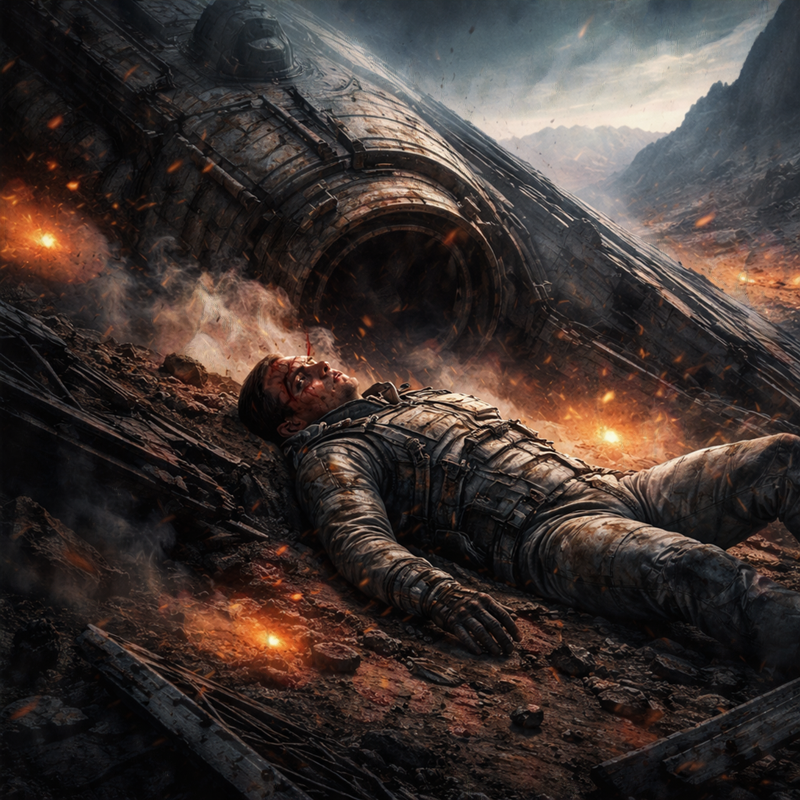
Death is akin to a human crashing his spaceship on an alien world—thrown violently across the ship on impact, his head striking with such force that he is cast instantly into a state of amnesia. He survives, but with no memory of where he came from.
Left to wander this unfamiliar terrain, he adapts. He learns its ways, its language, its rhythms. Over time, this alien world becomes his only reality. Not because it is all that exists—but because it is all he can remember.
And should he ever return to Earth, it would not feel like going home.
It would feel like passing through death… to the other side.
The Unfolding
At first, there is the shock of arrival.
Not the dramatic kind, not the kind filled with noise or spectacle—but a subtle dislocation. A sense that something is unfamiliar, even if it cannot be named. The body breathes, the senses awaken, the world presses in with color and form, and yet somewhere beneath it all is a faint echo: this is not entirely home.
But the human being is an extraordinary adapter.
Slowly, almost imperceptibly, attention turns outward. The textures of this world become more convincing than the whisper of another. Language forms. Identity takes shape. Relationships anchor perception. The alien landscape becomes navigable, then livable, then unquestioned. What was once strange becomes intimate. What was once unknown becomes “me.”
And memory… recedes.
Not because it is taken away, but because it cannot be accessed. The deeper memory—the one not made of events but of essence—remains, but without reference. It becomes a feeling without context, a longing without direction, a sense of having forgotten something immeasurably important without knowing what it is.
So we begin to search.
We search in love, in achievement, in understanding, in transcendence. We search in art, in silence, in the sacred. We search in each other. And sometimes, in quiet and unguarded moments, something stirs—a softness in the chest, a widening, a subtle recognition that feels less like discovery and more like remembering something we cannot quite reach.
But still, the world holds us.
Because it must.
To live here fully, the illusion of finality must feel real. The body must believe it is the beginning and the end. The mind must build continuity. The self must take itself seriously. Otherwise, the experience would not root deeply enough to matter. The crash landing would never become a life.
And so we forget completely…
until the idea of leaving this world feels like loss.
Until death appears as an ending rather than a transition.
Until the thought of “the other side” feels distant, abstract, even frightening.
But what if the metaphor holds?
What if returning is not an ascent into the unknown, but a re-entry into what was once intimately known? What if the fear of death is not fear of annihilation, but the trembling of identity sensing its own dissolution? What if the one who adapted so completely to this world cannot imagine surviving its absence—just as the stranded traveler, after years on the alien planet, cannot imagine Earth as anything but a fading dream?
Then death is not the extinguishing of life.
It is the undoing of adaptation.
It is the gentle or sudden release of everything that made this world feel like the only world.
It is the moment when the constructed familiarity falls away… and something older, quieter, and infinitely more native begins to reappear.
And perhaps—just perhaps—it feels like dying.
Not because we are ending, but because everything we mistook for ourselves cannot come with us.
Addendum
There is a strange mercy in the forgetting.
If we remembered too clearly where we came from, we might never fully arrive here. We would hover between worlds, unable to belong to either. The density of this life—the weight of touch, the intimacy of emotion, the friction of time—requires a kind of immersion that only amnesia can provide.
And yet, something survives even that.
It appears not as memory, but as resonance. In moments of stillness. In the ache of beauty. In the quiet expansion of the heart that has no clear cause. In Grace—arriving unearned, unbidden—like a presence that does not restore memory, but softens the edges of forgetting.
Not to take us away from this world…
but to remind us that we were never only this.
Epilogue
If this is so, then life is not a mistake, nor a fall, nor a punishment.
It is an experience so complete that it convinces us it is all there is.
And death is not a void waiting to erase us…
but a threshold waiting to reveal what could not be remembered while we were here.
So perhaps the question is not what happens after death.
But what we are, even now, that can survive both worlds.
Sources & Resonances
This reflection emerges not from doctrine, but from direct contemplation.
Still, echoes of this understanding can be found across spiritual and philosophical traditions:
The Upanishads — particularly the idea that the Self forgets its true nature upon entering the world of form, only to rediscover it through realization.
Plato’s Allegory of the Cave — the notion that what we take as reality may be a conditioned perception, and that returning to truth can feel disorienting, even threatening.
Advaita Vedanta — the teaching that the individual self (Atman) appears separate due to ignorance (Avidya), and that realization is not acquisition, but remembrance.
Mystical Christianity — the idea of being “in the world but not of it,” and the return to the Father as a kind of dying to the constructed self.
Modern Near-Death Experience accounts — many describing a sense of returning “home,” accompanied by recognition rather than discovery.
Contemplative and Meditative Traditions — which often speak of a felt sense of something prior to identity, accessible not through thought, but through direct awareness.

 Numinous Waves