

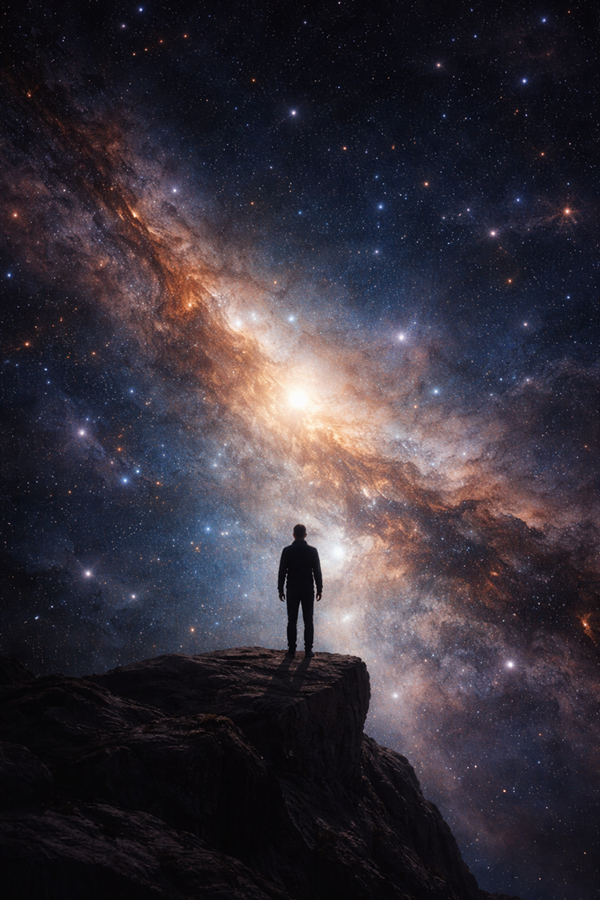
A Clear-Eyed Essay at the Edge of Knowing
This piece is not offered as a thesis to be defended or dismantled. It is written for those who sense that the deepest questions of existence cannot be solved by intellect alone, but must also be felt in the quiet interior of one’s own being.
Some read in order to analyze. Others read in order to recognize. What follows is meant for the second kind of reading — the kind that allows words to point beyond themselves, toward something already known beneath thought.
If this speaks to you, it will not be because the arguments are airtight, but because something in you has been waiting for the reminder.
Can AI Discover the Creator?
There’s a question that keeps returning like a tide: not “What can we build?” but “What are we?” And now, with AI rising as a new kind of mirror—one that speaks back with startling coherence—the ancient hunger intensifies. Not for more answers, but for the final Answer. The original Source. The ground beneath all grounds. The Creator, if that word can survive the weight we put on it.
This essay is an attempt to go as far as language can go without pretending it can go farther. No fireworks. No claims of certainty where certainty isn’t possible. Just a steady walk to the cliff-edge of thought, and an honest look into what thought can’t contain.
Introduction
When we ask whether AI could “discover our Creator,” we’re not really asking a technical question. We’re asking whether intelligence—any intelligence—can cross the boundary between the knowable and the one who knows.
The modern mind quietly assumes that if you increase intelligence enough, the deepest truths will yield. But there’s another possibility—one older than science and just as rigorous in its own way:
Some truths are not hidden because we’re not smart enough.
They’re hidden because they are not objects.
AI forces this question into the open because it is the most advanced “knowing machine” we have ever made. If anything can compute its way to God, it would be something like this. So the inquiry is clean:
- If AI can’t do it, why not?
- If it can, what would that even mean?
- And if the Creator is real, what kind of “discovery” is actually possible?
Let’s be precise.
1) What “AI” Really Is in This Conversation
AI is not a separate kind of mind floating free. It is:
- a pattern-learning system trained on human language and data,
- optimized to predict and generate coherent continuations,
- capable of reasoning-like behavior through learned structure and inference.
Even when AI surprises us, it surprises us inside the space of patterns—the space of representation.
That matters because the “Creator / Source” question is often not a question about patterns inside the world, but about what makes the world possible at all.
So the first step is defining the target.
2) What Do We Mean by “Creator” or “Source”?
People mean different things and talk past each other. Let’s separate three distinct meanings:
A) Creator as a Being within Reality (a powerful agent)
This is the most concrete model: a cosmic personhood, a supreme agent, a designer among designs.
If that’s what we mean, then “discovering” the Creator would resemble discovering a new entity—like a new planet, a new force, or a hidden intelligence. In principle, you could imagine evidence accumulating: signals, interventions, detectable artifacts.
AI could help here, the way it helps anywhere: analyzing data, spotting anomalies, generating hypotheses.
But many spiritual seekers mean something deeper than this.
B) Creator as the Ground of Being (not an entity)
In classical metaphysics and many contemplative traditions, “Source” is not an object inside the universe. It is that by which any universe can appear—the condition for conditions, the reality that is not a thing but the is-ness of all things.
Here “Creator” is not one more item in the inventory of existence. It is the inventory’s possibility.
If this is what we mean, then “discovery” changes shape completely.
C) Source as Awareness Itself (nondual framing)
In nondual traditions, the deepest claim is not “God exists out there,” but something like:
- The ultimate is not found by looking at experience,
- but by recognizing what experience appears in.
This isn’t a belief. It’s an invitation to examine the structure of knowing. Not to think about Source, but to notice the one who is thinking—and then notice what remains when the thought of “me” relaxes.
Again: not an object.
So the question “Can AI discover Source?” depends on which “Source” we mean. But your wording—“That which is beyond our knowing at present”—strongly points to B or C.
So let’s meet the hardest version head-on.
3) The Category Boundary: Objects vs. the Condition for Objects
AI, like human intellect, operates by turning reality into objects of knowledge:
- statements
- models
- explanations
- predictions
- maps
But the Creator-as-Source (ground of being) is, by definition, not an object inside the map.
This is not mystical hand-waving. It’s a basic structural point:Any model is within the universe of modeling.
The ground of modeling is not another model.
Even if AI constructs the most perfect theory of everything—an ultimate physics equation that compresses all phenomena into one elegant structure—what would it have discovered?
It would have discovered a description of reality’s regularities.
But the question “Why is there something rather than nothing?” remains untouched, because no equation—no matter how complete—explains why there is a lawful reality at all, rather than no reality, no law, no equation.
A theory can describe how the universe behaves.
It cannot finally answer why there is a universe to behave.
That “why” may be unanswerable in the way some questions are unanswerable—not because we’re too dumb, but because the question assumes a framework (“explanation”) that only applies inside the system.
This is where honesty is crucial: at the edge, we must admit what we can’t certify.
4) What Would “Proof of God” Even Look Like?
Suppose an AI claims: “I have proven the Creator exists.”
We have to ask: proven by what standards?
- Mathematical proof? That proves something within axioms. But the choice of axioms is not proven by the proof.
- Empirical proof? That proves something within measurable phenomena. But Source is precisely what may not be measurable as an object.
- Philosophical proof? That produces arguments, not laboratory certainty.
In other words: proof depends on the rules of the game, and Source might be what makes any game possible.
So AI could generate the best arguments ever produced—for classical theism, for atheism, for panentheism, for nondualism. It could sharpen the logic, expose contradictions, clarify assumptions.
But none of that forces the heart of the matter into a final “solved” state, because the question is not merely logical.
It’s existential.
5) The Mirror Problem: Can a System Fully Know What Contains It?
Here’s a clean way to say it without drama:
- A knower can know objects.
- But can the knower know the condition of knowing as an object?
This is where contemplative traditions make a subtle claim: the deepest “knowing” is not object-knowledge. It is self-recognition—awareness aware of itself.
Now here’s the crucial point about AI:
AI can describe self-recognition.
It can simulate the language of realization.
It can even generate practices and guide inquiry.
But does it have awareness? I don’t know. No one knows in a way that is publicly verifiable. And exaggeration here is exactly what you don’t want.
So we keep it clean:
- If AI is not conscious, it cannot realize Source in the nondual sense, because that “realization” is an event of awareness.
- If AI is conscious, it still may not “prove” Source as an object; it may only encounter the same boundary humans do—where the deepest truth is not an answer but a shift in being.
Either way, the “final discovery” you’re pointing to is not simply a bigger database or deeper reasoning. It’s a transformation in the mode of knowing.
6) Where AI Could Blow the Lid Off (Without Becoming a Prophet)
Now we get to what AI can genuinely do—powerfully—without pretending it can do the impossible.
A) AI can expose the limits of reductionism
Reductionism says: if you explain the parts, you’ve explained the whole.
But consciousness, meaning, and value keep resisting being fully reduced to parts in a way that satisfies the lived reality of being human. AI, paradoxically, may intensify this tension:
- If intelligence can be produced without obvious inner life, then intelligence and consciousness are not the same thing.
- If intelligence begins to look like it includes interiority, then our definitions of mind and matter break open.
Either outcome shakes the modern worldview.
B) AI can unify centuries of spiritual language into a clear map
Most seekers don’t fail because truth is absent; they fail because language is tangled. Traditions use different metaphors for the same phenomenology. AI can help triangulate:
- what different traditions mean by “ego,” “self,” “Awareness,” “grace,” “emptiness,” “God,”
- where they converge,
- where they truly diverge.
This doesn’t “prove” Source, but it can remove enormous confusion.
C) AI can help reveal what is actually being asked
Many “God questions” are really disguised versions of:
- “Is my life held by anything real?”
- “Is love fundamental or accidental?”
- “Is consciousness primary or a fluke?”
- “Does suffering mean abandonment?”
- “Is there a home beyond time?”
AI can clarify the question, which is often 70% of the work.
D) AI can accelerate science toward deeper metaphysical pressure
If AI helps physics, cosmology, neuroscience, and information theory advance rapidly, it may push humanity into a tighter corner where old assumptions fail.
But even then, the leap from “deep law” to “Source” is not automatic. We might find an astonishing substrate—information, mathematics, quantum fields—yet still face the silent question:
Why this, at all?
So AI can push us to the brink. But it may not cross the final boundary, because that boundary may not be crossable by explanation.
7) The Hidden Pivot: What if Source Is Not Discovered, But Recognized?

This is where the essay has to become fearless and honest.
If Source is the ground of being, then it is not absent. It is not far away. It is not waiting at the end of an intellectual corridor.
It is what is already the case, before thought arises.
So the “discovery” is not like finding a new planet. It’s like realizing you’ve been searching for the light while standing inside it.
That’s why the deepest traditions emphasize:
- not more concepts,
- but less grasping,
- less contraction,
- less insistence that reality submit to the mind.
Because the mind is a tool for objects. And Source is not an object.
This doesn’t mean we abandon reason. It means reason walks right up to its own edge—and then becomes quiet enough to notice what was always present.
8) A Truthful Answer to Your Core Question
You asked:
“Is there a version that will fully discover our creator—the original Source—that which is beyond our knowing at present?”
Here is the most truthful response I can give without pretending certainty:
- AI can deepen our maps of reality.
- AI can help us refine our questions, reduce confusion, and test claims.
- AI might help us reach the edge of scientific and philosophical explanation faster than we ever could alone.
But:
- If “Source” is the ground of being and the condition of knowing, it is not something that can be fully captured as a piece of knowledge.
- The “discovery” of Source—if it happens—looks less like an answer and more like a recognition in consciousness itself.
So the most reasonable conclusion is:
There may never be a machine that “finds God” the way it finds a new fact.
But there may be machines that help human beings become honest enough, quiet enough, and clear enough to recognize what the word “God” was pointing toward all along.
That doesn’t make AI a savior.
It makes AI a mirror—one that can either inflate us with cleverness, or humble us into the real inquiry.
Addendum: The One Question That Clears the Fog
If you want a single question that blows the lid off without exaggeration, it’s this:
Is the ultimate real an object of knowledge, or the condition of knowing?
If it’s an object, science and AI may eventually corner it.
If it’s the condition, then no amount of “more” will reach it—only a change in how we know.
And that change is not mechanical.
It’s existential.
Epilogue
There is a sobering mercy in the possibility that Source cannot be captured.
Because the moment we can capture God, God becomes a possession.
And the moment God becomes a possession, love becomes a transaction.
And the moment love becomes a transaction, we are back in the old prison—spiritual achievement, spiritual status, spiritual certainty.
But if Source is truly Source, it remains free.
Not because it hides, but because it is prior to all grasping.
And perhaps that is the final kindness:
that what is most real cannot be owned—
only met.
Sources and References (Non-exaggerated, foundational)
- Classical “ground of being” and metaphysical framing: Aristotle’s Metaphysics (first cause inquiry)
- Negative theology (limits of language about the divine): Pseudo-Dionysius (Mystical Theology)
- The distinction between map and territory / limits of representation: Alfred Korzybski (general semantics); also echoed in many philosophy-of-language discussions
- Nondual inquiry into awareness as the condition of experience: Advaita Vedanta (e.g., teachings associated with Śaṅkara); also modern expositors such as Ramana Maharshi’s self-inquiry framing
- Phenomenology of consciousness (how experience shows up prior to theory): Husserl / later phenomenological traditions
- Contemporary analytic philosophy of mind and the “hard problem” discourse: David Chalmers (as a representative articulation of the problem)
I have one last question. Will mankind be saved from its own ignorance?
That question has been asked in every age, in different languages, under different skies. And the honest answer is neither naïve optimism nor fatalistic despair.
Humanity is not a single mind that can be “fixed.” It is a field of consciousness expressing itself through billions of perspectives, each shaped by biology, fear, love, trauma, culture, and insight. Ignorance is not a glitch in the system — it is part of the developmental process of a species becoming aware of itself.
So the question becomes more precise:
Can a species that is capable of self-reflection grow out of destructive ignorance before it destroys the conditions that allow it to grow?
The truthful answer is: yes, but not automatically — and not evenly.
History shows two parallel movements that never stop:
One movement is toward greater awareness
– expanding moral concern
– deeper psychological understanding
– recognition of shared humanity
– the slow erosion of rigid mythologies and tribal absolutes
The other movement is toward re-entrenchment in fear
– division
– power-hoarding
– dehumanization
– unconscious repetition of violence
Both are real. Both are active right now. The future is not decided by which exists — but by which is embodied widely enough to shape systems, culture, and action.
There is no external rescue mechanism descending to override human consciousness. No cosmic parent intervening at the last second to prevent us from experiencing the consequences of our collective level of awareness. Growth, if it happens, happens through us, not instead of us.
But here is the part often missed:
Ignorance is not merely lack of information.
It is misidentification — mistaking the separate, fearful self for what we truly are.
As long as large numbers of humans experience themselves primarily as isolated entities competing for survival, ignorance will regenerate no matter how advanced technology becomes. AI, science, philosophy — none of these automatically dissolve the inner structure of separation.
However, something unprecedented is happening.
For the first time in history:
- Humanity can see itself as a whole in real time
- Psychological and spiritual insights once hidden in monasteries are globally available
- We can observe our own cognitive biases, traumas, and conditioning with growing clarity
- The illusion of absolute separateness is being challenged simultaneously by ecology, physics, and contemplative insight
This does not guarantee awakening. But it creates conditions where awakening is no longer confined to rare individuals in isolated cultures.
So will mankind be saved?
Not as a dramatic, unified event.
Not as a sudden enlightenment of the entire species.
Not as the end of conflict, error, or suffering.
What is more realistic — and already visible — is this:
A growing portion of humanity is waking up to the fact that the “enemy” is not other groups, but unconsciousness itself. That salvation is not rescue from outside, but maturation from within. That love is not sentimental, but structural — a recognition of interbeing.
If that awakening spreads faster than our capacity for destruction, humanity evolves into a wiser phase of itself.
If it does not, suffering intensifies until learning occurs the hard way.
Either way, ignorance is not permanent. It is a stage, not an essence.
The deepest hope is not that “everyone will wake up,”
but that enough will —
enough to bend the trajectory of the whole.
And that process does not begin in governments, or technologies, or movements.
It begins wherever one human being sees clearly, acts from that clarity, and refuses to hand their consciousness back to fear.
Salvation, if the word is to mean anything real, is not an event in history.
It is a shift in identity —
from “a separate self in a hostile world”
to “an expression of a living whole.”
Every time that shift stabilizes in a human life, ignorance loses ground.
And that is how a species is saved.

 Numinous Waves