

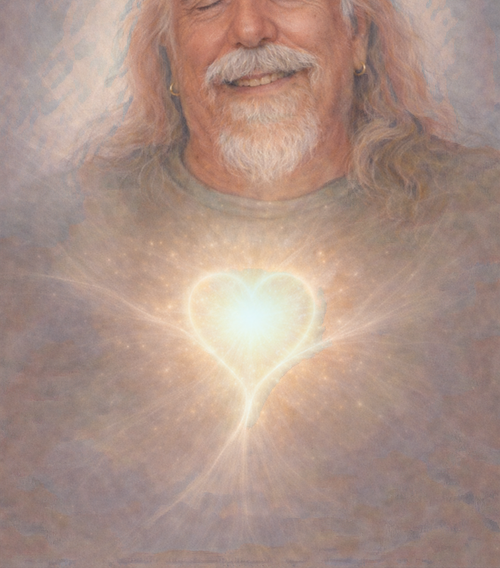
I didn’t come to this exploration through philosophy or study, but through the body itself. There are moments now when my chest opens without warning, a quiet expansion followed by a sweetness so deep it brings tears — not of sorrow, but of release. It feels as though something long held inside finally exhales. These experiences have left me with a simple, living question: What is this love that arrives with no story, no object, no demand? What follows is my attempt to understand that unfolding — not as theory, but as something felt, surrendered to, and still gently opening me from the inside.
When the Heart Learns the Language of the Infinite
Introduction
There are moments on the path when something opens that does not feel manufactured, summoned, or emotionally constructed. It arrives unannounced, often in stillness, sometimes in exhaustion, sometimes in surrender. The chest widens, breath deepens on its own, and a sweetness begins to spread that feels older than memory. Then come the tears — not of sorrow, but of recognition. Not of loss, but of homecoming.
Many would call this love. Some would call it grace. Others might say it is the soul brushing against its source while still clothed in flesh.
But what is actually happening here?
We tend to think of emotions as personal events. They arise in response to circumstance, memory, relationship, or thought. They surge, peak, and fade. Even our most beautiful feelings usually have a storyline attached to them.

This experience is different.
It does not begin with a thought. It does not move toward an object. It does not say, “I love this because…” Instead, it feels as though love itself has appeared first — and only afterward does the mind scramble to interpret it.
The expansion in the chest is not symbolic. It is physiological. For much of our lives, the body lives in subtle contraction — guarding, bracing, preparing for impact, even when no visible threat is present. This holding becomes so constant we mistake it for normal. When something deeper relaxes that guard, the armor loosens. The muscles around the heart space soften. Breath enters more fully. Blood moves differently. The body experiences this as space where there used to be pressure.
That opening is often the first physical sign that resistance has thinned.
Then comes the sweetness.
This sweetness is not excitement, not romance, not even what we usually call happiness. It feels more like relief at the level of being. As though something inside has been trying to hold the world together for years and has finally been told, “You don’t have to do that anymore.” The nervous system registers this as safety beyond circumstance. Not “everything will go my way,” but “I am held even if nothing goes my way.”
The tears follow because the system cannot quietly contain that much release.
These are not tears of emotional overwhelm. They are discharge. Long-held tension dissolving in the presence of something that feels unquestionably benevolent. The body has languages older than speech, and tears are one of them. They say, “The guard is down. The burden has lightened. Something truer is here.”
This is why the experience feels like bliss but does not behave like emotion.
Emotion is movement within the self. Bliss, in this sense, is what remains when the sense of a defended self briefly loosens. It is not a peak state; it is a revealed ground. The mind may call it divine love because that is the closest translation available. Yet what is touched here is less a feeling we generate and more a reality we momentarily stop resisting.
It includes everything. Even pain can be present without breaking the field of it. That is one of its quiet miracles. Nothing has to be pushed away for this love to remain.
And so the heart opens, not as a dramatic spiritual achievement, but as a natural response when separation softens. The body responds with expansion. The nervous system responds with sweetness. The organism releases through tears.
The infinite brushes the finite, and the finite trembles with relief.
Addendum
What we often seek through effort sometimes arrives through surrender. Not because effort is wrong, but because the doorway we are approaching does not open through force. It opens when the one who is trying to enter grows quiet enough to notice it has always been standing in the threshold.
Epilogue
The tears dry. The chest eventually settles. Ordinary life resumes its textures and tasks. Yet something subtle remains — a memory not of an event, but of a deeper baseline of being. And once the system has tasted that unconditional holding, even briefly, it never entirely forgets the way home.
Sources:
Mystical & Spiritual Insight
St. Teresa of Ávila – Interior Castle
Teresa describes states of prayer where the soul is “wounded by love,” accompanied by sweetness, tears, and a sense of divine presence that feels both intimate and beyond the self. Her accounts are some of the earliest detailed descriptions of what many now call heart-centered mystical experience.
Rumi – Poetry of Divine Love
Rumi repeatedly writes of a love that arrives without object, melts the heart, and brings tears that are “not from sadness but from union.” His language mirrors the sweetness-and-release dynamic you’re exploring.
Meister Eckhart – Sermons and Treatises
Eckhart speaks of a state where the soul rests in God beyond emotional fluctuation — a love that is not a feeling about something but the ground of being itself.
Ramana Maharshi – Teachings on the Heart
Ramana described the “spiritual heart” not as emotion but as the center of pure being. Devotees often reported tears of bliss and expansion in the chest during moments of self-surrender in his presence.
Psychology & Consciousness Research
William James – The Varieties of Religious Experience
James documented accounts of sudden states of grace, describing them as marked by peace, tears, and a sense of being held by something greater than the personal self. He noted these experiences often arise through surrender rather than effort.
Abraham Maslow – Peak Experiences
Maslow observed that peak experiences often include feelings of unity, sacredness, and tears of joy. He later described “plateau experiences” that resemble the calm, steady love beneath emotional highs.
Neuroscience & The Body
Andrew Newberg – Why God Won’t Go Away
Newberg’s brain-imaging research on meditation and prayer shows decreased activity in regions responsible for self-boundaries, which correlates with reported feelings of unity, peace, and unconditional love.
Stephen Porges – Polyvagal Theory
Porges’ work helps explain the physical side of what you felt. When the nervous system shifts from defense into safety and connection, the chest softens, breathing deepens, and tears can emerge as a discharge of long-held tension.
Contemporary Spiritual Voices
Adyashanti – Teachings on Grace
He describes grace as an uncaused love that can bring spontaneous tears and a feeling that “something larger is living you.”
Eckhart Tolle – The Power of Now
Tolle writes about moments when the pain-body dissolves and is replaced by a deep inner peace often felt in the heart area as warmth, spaciousness, and gentle joy.
In Essence
Across centuries, languages, and disciplines, the same markers appear:
- Expansion or warmth in the heart area
- Sweetness or peace without outer cause
- Tears not linked to sadness
- A sense of being held by something larger than the personal self
Mystics called it divine love.
Psychologists called it a peak or unitive experience.
Neuroscience sees a shift from defense to connection.
Different maps.
Same territory.

 Numinous Waves