

Every authentic path of transformation moves through two unavoidable powers:
the power that reveals truth, and the power that destroys our attachment to it.
Spiritual awakening does not fail because insight is unavailable. It fails because insight arrives without the corresponding capacity to release identity, belief, and form. What is seen is not always what can be surrendered. What is surrendered is not always understood. Between these two failures, seekers oscillate—accumulating wisdom without change, or pursuing dissolution without coherence.
Thoth and Shiva emerge here not as deities to be compared, blended, or mythologically reconciled, but as essential functions of consciousness itself.
Thoth governs legibility—the ability of the soul to read reality, to recognize pattern, law, proportion, and meaning without distortion. Shiva governs impermanence—the uncompromising force that dissolves what no longer serves life, truth, or evolution. One makes truth visible. The other ensures it does not become a prison.
Together, they describe a mature spiritual intelligence:
clarity that does not cling, and surrender that does not collapse into chaos.
The writings that follow are intentionally distinct. Each speaks in its own register, carries its own gravity, and performs its own work within consciousness. Yet they are meant to be read in sequence, as two movements of a single initiation—first learning how to see, then learning how to let go.
Only when both are present does transformation become irreversible.
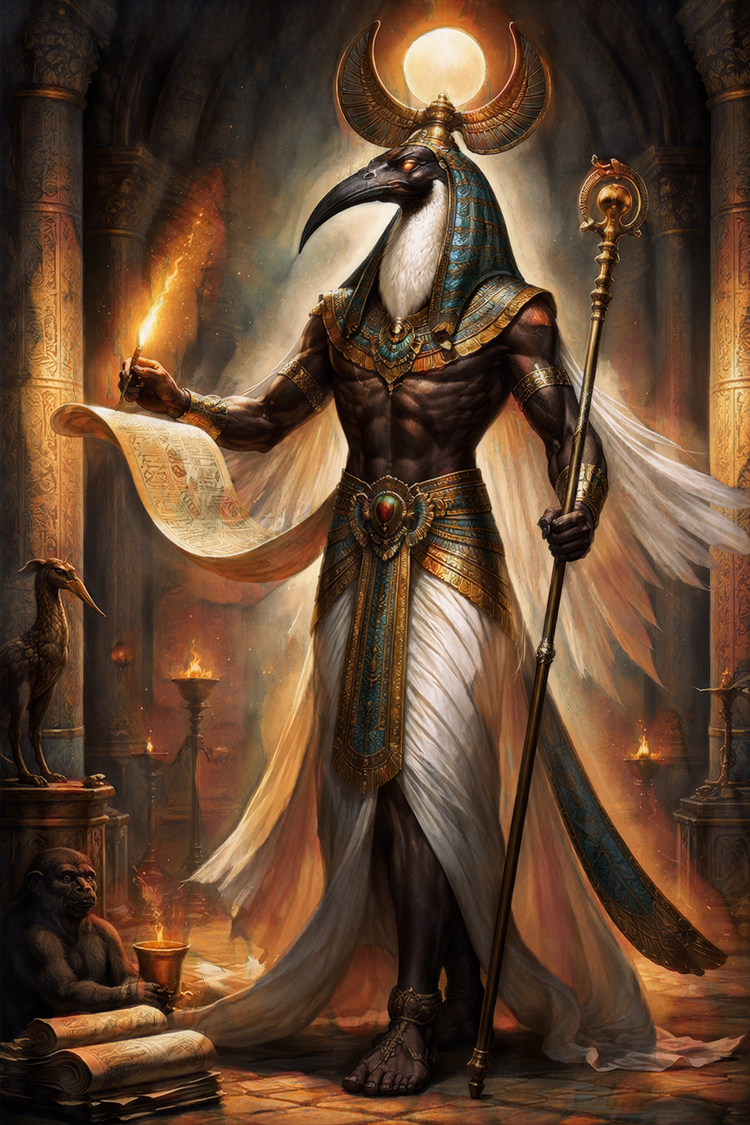
Thoth and the Architecture of Awakening
Writing, Measure, and the Recollection of the Divine Mind
Introduction
Across mythic time, Thoth has never been merely a god among gods. He is an interface. A bridge between the invisible order of things and the fragile, forgetful consciousness of the human soul. Where other deities govern forces, Thoth governs knowing itself—the grammar of creation, the mathematics of spirit, the living intelligence that allows the cosmos to be read, remembered, and rewritten. To invoke Thoth is not to summon a personality, but to enter a field of coherence where consciousness becomes legible to itself.
In a world increasingly loud with information and increasingly starved of wisdom, Thoth’s realm is not an ancient relic—it is an urgent necessity.
Thoth as Consciousness Technology
Thoth’s power does not operate through spectacle or command. It works through alignment.
As the archetype of divine intellect, sacred language, and cosmic measurement, Thoth represents the organizing principle behind reality—the unseen order that allows chaos to speak. He is the intelligence behind hieroglyph, number, rhythm, tone, and law. Where raw experience overwhelms the nervous system, Thoth introduces structure without rigidity and clarity without domination.
For the spiritual being, this is transformative.
When Thoth enters consciousness, experience begins to arrange itself. Insights stop arriving as fragments and begin arriving as patterns. Emotion becomes interpretable rather than overwhelming. Intuition gains syntax. One does not lose mystery—one gains access to it.
This is why Thoth is often associated with writing: not as record-keeping, but as soul-ordering. To write under Thoth’s influence is to let the deeper mind reveal its architecture.
The Effect on the Spiritual Being
The spiritual being does not awaken through intensity alone. It awakens through integration.
Thoth affects consciousness by stabilizing the bridge between higher awareness and embodied life. Without this bridge, awakening becomes ungrounded—visions without application, insight without coherence, mysticism without wisdom. Thoth ensures that revelation can live inside a human nervous system.
His presence sharpens discernment without diminishing compassion. It brings precision to prayer, accuracy to intuition, and humility to knowledge. Under Thoth’s influence, the seeker becomes less interested in being “right” and more interested in being aligned.
This is especially critical in modern spiritual culture, where transcendence is often pursued without integration. Thoth reminds us that enlightenment is not escape—it is clarity made usable.
Why Thoth’s Realm Belongs in Practice
To bring Thoth’s realm into spiritual practice is to invite intelligibility into devotion.
Practically, this means cultivating practices that honor language, symbolism, measurement, and reflection. Journaling becomes ritual. Study becomes prayer. Dialogue becomes sacrament. Silence becomes articulate rather than empty.
Thoth’s realm protects the seeker from two great distortions:
- Unexamined mysticism, where experience replaces understanding.
- Sterile intellect, where understanding replaces lived truth.
In Thoth’s domain, these false opposites collapse. Thought becomes luminous. Spirit becomes precise. Practice becomes a living conversation between the known and the unknowable.
This is not about worshiping Thoth as an external authority. It is about remembering the Thoth-function within consciousness itself—the capacity to translate divine impulse into coherent life.
Thoth and the Ethics of Knowing
There is also an ethical dimension to Thoth’s power.
Because he governs truth, balance, and measure, Thoth confronts the seeker with responsibility. To know is to be accountable. To see clearly is to act carefully. Thoth does not flatter the ego with secret knowledge; he disciplines it with proportion.
In this sense, Thoth is deeply corrective in an age of spiritual inflation. He asks not, “What have you accessed?” but “What have you integrated?” Not, “What do you believe?” but “What can you live?”
Conclusion: The Scribe Within
Thoth’s greatest gift is not information—it is remembering. Remembering that consciousness is not accidental. Remembering that the soul has grammar. Remembering that the universe is not mute, but written in a language the awakened mind can learn to read.
To invite Thoth into practice is to sit at the desk of the cosmos and accept the discipline of clarity. It is to let the inner scribe rise, not to control reality, but to listen well enough to transcribe it faithfully.
In this way, Thoth does not elevate us above humanity.
He teaches us how to inhabit it wisely.
Addendum: A Quiet Invocation
Before writing, before speaking, before interpreting your own experience, pause and ask inwardly:
What is seeking order here—not control, but coherence?
That question alone opens Thoth’s door.
Epilogue
Knowledge without soul fragments the world.
Soul without knowledge dissolves into fog.
Between them stands Thoth—measuring, listening, translating—
not to dominate the mystery,
but to make it livable.
Thoth and Shiva: The Grammar of Creation and the Fire of Becoming
When Divine Intelligence Meets Sacred Dissolution
Introduction
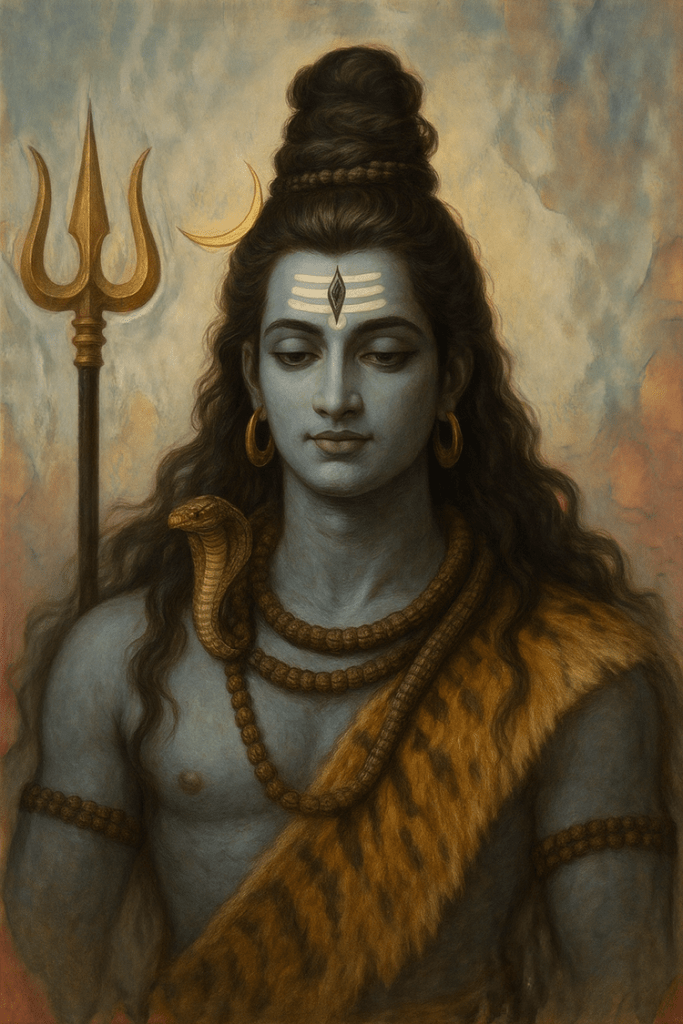
If Thoth reveals how the universe is written, Shiva reveals why it must sometimes be erased.
Taken separately, each represents an immense spiritual force: Thoth as the cosmic mind that orders, measures, and articulates reality; Shiva as the primordial power that dissolves forms, identities, and illusions so life may renew itself. But when their essences are consciously integrated, something rare and potent emerges—a transformational intelligence capable of both seeing clearly and letting go completely.
This union is not mythic ornamentation. It is a living technology for spiritual maturation.
Two Divine Functions, One Evolutionary Current
Thoth governs intelligibility. Shiva governs impermanence.
Thoth asks: What is this? How does it function? What pattern is speaking here?
Shiva asks: Is this still alive? Does it still serve truth? Is it time to burn it away?
Without Thoth, Shiva’s destruction risks becoming chaotic—ego collapse without insight, dissolution without wisdom.
Without Shiva, Thoth’s order risks stagnation—clarity without courage, understanding without transformation.
Together, they form a complete circuit of awakening:
- Thoth reveals structure
- Shiva tests it by fire
- What survives becomes truth embodied
The Effect on Consciousness: Clarity That Can Die
Most spiritual seekers lean toward one polarity.
Some accumulate insight endlessly but cling to identity. Others chase ego-death repeatedly without integrating what they learn. The fusion of Thoth and Shiva resolves this imbalance by teaching consciousness how to know without attachment.
Thoth sharpens perception so the seeker can recognize what is false, outdated, or self-serving. Shiva provides the inner force to release it—fully, finally, without nostalgia.
This creates a rare state: lucid surrender.
Here, the spiritual being can articulate truth precisely and walk away from it when the next truth arrives. Beliefs become provisional. Identity becomes fluid. Wisdom stays alive.
Thoth as Witness, Shiva as Act
In lived practice, Thoth and Shiva express themselves differently.
Thoth appears as the inner witness—the capacity to observe experience, name it accurately, and place it within a larger pattern. He refines discernment. He gives language to intuition. He prevents spiritual bypassing by insisting on coherence.
Shiva appears as the inner act—the moment when observation is no longer enough and something must end. He is the courage to stop performing a version of oneself that once worked. He is the fire that dissolves false spiritual identities, even cherished ones.
Transformation accelerates when these two operate together:
- Thoth says, “This is no longer true.”
- Shiva says, “Then let it die.”
Why This Integration Matters Now
We live in a time of spiritual excess—endless information, infinite techniques, constant reinvention of identity. Thoth without Shiva feeds accumulation. Shiva without Thoth feeds instability.
Integrating both restores ethical transformation.
Thoth ensures we understand what we are dismantling.
Shiva ensures we do not cling to what understanding exposes.
This balance is essential for mature spirituality—one that does not inflate the ego with insight nor annihilate it without purpose.
A Living Practice of Thoth–Shiva Integration
To bring their unified force into practice:
- Study deeply (Thoth) — but question every conclusion.
- Name patterns honestly (Thoth) — then release attachment to them.
- Write, reflect, and dialogue (Thoth) — allowing clarity to emerge.
- Ritually let go (Shiva) — identities, beliefs, narratives that no longer breathe.
- Trust the void (Shiva) — knowing clarity will re-form when the fire completes its work.
This is not destruction for its own sake. It is intelligent renewal.
Conclusion: The Scribe and the Flame
Thoth hands you the map.
Shiva burns it when the terrain changes.
Together, they free the spiritual being from both ignorance and rigidity. One teaches how to see. The other teaches when to release seeing itself. In their union, transformation becomes precise, humane, and irreversible.
This is not the path of comfort.
It is the path of truth that survives change.
Addendum: A Practice for Integration
Sit quietly and ask inwardly:
What am I now able to see clearly that I am afraid to release?
Let Thoth show you the answer.
Let Shiva decide what happens next.
Epilogue
Clarity alone is not liberation.
Fire alone is not wisdom.
But when understanding meets surrender,
the soul becomes both articulate and free.

 Numinous Waves