

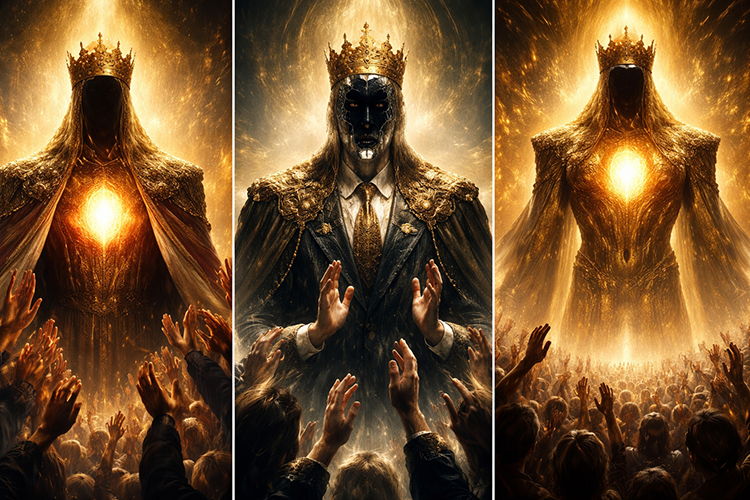
A Numinous Waves Inquiry into Shadow, Power, and the Reluctant Gift of Negative Clarity
Introduction
There are moments in history when a single figure seems to draw an entire psychic weather system around themselves. Not because they are wise, kind, or exemplary—but because they are revealing. Such figures feel less like leaders and more like exposures. They do not whisper truths; they blare distortions.
This reflection does not ask whether Donald Trump is good or bad, redeemable or irredeemable. It asks something more unsettling: What if humanity has been given a living portrait of lovelessness—not as punishment, but as revelation? What if the shock is not accidental, but diagnostic?
What follows is not a judgment of a man, but an exploration of what becomes visible when love is absent and power fills the vacuum.
Q: Is it fair—or even coherent—to say that a person can be “empty of love”?
A: Taken literally, perhaps not. But symbolically, yes. Lovelessness here does not mean the absence of emotion; it means the absence of intrinsic worth. When love is not internally anchored, the self must be propped up externally. Validation becomes survival. Attention becomes nourishment. Without inner coherence, the personality inflates to avoid collapse.
This is not unique. What is unique is how unhidden it is.
Q: Why does this particular figure provoke such visceral reactions across the globe?
A: Because he embodies traits most people work very hard to disguise—neediness masked as dominance, fear masked as certainty, emptiness masked as bravado. He externalizes what society normally conceals. That exposure triggers recognition, and recognition is uncomfortable. We react strongly not only because we see him—but because, in distorted form, we see ourselves.
Q: Are you suggesting he serves a function beyond politics?
A: Yes. He functions as a negative archetype—a living illustration of what happens when power is severed from love, and identity is severed from conscience. Archetypes don’t teach by instruction; they teach by contrast. They force clarity by exaggeration.
In myth, this role belongs to the tyrant, the false king, the hollow ruler. Their purpose is not to be admired, but to be recognized.
Q: Then why do so many people adore him?
A: Because unintegrated wounds recognize their own language. Those who feel unseen may mistake attention for love. Those who feel powerless may mistake dominance for strength. Those who feel humiliated may mistake vengeance for justice. He becomes a mirror that flatters unresolved pain.
This is not condemnation. It is diagnosis.
Q: Where does this leave moral responsibility? Isn’t there danger in spiritualizing harm?
A: There is real danger—especially if insight replaces accountability. Seeing symbolic function does not erase consequences. Harm remains harm. But understanding why such figures arise helps prevent recurrence. Moral outrage alone purifies nothing; awareness has a chance.
Shadow, when denied, multiplies. Shadow, when seen, can be metabolized.
Q: How does this become a boon rather than a contagion?
A: Only if the gaze turns inward. The moment this figure is used solely as a scapegoat, the lesson is lost. The moment one asks, Where do I demand recognition instead of offering presence? Where do I substitute certainty for humility? Where do I hunger to be right rather than whole?—the negative clarity becomes transformative.
Without that turn, the archetype replicates.
Q: Is humanity meant to outgrow the need for such figures?
A: Yes—and that may be the quiet invitation beneath the chaos. When societies no longer require exaggerated shadow to learn discernment, such figures lose oxygen. They fade not through defeat, but through irrelevance. Love that is embodied makes lovelessness unnecessary as a teacher.
Addendum: The Spiritual Risk
There is a subtle trap here. One can become addicted to condemning the loveless, which paradoxically hardens the heart. The work is not to despise emptiness, but to understand it without reproducing it. Otherwise, the critic becomes another vessel for the same force—just with different language.
Epilogue
If this moment is a mirror, then the question is not who we oppose—but what we refuse to integrate. Lovelessness exposed is not the end of the story. It is the invitation to mature beyond it.

 Numinous Waves