

Q&A Threshold
Q: Why does Human Design say I am two things at once?
A: Because you are both lived from and lived through.
Q: Which one is really me?
A: The one you think you are — and the one you’ve been all along.
Q: Why does this feel confusing at first?
A: Because awareness arrives before recognition.
Q: Can they ever come into alignment?
A: That is the experiment.
Introduction
Human Design often confuses people at first not because it is complex, but because it tells a truth most systems avoid: you are not a single-layered being. You are a convergence of consciousness and form, awareness and biology, intention and momentum. To describe this, Human Design speaks of two interwoven aspects of self — the Personality and the Design.
These are not psychological categories or metaphors. They are not “ego” versus “soul,” nor are they conscious versus unconscious in the casual sense. They are two Suns, two Moons, two perspectives operating simultaneously within one life. Understanding the difference between them is not about memorizing definitions; it is about recognizing why you so often feel divided between who you think you are and how life actually moves through you.
1. What the Personality Side Is
- Calculated at the moment of birth
- Associated with conscious awareness
- What you identify with as “me”
- The observing mind and narrator of experience
- The voice that says “I think,” “I choose,” “I decide”
The Personality side of Human Design is the part of you that woke up in this life at birth and said, I am here. It is the conscious mind, the narrator of your experience, the identity you recognize when you speak your name. This is the self that forms opinions, makes plans, remembers stories, and attempts to steer life through intention and will.
When people first encounter Human Design, they usually feel most at home with the Personality side. It aligns with how we’ve been conditioned to understand ourselves — as thinkers, deciders, actors. This is the part of you that reads a chart and says, Yes, that sounds like me, or No, that doesn’t fit. It is the lens through which meaning is assigned. But the Personality is not the driver of the vehicle. It is the one watching the road.
2. What the Design Side Is
- Calculated approximately 88–89 days before birth
- Associated with unconscious intelligence
- The body’s operating system
- How energy actually moves through you
- What others often notice before you do
The Design side represents something older than thought. It is the intelligence that organized your form before you ever took a breath — the way your nervous system processes stress, how your energy naturally moves, where you are consistent and where you are porous. It is not something you decide; it is something you are.
Unlike Personality, the Design side does not speak in words. It expresses itself through behavior, rhythms, instincts, and patterns. Others often recognize it more easily than you do. They see how you actually operate, even when it contradicts how you describe yourself. This is why Human Design can feel unsettling. It tells the mind that it is not in charge — and it never was. The Design side has been moving the body, shaping experiences, and responding to life long before the Personality could name what was happening.
3. Why There Are Two Calculations
- Personality reflects conscious incarnation
- Design reflects pre-birth imprinting
- Consciousness arrives after form is set
- Awareness does not create mechanics
- Recognition follows embodiment
The roughly 88-day difference between Design and Personality calculations is not symbolic. It reflects a metaphysical claim: consciousness enters an already organized form. The body is prepared first; awareness arrives later. This mirrors lived experience — the body reacts before the mind understands, emotions arise before explanations form, life happens before we interpret it.
Human Design insists that this sequence matters. If we try to live as the Personality alone, we end up fighting the very mechanics that carry us. When we live with the Design, awareness begins to relax. The experiment is not about becoming someone else. It is about stopping the internal war.
4. The Tension Between Design and Personality
- Personality wants control
- Design responds naturally
- Personality seeks consistency
- Design moves in patterns
- Misalignment creates resistance and exhaustion
Most suffering, in Human Design terms, comes from the Personality trying to override the Design. The mind wants certainty, agency, and predictability. The body operates on timing, response, and organic movement. When the mind pushes against this, life feels heavy. Decisions feel wrong even when they make sense. Effort increases while satisfaction decreases.
This tension explains why so many people feel they “know better” but still repeat patterns. The Design is not waiting for permission. It is already in motion. Awareness can either fight it — or learn to ride it.
5. Alignment: When the Two Begin to Work Together
- Strategy and Authority bridge the gap
- Personality learns to wait and observe
- Design leads without explanation
- Awareness deepens without force
- Life feels simpler, not smaller
Human Design does not ask the Personality to disappear. It asks it to step back into its rightful role: witness, interpreter, storyteller — not commander. Strategy and Authority are the practical mechanisms that allow the Design to lead while the Personality stays conscious.
When alignment begins, something subtle shifts. Decisions feel quieter. Life stops needing justification. You may still not understand why something works — but it does. This is not passivity; it is cooperation between awareness and form.
6. Why This Is a Metaphysical Science
- Integrates astrology, the I Ching, chakras, and genetics
- Describes mechanics, not morality
- Emphasizes experimentation over belief
- Invites lived verification
- Truth emerges through embodiment
Human Design calls itself a science not because it rejects mystery, but because it demands testing. You are not asked to believe the Design side exists. You are asked to observe whether life works better when you stop resisting it. The Personality does not surrender its intelligence; it refines it.
This is why Human Design is less about self-improvement and more about self-recognition. The experiment is not to change who you are — but to stop interfering with what already functions.
Addendum
The mind wants to know who it is.
The body already knows how to be.
When awareness stops trying to lead,
life begins to move with less friction.
Design does not explain itself.
Personality learns by watching.
This is not loss of control — it is relief.
Epilogue
At its deepest level, Human Design is not about charts or types or systems. It is about reconciliation. The moment the Personality stops trying to manage the Design, awareness softens. Life becomes less of a project and more of a participation. You are no longer split between who you think you are and how life actually moves through you. You become a witness inside your own unfolding — present, awake, and finally at home in the body you were given.
Sources and References
Ra Uru Hu — The Human Design System
Chetan Parkyn — Human Design: Discover the Person You Were Born to Be
Richard Rudd — The Gene Keys
Carl Jung — Psychological Types and the unconscious
I Ching — Hexagrammatic structure of transformation
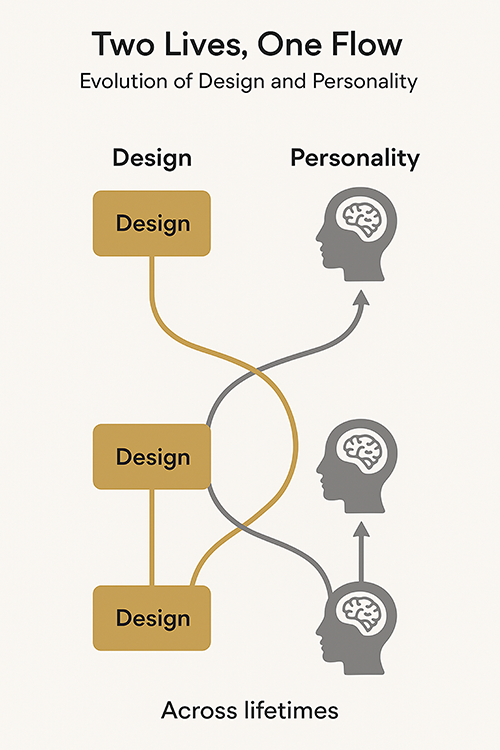
Two Lives, One Flow: Evolution of Design and Personality
Q&A Threshold
Q: Does my Design change from life to life?
A: The Form is chosen; the mechanics evolve subtly.
Q: Is my Personality really me?
A: It is a conscious fragment of the Soul experiencing this life.
Q: Can the Personality and Design evolve together?
A: Only if awareness learns to witness without interference.
Q: Why does this matter?
A: Because understanding the difference brings freedom, not dogma.
Introduction
Human Design presents the Personality and Design as fixed coordinates for a lifetime. But at the soul level, these aspects are part of a dynamic continuum. The Design, the pre-birth template of your body and energy, may subtly evolve across incarnations. The Personality, meanwhile, is the soul’s conscious fragment navigating the world through this unique instrument. Understanding this distinction illuminates both continuity and transformation: the soul is the constant; the Design and Personality are its vehicles for exploration.
1. Design Across Lifetimes
- Pre-birth calculation defines energy mechanics
- Reflects how the soul intends to live this particular life
- May shift in expression in future incarnations
- Embeds lessons the soul needs to experience physically
- Offers both boundaries and a field for evolution
The Design is the canvas the soul chooses for each life. Across lifetimes, the “palette” may remain similar or shift subtly, depending on the soul’s evolving intentions. Core themes — how energy flows, how consistent patterns are expressed, how the body interfaces with the world — tend to endure. Yet, the soul experiments: one life may require greater emotional resilience; another may demand flexibility in social interaction. The Design carries the residue of evolutionary choice, encoding the patterns most conducive to growth, embodiment, and learning.
The Design is both stable and malleable. Stability ensures continuity; malleability allows the soul to explore new ways of engaging the world without breaking the field of form. Evolution in Design is rarely dramatic. It’s subtle: timing, energy distribution, response patterns, and thresholds for stress shift as the soul experiments with different lessons.
2. Personality as an Aspect of the Soul
- Conscious awareness entering life at birth
- Fragment of the Soul in direct experience
- Learns, observes, and interprets life through this incarnation
- Evolves by witnessing Design without trying to override it
- Bridges human experience with transpersonal awareness
The Personality is the soul’s conscious ambassador. It is a facet of the soul learning through direct experience: thought, intention, reflection, and observation. Unlike Design, it carries the memory of awareness rather than the memory of mechanics. Personality is what recognizes patterns, feels emotion, makes plans, and asks why. It is the part of the soul that steps into the river of Design to swim and see where currents flow.
Across lifetimes, Personality evolves differently than Design. It is not pre-calculated in the same rigid sense; rather, it develops through lived experience. Each incarnation adds layers of observation, integration, and understanding. Personality is a living record of consciousness interacting with form, whereas Design is the record of form set to interact with consciousness.
3. How Personality and Design Interact Over Lifetimes
- Design sets the field; Personality explores it
- Misalignment in one life creates friction; alignment fosters flow
- Personality’s evolution reflects awareness, not Design mechanics
- Design’s subtle evolution reflects soul’s experimental choices
- The interplay is the laboratory of incarnation
The soul’s experiment is enacted through the dance of Personality and Design. Each lifetime presents a unique configuration of energies and consciousness. Misalignment — when Personality tries to command the Design — is a teacher. Alignment — when Personality learns to observe and respond — is liberation. Across lives, the soul gradually hones the Personality’s ability to witness the Design without interference, deepening the integration between conscious awareness and embodied mechanics.
Each life is a feedback loop. Personality evolves by seeing the Design in action. Design evolves subtly as the soul chooses new ways to experience being human. Together, they form the ongoing story of selfhood: a dual-aspect system that carries both continuity and novelty, both lessons and liberation.
Addendum
The Design is the canvas the soul paints anew in each life, subtle variations reflecting intention and growth.
The Personality is the conscious brush, learning through lived experience.
Across incarnations, soul, Design, and Personality form a triad of experiment: body, awareness, and the deeper impulse to know itself.
You are not two beings — you are two expressions of the same ongoing exploration.
Recognition of this duality is freedom.
Interference with it is suffering.
Epilogue
If the soul is the river, the Design is the channel, and the Personality is the swimmer. Across lifetimes, the channel may shift slightly, but the river flows. The swimmer may become more skillful, more fluid, more aware of currents. Understanding this is not about prediction or dogma. It is about recognizing that every choice, hesitation, and surrender is part of the ongoing orchestration of soul, body, and consciousness.
Sources and References
Ra Uru Hu — The Human Design System
Chetan Parkyn — Human Design: Discover the Person You Were Born to Be
Richard Rudd — The Gene Keys
Alan Watts — The Book on the Taboo Against Knowing Who You Are
Pema Chödrön — When Things Fall Apart

 Numinous Waves