

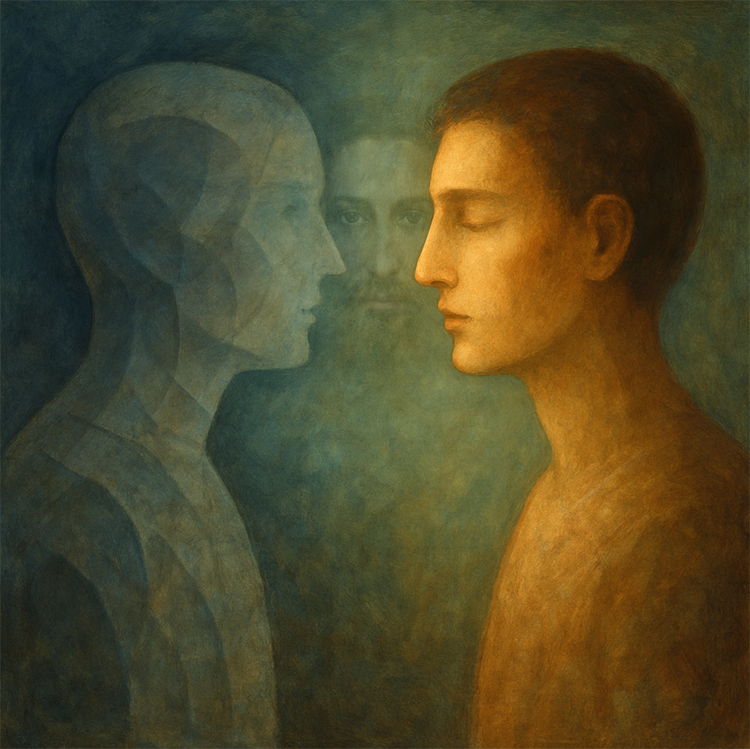
Part I — When a Living Way Became a Story
Introduction — Finding the Meaning Beneath the Season
Each December, the world pauses to celebrate Yeshua. Lights go up, hymns are sung, stories are repeated with comforting familiarity. And yet, quietly beneath the pageantry, something essential is often missed: this season is not truly about a date, a manger scene, or a perfected narrative. It is about recognition.
Christmas endures not because it marks a precise historical birth, but because it points toward a deeper question that still presses on the human heart: What does it mean to live a righteous life in a world shaped by power, fear, and story?
To encounter Yeshua honestly during this time is not to reenact the myth, but to look past it—to sense the original simplicity that his life embodied before it was shaped into doctrine, identity, and institution. This is a season that invites us not to believe more firmly, but to see more clearly.
What follows is not a dismantling of faith, but an examination of how stories—personal and collective—gradually replaced lived truth, and how the meaning of Yeshua was transformed in the process.
I. The Living Way Before the Story
Before there was Christianity, there was a life.
Yeshua did not arrive with a theology, a hierarchy, or a political vision. He arrived with a way of being that confronted every system built on dominance. His teachings were inseparable from his conduct; his words carried weight only because they were enacted in flesh.
This way was simple, but never easy. It demanded presence, courage, and continual self-emptying. There was no invitation to escape the world—only a call to meet it differently.
At its core, this living way emphasized:
- Love as an active force, not a sentiment
- Righteousness as alignment, not moral superiority
- Authority rooted in integrity, not position
- Power expressed through service, not control
Nothing about this could be safely institutionalized. It required choice. It required risk. And most of all, it required participation.
II. When Language Began to Shift the Meaning
Yeshua spoke in Aramaic—an earthy, relational language shaped by action, story, and shared life. His words were meant to move people, not define concepts.
As these teachings crossed into Greek and later Latin, something subtle but decisive occurred: verbs became nouns, processes became objects, relationships became ideas.
Meaning shifted in quiet ways:
- “The Kingdom of God” moved from a present, unfolding reality into a distant realm or future reward
- “Sin” shifted from misalignment to moral debt
- “Faith” moved from lived trust to intellectual agreement
- “Repentance” narrowed from a total life-turn into an internal feeling
These were not malicious distortions. They were linguistic accommodations. But each accommodation pulled the teaching one step further from embodiment and one step closer to abstraction.
Language did not merely translate the message—it reframed it.
III. Who Heard Him—and Why They Didn’t Write Him Down
Those who heard Yeshua most closely were not scholars or scribes. They were fishermen, laborers, women, social outcasts—people formed by oral culture rather than textual authority.
They carried memory, not manuscripts.
This matters because oral transmission preserves meaning through story, not precision through transcription. What survived first was not exact phrasing, but lived impact:
- How he treated the poor
- How he confronted hypocrisy
- How he refused violence
- How he embodied mercy without calculation
When written texts eventually emerged decades later, they were shaped by communities navigating survival, coherence, and expansion. The writers preserved truth—but through the lens of their moment.
The shift was inevitable: from encounter to narrative, from memory to meaning, from life to story.
IV. Where the Story Replaced the Way
Here is where your earlier reflection on the stories we live becomes essential.
A lived truth demands transformation. A story offers identification.
Once the story of Yeshua solidified, it became possible to:
- Belong without becoming
- Believe without embodying
- Defend righteousness without living it
The story created identity. Identity created safety. And safety dulled the original edge of the teaching.
Collectively, the story hardened into doctrine. Doctrine required protection. Protection invited power. And power reshaped the message to justify itself.
What was once a mirror became a banner.
V. How Power and Greed Entered the Narrative
When the movement aligned with empire, the teaching faced an impossible tension: a way rooted in self-emptying was now tasked with sustaining authority.
To resolve this tension, certain elements were emphasized while others were softened or deferred:
- Enemy-love became aspirational rather than essential
- Wealth warnings were spiritualized or postponed
- Humility was praised while hierarchy expanded
- Righteousness became external compliance
The cross shifted from a symbol of refusal to dominate into a symbol used to legitimize domination.
This was not betrayal by individuals alone. It was the predictable outcome of placing a truth meant for transformation inside systems built for preservation.
VI. Christmas as a Portal, Not a Performance
Seen this way, Christmas becomes something far more demanding—and far more alive.
It is not about celebrating a perfected story, but about sensing where the story has replaced the life it points toward. It invites a return not to belief, but to attention.
The question Christmas quietly asks is this:
Are we honoring Yeshua by repeating the narrative—or by living the way his life revealed?
Addendum — From Story Back to Encounter
Stories are not the enemy. They are necessary vessels. But they must remain transparent, not opaque.
The work is not to discard the story of Yeshua, but to allow it to break open again—so it leads us back to direct encounter, lived conscience, and embodied love.
When the story once more points beyond itself, it regains its power.
Epilogue — The Birth That Still Waits
Perhaps the true birth this season is not something that happened once, long ago.
Perhaps it is the birth of clarity—when story loosens its grip, when identity softens, when righteousness returns to the body.
That birth has no date. It happens wherever a life chooses truth over narrative, love over control, and presence over power.
When the Story Becomes the Self -Part Two
Part II — When the Story Becomes the Self
Introduction — The Quiet Turn Inward
After seeing how a living way became a story, there is an unavoidable next step: turning the lens inward.
Because the same process that reshaped Yeshua’s life into doctrine is the very process by which we shape our own lives into narratives we then defend. What happens on the scale of history happens first within the individual soul.
This follow-up is not about religion at all. It is about identity.
I. The Moment Experience Becomes Narrative
Experience arrives whole, unfiltered, and alive. But it does not stay that way for long. Almost immediately, the mind begins to arrange it into meaning.
This is not a flaw. It is how humans survive. Story gives coherence to chaos. It answers the question, “Who am I in what just happened?”
But a subtle shift occurs when the story hardens:
- Meaning replaces curiosity
- Interpretation replaces presence
- Memory replaces immediacy
What was once alive becomes something remembered, explained, and eventually repeated.
II. Identity as a Narrative Structure
Over time, repeated stories form identity.
We say:
- “This is the kind of person I am.”
- “This always happens to me.”
- “People like me don’t…”
These statements feel like truth, but they are compressed histories, not living realities. Identity becomes a story we carry forward, filtering each new moment through its expectations.
In this way, the self becomes familiar—but no longer free.
III. How the Story Protects Us
Stories are not only descriptive. They are defensive.
A fixed narrative:
- Protects us from uncertainty
- Shields us from vulnerability
- Prevents us from being undone by the unknown
Just as collective religious stories shield communities from existential threat, personal stories shield the ego from dissolution.
The cost of that protection is aliveness.
IV. The Substitution of Presence
Presence is demanding. It offers no guarantees.
A story, by contrast, allows us to live slightly removed from what is happening. We can observe ourselves rather than be ourselves.
This is where the substitution occurs:
- The story of being loving replaces the act of love
- The story of being awake replaces awareness
- The story of being healed replaces contact with pain
The narrative performs the role the moment asks us to embody.
V. Why This Feels Safer Than Truth
Truth is destabilizing. It asks something of the body, the heart, the will.
Stories ask only to be believed.
Once believed, they carry us forward automatically. No risk. No cost. No interruption.
This is why stories persist even when life contradicts them. They offer continuity when reality threatens change.
VI. Returning to Living Presence
Presence does not require destroying the story. It requires loosening its authority.
Living presence begins when we notice:
- When we are narrating instead of feeling
- When we are explaining instead of listening
- When we are defending instead of meeting
In those moments, life quietly waits for us to return.
Addendum — Letting the Story Breathe
The goal is not to become storyless. It is to let the story remain permeable.
A living story changes as life changes. It does not demand loyalty at the expense of truth.
Epilogue — The Risk of Being Here
To live without clinging to story is to risk being surprised by oneself.
It is the same risk Yeshua embodied—and the same risk we instinctively avoid by turning life into narrative.
Presence has no script. But it has life.
Sources & References
Historical & Linguistic Context
- Geza Vermes — Jesus the Jew
(Foundational work situating Yeshua within first-century Jewish and Aramaic culture.) - E. P. Sanders — The Historical Figure of Jesus
(Clear scholarship on what can be reliably known about Yeshua’s life and teachings.) - Bart D. Ehrman — Jesus: Apocalyptic Prophet of the New Millennium
(Explores oral tradition, literacy, and the formation of gospel narratives.) - James D. G. Dunn — Jesus Remembered
(Seminal work on oral memory and how early communities preserved meaning rather than verbatim speech.)
Language, Translation & Meaning
- Kenneth Bailey — Jesus Through Middle Eastern Eyes
(Essential for understanding how Semitic storytelling and culture shaped Yeshua’s teachings.) - Joachim Jeremias — The Parables of Jesus
(Explores Aramaic roots and how parables functioned as lived provocations rather than doctrine.) - David Bentley Hart — The New Testament: A Translation
(Highlights how theological assumptions shaped traditional translations.)
Power, Institution & the Shift to Doctrine
- Elaine Pagels — The Gnostic Gospels
(Shows how early diversity was narrowed as authority consolidated.) - John Dominic Crossan — Jesus: A Revolutionary Biography
(Examines how empire reshaped the meaning of Yeshua’s life and death.) - Walter Wink — The Powers That Be
(Insightful on how spiritual language becomes entangled with domination systems.)
Story, Identity & the Inner Turn
- Joseph Campbell — The Power of Myth
(On how stories shape identity and meaning.) - James Hillman — The Soul’s Code
(Explores how narrative becomes destiny when unconsciously lived.) - Eckhart Tolle — The Power of Now
(On the substitution of narrative identity for living presence.) - Iain McGilchrist — The Master and His Emissary
(Illuminates how abstraction replaces lived reality at both cultural and personal levels.)
Scriptural References (Contextual, Not Literalist)
- The Synoptic Gospels (Matthew, Mark, Luke), read through historical-critical and cultural lenses
- The Sermon on the Mount (Matthew 5–7) as embodied ethic rather than moral code
- Pauline Epistles as early theological interpretation rather than eyewitness testimony
Author’s Note
This reflection is shaped not only by scholarship, but by contemplative inquiry, lived experience, and direct engagement with silence, presence, and the limits of narrative. The sources above serve as guides, not authorities. The invitation remains experiential.

 Numinous Waves