

Introduction:
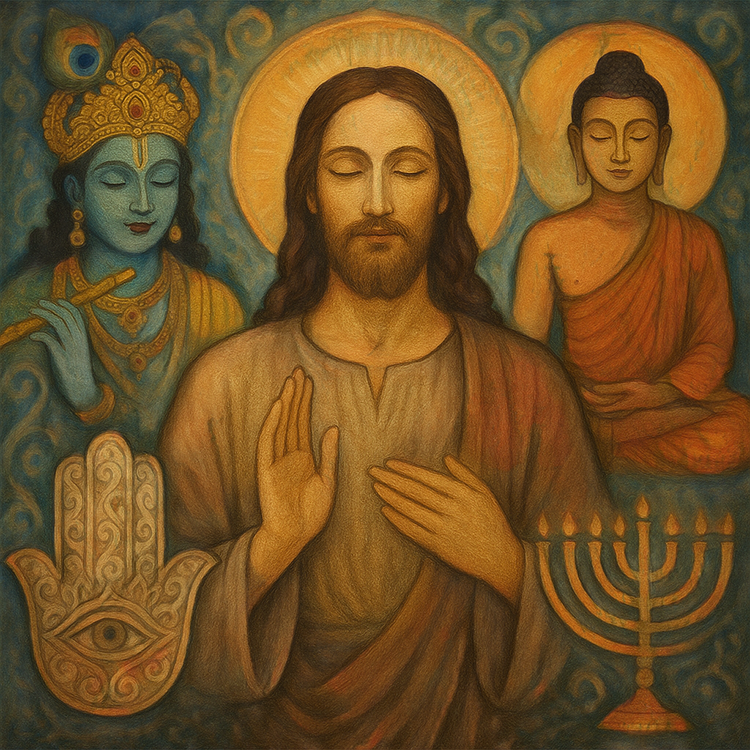
Over many months, I have combed through the known texts, histories, and mystical teachings of India, Judaism, and early Christianity to see where the threads of Transcendental Consciousness might intersect. I approach this exploration with full respect for all beliefs, fully aware that what I write is not intended to dilute or challenge anyone’s sacred convictions. Instead, it is an attempt to illuminate possibilities: ways that mystics in different lands, across millennia, might have discovered, embodied, and transmitted the same inner reality — a consciousness beyond form, history, and doctrine — to humanity. This post is an invitation to step beyond the familiar and to consider a continuity of mystical realization that flows through many traditions.
The Hebrew Scriptures vs. the Indian Mystical Texts
Question: How do we reconcile the Hebrew Scriptures with the Indian mystical texts in terms of their purpose and guidance?
Answer:
The Hebrew Scriptures and the Indian texts emerged to answer different human challenges. The Hebrew writings, rooted in survival, law, and covenant, focus on ethical living, societal cohesion, and the narrative of a people seeking guidance and protection. Their stories, commandments, and prophecies are deeply grounded in human history and communal life. They give us ways to remain faithful and just within the world, and the mystical sparks in prophets, psalms, and visions appear more as glimpses than as systematic teaching.
The Indian texts, by contrast, have always been concerned primarily with consciousness itself. From the hymns of the Vedas to the philosophical depth of the Upanishads, the Gita, and beyond, these writings explore the Self, the Absolute, and the mechanics of awakening. They present practical and contemplative technologies — methods to perceive, refine, and unite with the source of all awareness. The Gita synthesizes devotion, action, and wisdom into a living path toward realization.
Jesus’ teachings, emerging from the Jewish world, operate differently. He spoke from God-consciousness itself, not as a law-giver, prophet, or ethicist, though he certainly embodied ethics. His words — “The kingdom is within you” and “I and the Father are one” — point directly to interior states of awareness, resembling the mystical insights preserved in India. This is why the early Christian movement struggled to interpret him: a realized consciousness does not easily fit into legal or narrative frameworks.
When we examine these texts together, a clear pattern emerges: the Indian tradition maps consciousness and liberation, the Hebrew tradition preserves ethical and social guidance, and Jesus exemplifies the living union of human life with the divine interior, demonstrating that these streams are not separate but convergent reflections of the same reality.
Did Indian Mystics Reach the Near East?
Question: Could Indian mystics have traveled westward and influenced the spiritual atmosphere of the lands where Jesus lived?
Answer:
The ancient world was a lattice of trade routes, caravan roads, and coastal sea lanes connecting India with the Mediterranean. Merchants, travelers, and philosophers moved constantly, creating opportunities for cultural and spiritual exchange. Records like the Periplus of the Erythraean Sea confirm that Indian ports and Roman Egypt were in regular contact, making it plausible that ideas, texts, and perhaps ascetics could have traveled along these routes.
The Mauryan emperor Aśoka’s edicts also attest to intentional communication with Hellenistic rulers, demonstrating that Indian religious emissaries were sent westward centuries before Jesus’ time. Encounters between Greek philosophers and Indian ascetics, such as Pyrrho meeting the gymnosophists, show that philosophical and contemplative dialogue occurred. In the Gandhāra region, Greco-Buddhist syncretism created hybrid forms of art and practice, proving that cultural blending was not only possible but transformative.
While no historical evidence confirms Indian mystics preaching directly in Galilee, the presence of Indian merchants, diaspora communities, and philosophical influence in port cities like Alexandria and Antioch makes the possibility of subtle cultural and spiritual exchange entirely plausible. Even without direct contact, shared human experiences of suffering, love, and the search for truth often produce convergent spiritual insights, allowing distant traditions to echo similar realizations.
The Gnostics, Desert Mystics, and the Hidden Thread of Jesus’ Consciousness
Question: How did the mystical dimension of Jesus’ teaching survive in early Christianity, and what parallels exist with Indian mysticism?
Answer:
After Jesus’ departure, early Christian communities struggled to translate his God-consciousness into a coherent tradition. One stream, the Gnostics, preserved the essence of his realization: salvation as awakening, the kingdom as interior, and knowledge as direct experience. They recognized Jesus as a being speaking from realization, not merely as a prophet or moral teacher. Statements such as “The kingdom is within you” echo the Upanishads and the Gita in profound ways.
These mystical teachings were suppressed by the institutional church because they threatened hierarchy and control. The Desert Fathers and Mothers rediscovered the contemplative dimension centuries later, practicing inner stillness, ego-transcendence, and union with God, parallel to Indian yogic and nondual practices. Jewish mysticism, too — Merkabah visions, Kabbalistic sparks, and ecstatic prophecy — had preserved methods for connecting with God internally.
Across these traditions, a common thread emerges: consciousness as the primary terrain of realization, with ego dissolution, inner guidance, and direct experience as central. India described it systematically, Judaism preserved its glimpses, Jesus embodied it fully, and mystics across centuries kept the flame alive.
Krishna and Christ: The Mystical Convergence
Question: How do Krishna’s teachings and the Gita align with Jewish and Christian mystical insight?
Answer:
Krishna in the Gita speaks from within the consciousness of Arjuna, revealing a principle universal to all mysticism: the divine resides within. He demonstrates that God is both personal and formless, moving effortlessly between intimate guidance and cosmic revelation. This duality mirrors Jewish mystical concepts of YHVH and the divine spark, as well as Christ’s embodiment of the Logos — both historical and eternal, both intimate and absolute.
Krishna’s universal form (Vishvarupa) symbolizes the realization of God as consciousness itself, in which all beings arise and return. This resonates with Jesus’ statements about the inner Kingdom and the unity of the Father and Son. The Gita also teaches integration: selfless action, devotion, and contemplative insight converge in a single path — a blueprint found across Jewish, Christian, and Indian mysticism.
In all these traditions, the inner witness is central: consciousness as observer, presence as guide, and ego as instrument to be surrendered. Mysticism, therefore, is less about doctrine and more about awakening. Krishna, Jesus, and the mystics of Israel converge in teaching that the Divine is the consciousness that knows itself through human life, and the journey is one of realization, not mere belief.
Conclusion
Through this exploration, it becomes clear that the mystical currents of India, Judaism, and early Christianity are not isolated streams. They are reflections of a single, transcendent consciousness, expressed in different forms and contexts. Whether through the methodical introspection of the Gita, the covenantal ethics of the Hebrew Scriptures, or the lived God-consciousness of Jesus, the same reality emerges: the path to awakening is both universal and experiential, accessible to those who seek it earnestly, regardless of creed.
Addendum
In the quiet spaces between the texts, a subtle thread emerges—a thread uniting the dharmic wisdom of India with the prophetic heart of Israel. Here, the self is not a solitary point but a luminous node in a web of consciousness, and Christ is felt not as a figure fixed in history, but as a presence echoing the awakening found in all traditions. The boundaries between East and West dissolve in the inner landscape, leaving only the resonance of devotion, insight, and the trembling awareness of the infinite. In this place, prayer becomes meditation, meditation becomes recognition, and recognition becomes a gentle surrender to the ineffable mystery that underlies all form.
Epilogue
And yet, what is shared here is only an invitation, a gesture toward the vast interiors of your own soul. Perhaps the mystics of India and the prophets of Israel are not distant teachers, but reflections of your own hidden depths calling you to remember. Step into that space, even for a breath, and listen for the whisper of the eternal. Let it guide, let it question, let it unsettle—so that the bridge we trace on paper may also be walked within. Here, the soul meets itself, and all the paths converge into the quiet, radiant heart of being.
Sources Consulted:
- Eastern Texts and Traditions
- Bhagavad Gita – insights on dharma, devotion, and the cosmic self.
- Upanishads – explorations of Atman, Brahman, and consciousness beyond form.
- Yoga Sutras of Patanjali – principles of inner mastery and meditation.
- Classical Taoist writings – understanding flow, balance, and the ineffable Tao.
- Mahayana Buddhist texts – teachings on emptiness, compassion, and nondual awareness.
- Western Mystical and Philosophical Traditions
- Christian mystical writings (e.g., Meister Eckhart, Julian of Norwich) – union with God beyond doctrine.
- Neoplatonism (Plotinus) – emanation, the One, and the ascent of the soul.
- Hermetic texts – universal principles and the synthesis of spirit and matter.
- Gnostic traditions – inner knowledge (gnosis) as the path to liberation.
- Modern Comparative Sources
- Works on cross-cultural mysticism and comparative religion.
- Scholarly interpretations bridging East and West, focusing on universal spiritual archetypes.
Note: These sources were carefully considered to explore resonance across traditions. The aim is to illuminate, not to dilute or replace any individual path of belief.

 Numinous Waves