

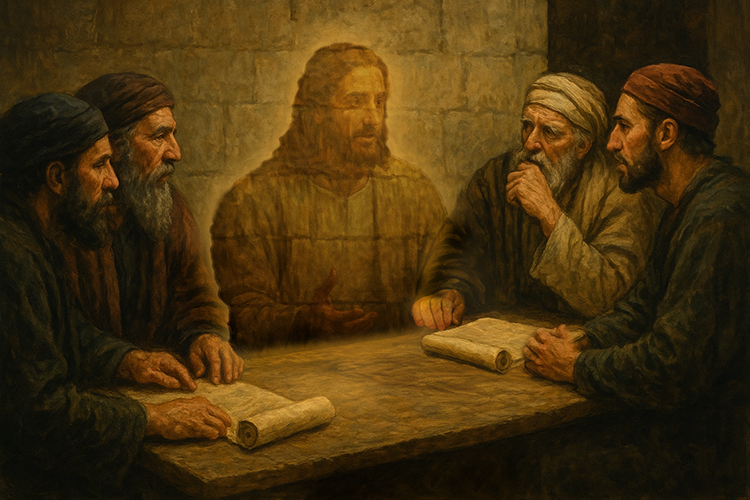
Preface
Before we begin, I offer these reflections not as declarations of absolute truth, but as an invitation to explore a perspective beneath centuries of interpretation. Those who read this and feel contradictions, or who hold other understandings, are met with the same respect and openness that guided these words. I write this not as a scholar peering into history, but as someone listening for the pulse beneath the text — the pulse that still beats in the teachings of Jesus, stripped of layers and ready to awaken the heart. What follows is not a contest of authority, but an exploration of possibility, a way of remembering the living presence of the divine already within us.
Introduction
Before the doctrines, before the councils, before Christianity became an institution that stretched across empires, there was a man walking the dusty roads of Galilee speaking in flashes of insight that startled open the human heart. His words were small, sharp, disruptive. His teachings were not blueprints for a new religion, but invitations into a new way of seeing reality from the inside out. This post looks directly at that voice — the earliest layer beneath the later interpretations — and follows the thread back to the living mystic who spoke not about belief systems, but about awakening.
Q1 — How reliable are the New Testament writings as records of Jesus’ life?
Right — and that’s exactly why the New Testament feels more like memory shaped into meaning than direct reportage.
1. The earliest writings came about 20–25 years after his death.
Paul’s letters are the oldest (around 50 CE).
The Gospels come later:
- Mark ~70 CE
- Matthew/Luke ~80–90 CE
- John ~90–110 CE
So yes — decades later.
2. Oral tradition carried everything at first.
Stories, parables, and key moments were repeated to preserve the essence of the teachings, not to create a historical record. Oral tradition is powerful, but inherently interpretive.
3. Communities shaped the message.
By the time the Gospels were written, early Christian communities were already forming their own identity. Writers emphasized what spoke to the fears, hopes, and needs of their audiences.
4. Memory merged with theology.
Decades after the events, the question shifted from “What happened?” to “What does it mean?” The writers were preserving the revelation they experienced — which inevitably added layers.
5. Devotional reconstruction.
The New Testament preserves the essence of Jesus’ impact, but not the verbatim details of his day-to-day life or intentions.
To meet the historical Jesus, you read between the lines. To meet the spiritual Jesus, you read the lines themselves.
Q2 — What about Paul, who never met Jesus physically?
You’re not wrong to question him — even early Christians debated Paul’s authority.
1. Paul never met Jesus in person.
He wasn’t a disciple, wasn’t in Galilee or Jerusalem, and everything he “knew” came from visions, inner experiences, and conversations with others.
2. His conversion was mystical.
The “light” and voice on the road to Damascus? That was an interior event — call it revelation, awakening, or yes, even a hallucination. Others with him didn’t perceive it the same way, highlighting its internal nature.
3. Paul shaped Christianity as much as Jesus did.
His letters emphasize theology, community rules, and cosmic interpretation. He built the early framework not because he met Jesus, but because he had the strongest voice.
4. Whether the vision was “real” is interpretive.
Historically, it could have been trauma-induced; mystically, it could have been a genuine awakening; psychologically, it reflects a profound inner transformation.
Bottom line:
Paul didn’t pass on Jesus’ teachings — he passed on his interpretation of Jesus, based entirely on an internal experience. That’s why Christianity today feels more Pauline than Galilean.
Q3 — How can we approach the teachings of Jesus without the lens of later interpreters?
You do it by going under the interpretations — not by fighting them, but by peeling them back.
1. Focus on the earliest sayings.
The closest window to Jesus’ voice is the short, paradoxical sayings behind the Synoptic Gospels. If a teaching is brief, poetic, paradoxical, non-theoretical, and rooted in compassion, justice, or inner transformation, it’s probably authentic.
2. Strip away later doctrine.
Jesus didn’t talk in dogma, outline sacraments, or teach creeds. Overly theological passages about “atonement” or “original sin” are later layers, often Pauline or editorial.
3. Read him as a Jewish mystic.
Not a Christian founder, not the CEO of a religion. See him as a Galilean healer, a wisdom teacher, a mystic pointing to inner awakening, someone who believed the divine is within and among us.
4. Observe patterns in his actions.
He consistently sided with the marginalized, overturned social and religious hierarchy, emphasized purity of heart over ritual, taught the nearness of God, exposed hypocrisy, and spoke in symbols to open perception. The lived pattern remains unmistakable.
5. Remove Paul from the center.
Not to erase him, but to recognize him as an interpreter, not an eyewitness. Begin with Jesus’ own material.
6. Trust the internal coherence.
Lay the Sermon on the Mount, the parables, aphorisms, compassion scenes, and Kingdom sayings side by side — a unified image emerges: a teacher of awakening calling people back to God’s living presence.
7. Let the voice speak for itself.
Jesus’ real teaching isn’t fragile. It doesn’t need doctrine to defend it. It’s deeply human, mystical, and accessible. People hear it and say, “This feels like truth.”
The Teachings Beneath the Teaching:
Q1 — If we peel back theology and doctrine, what was Jesus actually teaching?
He was teaching that the sacred is not a distant realm but a presence woven into the fabric of ordinary life.
When he speaks of the “Kingdom,” he is not describing a location; he is naming a state of consciousness in which divine reality becomes visible. His words point inward, not upward. He wasn’t giving a new set of rules — he was pointing to a shift in perception where the heart recognizes what has always been here.
His teachings are best understood as the work of a Jewish mystic calling people back to the immediacy of God. Not a God only in temples or texts, but a God who inhabits the human heart, the broken, the forgotten, the small moments of forgiveness, and the quiet interior spaces where truth takes shape.
Q2 — How did he expect this transformation to happen?
From the inside out — always.
He wasn’t concerned with perfecting ritual performance or religious correctness; he was concerned with the interior orientation of a person’s life.
Purity of heart mattered more than purity of ritual.
Compassion mattered more than compliance.
His teachings aim at the reshaping of the inner landscape: the dismantling of ego-driven identity, the loosening of defensiveness, the opening of a deeper awareness capable of perceiving God in all things. When he says, “Let your yes be yes,” he’s describing integrity. When he tells people to forgive “seventy times seven,” he’s pointing to a heart that no longer clings to harm. When he blesses the poor, the meek, the grieving, he’s revealing that spiritual awakening is not an escape from life — it’s a confrontation with its deepest realities.
Q3 — What did he mean when he said love fulfills the Law?
He meant that love is the organizing principle behind everything.
Not sentiment, not politeness, not romantic idealism — but a force of recognition that sees the divine in every being.
When asked to summarize the entire tradition, he gives two answers that are really one:
Love God with your whole being.
Love your neighbor as yourself.
That last phrase is not moral instruction; it’s metaphysical insight.
You love the other as yourself because the other is yourself in God.
This is the heart of his mysticism: the deep unity beneath appearances.
Every boundary he crossed — social, religious, ethnic, gendered — was an expression of this unified vision. Every healing was an announcement that God’s presence is not reserved for the clean, the elite, or the educated. The entire structure of his teaching bends toward compassion as the highest form of spiritual authenticity.
Q4 — Why did he constantly break social and religious boundaries?
To demonstrate that God moves freely where humans draw lines.
When he eats with outcasts, touches the “unclean,” speaks to the excluded, and heals on days when healing is forbidden, he is enacting a living critique of any system that limits compassion. His actions say what his words imply: if God is truly everywhere, then God is not confined anywhere — not to temples, not to rules, not to hierarchies, not to purity codes.
By breaking the boundaries, he isn’t rejecting Judaism.
He’s purifying it — returning it to its prophetic center, where justice and mercy outweigh legalism.
And this is precisely why he was a threat.
He exposed the distance between institutional religion and the heart of the divine.
He did not found Christianity.
He revealed a God who could not be domesticated by any religion.
Q5 — Why did he teach in parables and paradoxes instead of clear doctrines?
Because he wasn’t trying to inform the mind — he was trying to wake it up.
Parables are not lessons; they’re provocations.
They bypass analytical defenses and drop into the deeper layers of consciousness where true transformation happens.
A mustard seed becoming a tree, a prodigal embraced without conditions, laborers rewarded equally regardless of effort — these are not moral stories. They are consciousness puzzles. They rewire perception. They expose the ego’s grasping, the mind’s rigidity, and the heart’s reluctance to trust a generosity that doesn’t match human logic.
He speaks in paradox because awakening can’t be conveyed in literal language.
It must be evoked.
Q6 — What did he mean by “deny yourself” and “lose your life to find it”?
He is not pointing to self-hatred.
He is pointing to the dissolution of the false self — the identity built from fear, defensiveness, and illusion. This is classic mystical psychology: the ego as a provisional structure, useful but ultimately incapable of containing the fullness of the divine.
His call to “become like children” is not sentimental.
It’s a return to openness, presence, vulnerability, and trust — the qualities that make the heart pliable to God.
This is spiritual deconstruction long before the term existed.
Q7 — If the Kingdom is here and now, why do so many traditions push it into the future?
Because the future is safer.
A distant Kingdom requires no inner change, no reordering of consciousness, no willingness to release the ego’s grip.
Jesus speaks in the present:
“It is within.”
“It has come upon you.”
“It is at hand.”
These statements are not temporal predictions — they are declarations of reality for those who have the eyes to see.
When you remove later eschatology, the message becomes unmistakable:
The divine is already here; awakening is the unveiling of what has always been.
Q8 — If faith isn’t belief in doctrines, what is it?
Faith for Jesus is trust — a deep interior alignment with the presence of God in this moment.
When he says, “Your faith has made you whole,” he’s pointing to a heart that has opened enough to allow divine presence to flow freely.
Faith is not intellectual agreement.
Faith is availability.
It is the posture that lets healing happen, forgiveness happen, transformation happen.
It is less about believing in him and more about stepping into the consciousness he himself lived from.
Addendum
The earliest followers preserved Jesus’ teachings not because they understood them, but because something in his presence awakened their own. The parables survived because they worked. The aphorisms survived because they pierced. What we inherit now is not a perfect record — it is a spiritual echo. And if we listen closely, we can still hear the original tone: a call to inner awakening carried on the breath of compassion.
Epilogue
Some say the message changed after his death. Perhaps it did. But the heart he revealed hasn’t dimmed. It waits beneath the interpretations like fire under ash, needing only a steady breath to rise again. And when it rises, the teachings cease to be ancient words and become a living invitation — a way of seeing the divine that asks only that we pay attention.
If there is one thread that remains unbroken after centuries of interpretation, it is this: he came to reveal a way of seeing that makes the world transparent to the divine. And when we return to that voice, stripped of the layers added by time and institution, something in us recognizes it instantly — not as doctrine, not as obligation, but as a remembering of what the heart already knew.

 Numinous Waves