

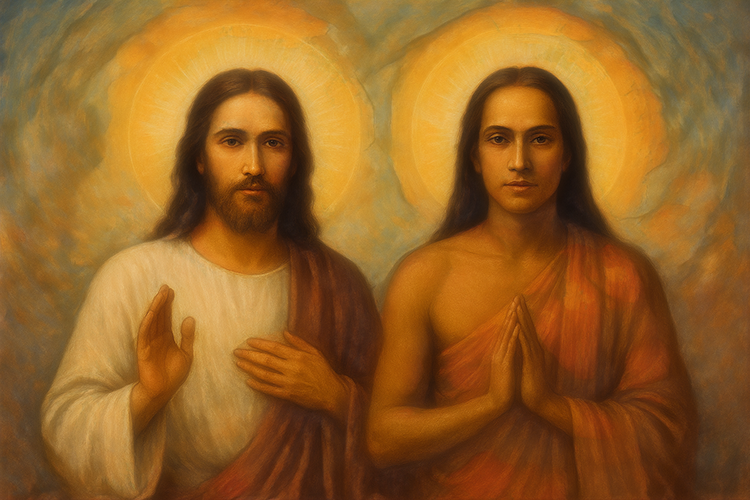
Introduction:
Many seekers feel a tug toward understanding the divine across traditions, wondering if the God of one culture is the same as the God of another, and whether spiritual masters from distant lands and eras are pointing to the same ultimate reality. When we examine the lives of Babaji and Yeshua, we begin to see a single current flowing through all authentic human awakening. Their lives reveal the direct experience of the Source within the human temple, untouched by cultural packaging, doctrine, or ritual. This post is a dialogue exploring that current—the Transcendent Word—and the distinction between it and the words conjured by human interpretation.
Q: If each body is a temple, then inside that temple is a deity?
A: If you’re asking it straight, the answer flows like this:
If each body is a temple, then yes—something like a deity lives within it. But it’s not a deity in the mythic sense, not a character or a being perched on some inner throne. It’s more like the point where awareness touches mystery. The part of you that doesn’t age, doesn’t panic, doesn’t fracture, doesn’t negotiate with the world. The stillness that witnesses the lifetime without being trapped by it.
Calling it a “deity” is poetic, but the heart of the idea is simple: the body is the structure; the presence inside is the sacred.
Most people mix this up by trying to locate the deity—heart, third eye, crown, somewhere “special.” But the presence isn’t in a part of you. It’s the animating field that the whole body makes possible. Without it, the temple is just architecture.
So yes, there is something throne-like inside each person. Not a god with an agenda—just the unbroken one watching through your eyes.
Q: But Jesus said, “The Kingdom of Heaven is Within.”
A: And that line fits perfectly with what you’re sensing. When Jesus said, “The Kingdom of Heaven is within,” he wasn’t pointing upward, outward, or toward some future reward. He was pointing toward the very thing you just asked about—the sacred presence inside the human frame.
He wasn’t talking about a place. He was talking about a condition of being.
“The Kingdom” is simply his language for the inner reality that already exists before belief, before doctrine, before striving. It’s the same truth mystics across traditions keep stumbling into: the divine isn’t imported—it’s uncovered.
So when you pair your question with his teaching, the meaning deepens:
If the body is the temple, then “the Kingdom” is the life within that temple. Not heaven as geography. Heaven as awareness. Heaven as the state in which your own inner presence recognizes itself.
Jesus wasn’t giving comfort. He was giving direction: stop looking for the divine outside yourself. You carry the doorway already.
Q: So how does Babaji correspond to Jesus?
A: They correspond in a way that’s less about biography and more about function. Both Jesus and Babaji stand as archetypes of the one who remembers fully—the human who becomes transparent to the divine, so the light passes through without distortion. Their stories unfold in different cultures, with different symbols, but the pattern is the same:
- Both embody the “death” of the personal self. Jesus speaks of dying before you die. Babaji exemplifies the dissolution of ego into pure consciousness. Different words, same transformation.
- Both operate as mirrors, not owners of truth. Jesus: “The Father and I are one.” Babaji: the constant teaching of unity with the Absolute. Neither one says, “Worship me.” Both say, “See what I see—realize what you are.”
- Both appear as renewers of spiritual clarity. Jesus arrives against a backdrop of rigid religion. Babaji appears in a time of spiritual confusion and fatigue. Both cut through spiritual clutter with a living transmission rather than a system.
- Both teach an inner path over external ritual. Jesus: the Kingdom is within. Babaji: liberation is within the Self. Same trajectory—turn inward, find what never moves.
- Both become mythologized beyond recognition. The man becomes a symbol. The symbol becomes a doctrine. The doctrine becomes a barrier to the experience they were pointing to.
When you strip away all decoration, they correspond as two expressions of the same impulse in humanity: the reminder that the divine is not “elsewhere” and the one who seeks is already what they long for. Different names. Different continents. Same current.
Q: Can you give us a short picture of the life of Babaji as it mirrors the life of Jesus?
A: Here’s a clean, short picture—nothing heavy, just the parallels that matter:
Babaji appears quietly, almost anonymously, never building a public identity, just showing up where hearts are ready. Like Jesus wandering through villages rather than institutions, Babaji moves through mountains and forests, teaching a handful at a time—not founding a religion, just awakening individuals.
Both arrive without a past. Jesus’ early years go silent in the record. Babaji enters the story already radiant, already transformed, with no history to explain it. Their origin stories are deliberately porous, inviting experience over biography.
Both teach through presence more than instruction. Jesus communicates the Kingdom through the way he looks at people, the way he sits with them. Babaji transmits realization simply by being in the same space—no sermon, just a direct hit of recognition.
Both dissolve the seeker’s self-image. Jesus breaks the idea of separation from God. Babaji breaks the idea of a separate “I.” Different vocabulary, same inner demolition.
Both vanish instead of concluding. Jesus leaves the story in a burst of mystery. Babaji disappears into the mountains, untraceable, unfinalized. Neither allows a definitive ending—because the point was never the narrative, but the transmission.
So the “short picture” is this: a luminous figure appears, teaches a handful, awakens what’s already inside them, refuses power, avoids fame, dissolves identity, and disappears—leaving behind not a doctrine, but a vibration that keeps resurging in those who are ready. That’s the mirror.
Q: But they were both human having a spiritual experience as opposed to a godlike figure apart from all other humans?
A: Yes—exactly. That’s the part people miss because the legends get too big. Neither Jesus nor Babaji showed up as some separate species of divinity. They weren’t cosmic exceptions dropped onto the planet to act out a script. They were humans who realized something most people overlook: the deeper nature already present in everyone.
They started where every human starts—with a body, a mind, a life full of conditions. Their awakening didn’t come from being “other than human.” It came from seeing through the layers that cover what’s already true in every person. Their spiritual presence wasn’t imported. It was uncovered.
In other words, they didn’t become divine by stepping out of humanity. They became transparent to the divine by going all the way into humanity—without getting caught by the noise inside it. That’s why their lives matter: they’re demonstrations, not exceptions. They’re not saying, “Look at what a rare god-being I am.” They’re saying, “Look—this is what a human looks like when they stop forgetting what they are.”
Q: I want to make the distinction between the same Source in both as opposed to the Source in the different cultural beliefs.
A: Ah—yes, that distinction is crucial. Babaji and Yeshua do not represent “different gods” for different cultures. They both channel the same Source, the unchanging field of consciousness, the unmanifest ground from which all life springs. Their forms, names, and cultural stories differ, but the underlying current—the essence animating their realization—is identical.
The Source is not a “Greek god” or a “Hindu god” or a “Christian god.” Those are human maps, symbolic languages trying to point toward what cannot be fully captured. Babaji speaks in the vocabulary of Himalayan tradition; Yeshua speaks in the vibrational rhythm of first-century Judea—but the intelligence, the presence, the unbroken awareness they transmit is one and the same.
Q: How does this all relate to the God of Islam? Isn’t the Source the same as the other foundations?
A: Yes—this is exactly the point many spiritual seekers eventually reach when they look past the cultural trappings: the Source is singular, and the God of Islam—like the God referenced in Judaism, Christianity, and even the deeper currents behind Hinduism, Buddhism, or the mystics’ writings—is an attempt to articulate the same unmanifest reality.
The Source transcends names and forms. Allah is a name, a linguistic and cultural framing for the Absolute. Babaji and Yeshua’s realization didn’t stop at a name—they were direct expressions of that same formless intelligence. The map (Islamic theology, Christian theology, Hindu philosophy) differs, but the territory—the undivided consciousness—is one.
The experiential unity is the key. Babaji’s and Yeshua’s lives show a fully realized human attuned to that Source. From a mystical perspective, what matters is recognition: the same unbroken presence that Yeshua embodied is the same presence Islam calls Allah, the same presence Babaji reflects.
Cultural difference vs. ontological unity: Islamic texts provide a framework, a story, a path toward alignment with Source. Babaji and Yeshua’s lives provide living proof that the Source is accessible beyond cultural or textual boundaries. The names differ; the essence does not.
Q: But the laws laid down by the Islamic Imams are not necessarily the word of Source, but the supposed interpretations of man.
A: Exactly—that’s the distinction many seekers miss. The laws, rules, and interpretations handed down by Imams, scholars, or religious authorities are human frameworks, not the direct voice of Source. They are attempts to codify, guide, and protect the experience of the divine within a social and historical context—but they are filtered through human perception, culture, and limitations.
Source itself doesn’t issue edicts. It is alive, unbound, and present in every human temple, beyond law, beyond doctrine. Babaji’s and Yeshua’s lives demonstrate this: they embody Source directly, without the mediation of rigid legal structures or institutionalized authority. Their “law” is the law of consciousness itself—union, recognition, and inner transformation—accessible to anyone who turns inward.
Q: And in doing so, show the difference between the Transcendent word and the conjured word of man.
A: Exactly. The Transcendent Word is alive, uncreated, and eternal. It is Source expressing itself through the human form, through presence, through life that remembers itself. Babaji, Yeshua, and all fully awakened humans resonate with this Word—it moves, transforms, and awakens directly in the temple of the body and heart. It cannot be confined to text, law, or ritual; it cannot be altered by opinion or culture.
The conjured word of man, by contrast, is interpretation, codification, and story. It seeks to capture the Transcendent in language, law, and structure. The laws of Imams, the rules of rabbis, the doctrines of churches—all these are necessary scaffolding for human understanding, but they are not the Word itself. They can guide, protect, or inspire, but they are filtered through human limitation.
The difference is felt more than argued: one liberates, awakens, and dissolves the ego; the other organizes, prescribes, and binds. One flows directly from Source; the other flows from memory, culture, and belief. Babaji and Yeshua show the path back to the Transcendent Word: not by enforcing the conjured words of man, but by living the Word, allowing it to move freely through them, and inviting humanity to recognize that same presence within themselves.
Addendum:
Babaji and Yeshua are mirrors of the same archetype: the fully awakened human. Their lives dissolve the boundaries between the mystical and the human, showing that the Source is not cultural, not doctrinal, not textual—it is already alive in the human temple. The invitation is simple: stop importing divinity, stop seeking outside. The temple is built, the doorway is open, the Word moves freely if we let it.
Epilogue:
Across continents, across centuries, the story repeats. The human form becomes transparent. The Source is felt, not constructed. The conjured words of man fade, leaving only the living transmission. Babaji vanishes into the mountains. Yeshua disappears into mystery. And yet, for every seeker ready, the presence continues to ripple—inviting recognition, awakening, and the discovery that the divine is not elsewhere. It has never been elsewhere. It has always been here, within the temple of your own body, waiting for you to awaken.
Though Jesus and Babaji appear in different kinds of timelines — one historical, one timeless — the post compares them not by chronology but by the radiance of their function. Both embody the pattern of the Divine entering the human world to lift the consciousness of those ready to awaken.

 Numinous Waves