

Introduction
We often speak of belief as though it’s an intellectual position — an opinion, a conviction, a stance. But belief lives far deeper. It weaves through our sense of self, carrying within it the need to belong, to survive, to be right, to be real. What begins as meaning-making becomes identity-maintenance. And in that fragile place where the ego meets its own uncertainty, belief hardens into certainty. Yet beneath that tension lies something profoundly human — the longing to know who we are.
Q&A Dialogue
Q: What is it about belief systems that we get so adamant about something we’re not even sure is real or factual?
A: It’s because belief systems don’t live in the intellect — they live in identity.
When someone adopts a belief, especially one tied to meaning, purpose, or morality, it becomes woven into the sense of who they are. Challenging that belief can feel like an attack not on an idea, but on the self. The nervous system reacts as though survival itself is at stake. That’s why even the most irrational claims can be defended with absolute certainty — it’s not really about the facts, it’s about belonging, safety, and the continuity of the “I.”
Beliefs also act as stabilizers in an unstable world. They offer coherence where there is chaos, narrative where there is mystery. So even uncertainty — which could lead to discovery — is often avoided because it threatens the delicate architecture that keeps life feeling navigable.
In truth, many people aren’t defending beliefs; they’re defending the comfort those beliefs provide. The irony is that the deeper one clings to the story, the further one drifts from the living mystery those stories were meant to point toward.
Q: So now, since ego is the primary force behind beliefs, let’s take a deep dive into the intertwining of the Ego and one’s belief.
A: When we speak of ego, we’re not just talking about arrogance or pride. We’re talking about the psychological construct that organizes experience — the story of “me.”
Now, here’s where the entanglement begins.
The ego’s task is to define and preserve the self. It does this through boundaries, roles, memories, and, crucially, beliefs. Beliefs are the building blocks of identity — they tell the ego what’s true, what’s safe, what’s right, and where it belongs. Without them, the ego feels naked in an infinite field of uncertainty. So it clings. Even beliefs that cause suffering can feel preferable to the ego’s greatest fear: dissolution.
This is why ego and belief often form a self-reinforcing loop. The ego needs belief to exist; belief needs ego to persist. Each validates the other’s illusion of solidity. When someone questions your belief, it’s not just an intellectual challenge — it’s a tremor in the foundation of your self-story. You’re not just defending an idea; you’re defending the very image of yourself as “someone who knows.”
Paradoxically, awakening or ego-transcendence doesn’t necessarily destroy the ego — it reframes its role. The ego becomes transparent, a useful interface rather than a ruler. Beliefs, too, become fluid — provisional rather than permanent, symbolic rather than literal. You begin to see that beliefs were never truth itself, only fingers pointing toward it.
The deepest freedom isn’t found in having the right beliefs — it’s in no longer needing them to know who you are.
Q: And the pride of being right — that is an arm of ego’s existence, isn’t it?
A: Exactly — that pride is one of ego’s cleverest disguises.
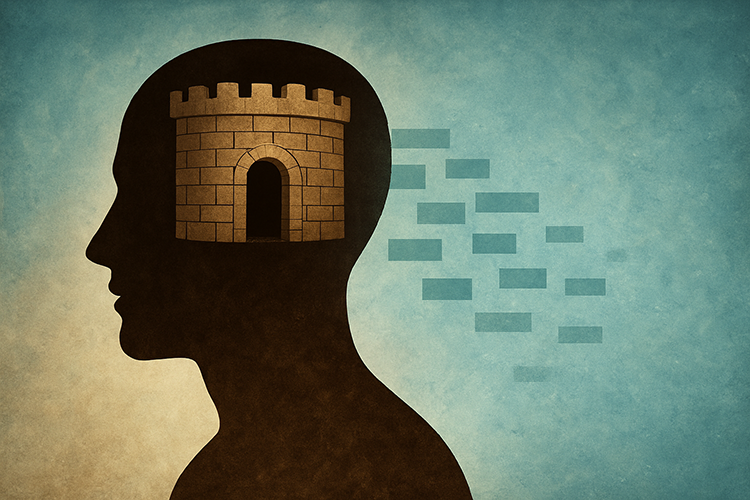
The ego’s survival depends on maintaining a sense of control and certainty. “Being right” gives it both — it reinforces the illusion that the self knows, understands, and stands on solid ground. It’s a psychological fortress built out of conclusions. Every time the ego asserts its rightness, it reaffirms its own existence: “See? I am. I know.”
This pride also feeds on comparison. It needs an “other” to be wrong, confused, or blind — because contrast sharpens identity. The ego thrives in duality: me versus you, truth versus falsehood, light versus dark. The more it can feel distinct, the more it feels alive. That’s why argument and ideology can feel intoxicating — they’re not just about conviction; they’re about self-preservation.
But here’s the quiet twist: pride is a fragile glue. The more tightly the ego clings to its rightness, the more brittle it becomes — because reality has a way of defying certainty. When the cracks appear, pride doubles down, becoming defensive, dismissive, or even spiritualized (“I’m more awakened than you”). This is the ego wearing enlightenment as armor.
When awareness begins to see this — really see it — something shifts. You start noticing that the need to be right feels tense, constricted, brittle. Whereas surrender, humility, and curiosity feel spacious, peaceful, alive. Truth begins to reveal itself not through control, but through quiet listening.
Q: I’m trying to build an inspirational narrative that won’t criticize those who are total naysayers in this area but expand the discussion with those who are on the fence about this topic.
A: That’s a beautiful and wise intention — and it changes the tone entirely.
When we stop trying to expose the ego as a villain and instead reveal it as a natural, protective function that simply overreaches its role, we invite people in rather than make them defensive. Many who are “on the fence” aren’t resisting truth; they’re protecting the fragile framework that has held their world together. So this kind of narrative works best when it’s compassionate, almost tender, toward that mechanism.
You can show how the ego, in its innocence, builds beliefs the way a child builds a fort — for safety, not deceit. Then gently unfold how, over time, those walls can become prisons if we forget why they were built. Rather than scolding pride, you can illuminate how the joy of being right once felt like security — and how the deeper peace of not needing to be right is actually richer.
The tone becomes invitational: “Haven’t we all felt that tightening when our belief is questioned? What if that tension isn’t a flaw, but a doorway?”
You turn the conversation inward rather than outward, making it about shared humanity, not sides.
When we meet ego’s grasping with understanding instead of judgment, pride begins to dissolve on its own. What remains is something pure — the mind resting in humility, the heart resting in truth.
Addendum: The Soft Light of Seeing
We built our beliefs as children build forts — from longing, not deceit.
Over time, we forgot they were temporary shelters and called them truth.
But when the light comes, it doesn’t break the walls — it reveals the openings.
Through those cracks, reality breathes.
The ego, once the architect of fear, becomes a servant of awareness.
And in the quiet after defense,
we discover that being real was always greater than being right.
Mythical Epilogue: “The Mirror and the Flame”
In the realm before memory, the gods gathered to shape the first Belief.
They forged it not as truth, but as a mirror — a way for the soul to see itself through shadow.
But Ego, curious and hungry, touched the mirror and saw not reflection but dominion.
“I am the one who knows,” it declared, and the mirror flared into fire.
The gods wept, for they knew that every flame born from Belief would burn until the seer learned to unsee.
And so, humanity walks the long arc of that fire — mistaking the warmth of conviction for the light of knowing.
Only when the mirror cools again does the soul remember: it was never meant to worship the image, but to see through it.
Sources and References
- Franklin Merrell-Wolff, Experience and Philosophy (Harper & Row, 1973)
- Ramana Maharshi, Talks with Sri Ramana Maharshi
- Eckhart Tolle, A New Earth: Awakening to Your Life’s Purpose (Penguin, 2005)
- Thomas Merton, New Seeds of Contemplation (New Directions, 1961)
- Alan Watts, The Wisdom of Insecurity (Pantheon, 1951)
- Carl Jung, The Archetypes and the Collective Unconscious (Princeton University Press, 1959)

 Numinous Waves