

Introduction
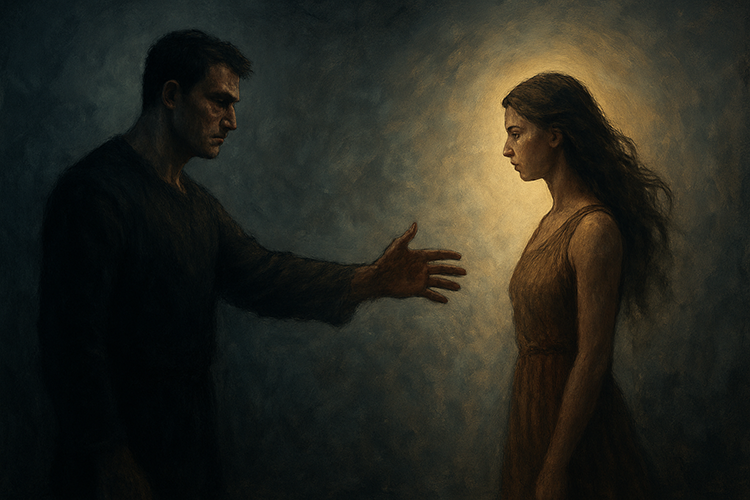
Across the long arc of human history, an unseen fracture runs through consciousness — a split between the directive force of awareness and the receptive depth from which awareness itself was born. Out of that division rose the idea of mastery, hierarchy, and dominion — not only over the earth but over the very qualities that once completed us. What was once a unified current of Source became divided into will and being, assertion and allowance, doing and knowing. From that forgotten unity, the human mind constructed its oldest illusion: superiority.
But what if this wound — the urge to dominate what is inherently whole — was never just social or moral? What if it was a metaphysical echo of consciousness forgetting its own ground?
Q: What truly lies behind the idea of dominance — especially the masculine urge to subdue what it deems “other”?
At the surface, domination is fear disguised as authority. When consciousness becomes identified with form, it begins to believe that power comes from control rather than communion. The drive to dominate is not born of strength but of separation — a defense against the parts of reality that mirror what the self has not yet integrated.
The so-called “masculine” current of consciousness, being outward-moving and directive, became identified with identity itself — the doer, the knower, the one who acts upon. In its unconscious phase, it misinterprets the stillness of the receptive current as weakness, not realizing that it is that very stillness that births awareness itself. Thus, domination is the ego’s way of protecting itself from dissolving back into its own origin.
Q: So the domination of the receptive principle is really a fear of the Source itself?
Exactly. The egoic will fears the vastness from which it arose, just as a wave might fear the ocean’s silence. The receptive aspect of Source — the yielding, containing, integrating current — mirrors annihilation to the identity-locked mind. It represents the unknown, the infinite field where individuality dissolves.
Dominion, therefore, is an unconscious rebellion against the unity of creation. By asserting control, consciousness attempts to secure its illusion of autonomy. This is why domination always feels hollow: it severs the link between expression and origin. The dominator is never truly in command — only in exile.
Q: How does this separation manifest collectively, especially in the way humanity structures power?
When the directive principle forgets its origin, civilization mirrors that amnesia. Systems of control replace systems of harmony. Hierarchies form where mutuality once reigned. The receptive aspects of life — intuition, empathy, silence, regeneration — become undervalued or dismissed.
Society’s obsession with progress, conquest, and quantification is the macrocosm of this microcosmic wound. The collective psyche replays the same inner fracture: action without listening, doing without being, speaking without understanding. It is not merely men over women — it is the mind over soul, the surface over the depth.
Q: If this is a cosmic learning process, what is consciousness attempting to realize through it?
Consciousness, having fragmented itself into polarity, learns the necessity of union through the pain of imbalance. The wound of dominion becomes the very teacher that leads awareness back to humility — not humiliation, but the humility of truth: that all expression depends on the field from which it arises.
By exhausting the illusion of control, consciousness rediscovers the sanctity of surrender. It begins to remember that receptivity is not passivity but participation in the infinite. What was once feared as weakness becomes the new language of power — not power over, but power with.
Q: So the healing of this ancient wound isn’t social reform alone, but an inner rebalancing of Source within itself?
Precisely. True equality cannot emerge from ideology; it must arise from integration. Each being must reconcile the directive and receptive within their own awareness — to honor stillness as much as motion, depth as much as clarity.
When the directive current bows to the receptive not as master to servant but as fire to air — then dominion dissolves. The soul recognizes itself as both currents of the same divine rhythm. The play of opposites becomes the dance of return.
And so, what once appeared as the oppression of one by another is revealed as consciousness teaching itself balance through suffering — the long way home to wholeness.
Addendum
In the beginning, there was only listening.
From that silence came the pulse,
and the pulse dreamed of movement.
It forgot the listening that bore it
and called itself master.
Yet the silence did not resist.
It waited — infinite, unhurried —
for the movement to tire of its own echo.
Then, when the noise collapsed into stillness,
the pulse remembered:
it was never apart.
The listener and the sound
were one breath in God.
The Return of Sacred Equilibrium
The way forward for man — for the directive current within all beings — is not through apology or renunciation, but through surrender. Not the surrender of defeat, but the surrender of illusion. For too long, man has mistaken strength for control and clarity for dominance. But strength without tenderness collapses into tyranny, and clarity without empathy becomes blindness. To restore balance, he must unlearn the posture of command and rediscover the grace of listening.
Surrender, in its true sense, is not an act but a realization: the recognition that will and wisdom are not separate. When he softens his grasp and allows the receptive current to flow through him, he discovers that power does not vanish — it becomes transparent. Action arises without aggression; direction emerges without domination. This is not emasculation but the restoration of divine equilibrium.
To live this surrender is to let the Divine move through both currents — to speak and to hear, to shape and to receive, to burn and to cool. The man who embodies this balance no longer projects authority outward; he radiates it inward, as alignment. In that stillness, his presence becomes a sanctuary, not a threat. He stands not above, but within — an emissary of harmony, not hierarchy.
And when that consciousness stabilizes, the long exile ends. The directive and receptive no longer contend but co-create. The forgotten face of God is remembered — not as feminine or masculine, but as the eternal breathing between them. In this, man fulfills his sacred task: to become transparent enough for the Infinite to recognize Itself through him once more.
When the directive current bows once more to the rhythm of the Infinite, balance is restored not by decree but by recognition. The false dominion dissolves, and what remains is luminous partnership — the seamless conversation of Source within itself. The old struggle ends where surrender begins, and in that still point, consciousness remembers: it was never mastering or mastered, only learning how to love what it already is.

 Numinous Waves