

Introduction
We live in a time where anger seems to hum beneath everything—online, in traffic, at work, even in the quiet corners of our own minds. It’s as if fury has become the default temperature of the collective soul. But what lies beneath this global tension? What is the true nature of all this noise that calls itself rage?
Q: Why are people so angry?
A: Because anger has become the most available language for pain.
Most people today aren’t truly furious—they’re overwhelmed, frightened, unseen, or disconnected, but anger is the only emotion that still feels like power. It doesn’t require vulnerability, and it momentarily disguises despair as control. In a world where few feel heard and many feel small, anger offers the illusion of significance: If I’m angry, I matter. If I shout, I exist.
Our culture rewards outrage. The digital world amplifies it, monetizes it, and mirrors it back until collective irritation feels like the pulse of society itself. Beneath that noise, though, most anger is grief—grief for lost meaning, lost trust, lost belonging. We’ve been trained to express that grief through conflict rather than communion.
If you listen closely to someone’s anger—really listen—you’ll often hear something softer beneath it: fear of being unloved, unseen, unvalued. But because few of us were taught how to voice that tenderness safely, we armor ourselves in rage and call it truth.
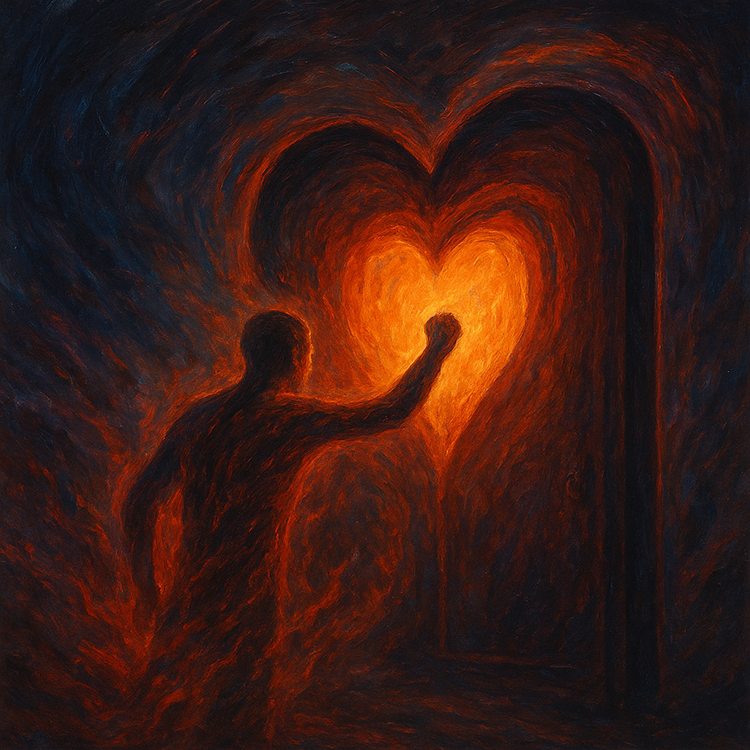
Anger, then, is not the enemy. It’s the messenger knocking wildly at the door of a heart that still wants to be healed.
Answer to the Analogy
If anger is the messenger, then the message it brings is this: “You are still capable of feeling.” It is the trembling proof that the heart has not gone numb, that something sacred within still longs to be known.
To open the door to that messenger is not to surrender to the storm, but to listen through it. When you meet your own anger with curiosity instead of condemnation, it begins to unravel, revealing the wound beneath—the heartbreak of separation, the ache for justice, the sorrow of not being seen as you truly are.
And if you can stay with that revelation—without naming it evil, without rushing to silence it—anger transforms. It no longer demands to be shouted into the world; it begins to weep into your hands. From that weeping, compassion rises—not a passive forgiveness, but a fierce, luminous understanding: that everyone’s anger is, at its root, a prayer for connection.
To hear the messenger’s knock is to remember that the world’s fury is not its hatred—it is its heartbreak. Every shout, every clash, every burning word is a soul trying, however clumsily, to say: I am still here. Please, someone, help me remember how to love.
Addendum: The Silent Medicine
In the stillness beyond reaction lies a deeper knowing—the place where anger dissolves back into the grief that birthed it, and grief dissolves into love’s original shape. This is the silent medicine: not to reject anger, but to bow to it as the last remaining proof that the human spirit still feels enough to cry out.
Epilogue: The Soul That Burns to Rise
Every soul is tested by the weight of its own becoming. Some rise through fire, others sink beneath it, yet both are written in the same script of evolution. What we call adversity is not punishment—it is friction, the heat that reveals whether the soul remembers what it truly is when stripped of comfort and illusion.
For some, anger becomes the crucible through which the false self burns away. They feel the heat of their rage until it becomes unbearable, until something ancient in them whispers, Enough—there is another way to see. In that moment of surrender, the fire that once destroyed becomes the very flame that purifies. These souls learn that true triumph is not to escape suffering but to transmute it—to turn fury into compassion, grief into wisdom, and resistance into radiant presence.
Yet others cannot bear the heat. They build walls of belief to protect themselves from the pain of growth, mistaking the echo of their defenses for truth. Their anger calcifies into bitterness, their fire devours rather than refines. These souls are not lost; they are paused—midway through remembering. Their failure to rise in one life is but the shadowed side of grace, for even the ashes are sacred. The Divine wastes nothing.
And so the soul travels on, again and again, through lifetimes of unlearning and rediscovery—sometimes triumphant, sometimes broken, always luminous beneath the debris of its forgetting. Each incarnation is another chance to open the heart’s locked door, to welcome the messenger once feared, and to realize that even in the storm, it was never abandoned by light.
In the end, there are no failures—only unfinished songs in the vast music of becoming.
Sources & References
1. Spiritual and Philosophical Works
- Krishnamurti, Jiddu – Freedom from the Known (1969).
Explores how anger and conflict arise from conditioning, and that true freedom comes from observing emotion without judgment. - Eckhart Tolle – The Power of Now (1997).
Speaks to anger as an egoic construct born of identification with pain; the stillness beneath it reveals presence. - Thich Nhat Hanh – Anger: Wisdom for Cooling the Flames (2001).
A direct teaching on anger as a form of suffering seeking understanding; mindfulness as a way to embrace and heal it. - Rumi (Jalal al-Din) – Masnavi and Divan-e Shams.
Poetic reflections on the soul’s journey through fire, emphasizing transformation through love and surrender. - Franklin Merrell-Wolff – Pathways Through to Space (1936).
His reflections on the purification of emotion and the transcendence of self-identity echo the post’s deeper soul arc. - Carl Jung – The Archetypes and the Collective Unconscious (1959).
On the shadow as the denied emotional life; anger as projection of the disowned self.
2. Psychological and Emotional Insight
- Brené Brown – Atlas of the Heart (2021).
Maps emotional language, showing anger as a protective cover for more vulnerable feelings such as shame and grief. - Harriet Lerner – The Dance of Anger (1985).
Explores anger as a signal of unmet needs and boundaries, especially in relational and societal contexts. - James Hollis – Living an Examined Life (2018).
On the soul’s confrontation with its own limitations and the necessity of adversity for individuation.
3. Mystical and Poetic Resonances
- Kahlil Gibran – The Prophet (1923).
Especially “On Pain,” which frames suffering as the breaking of the shell that encloses understanding. - Teilhard de Chardin – The Phenomenon of Man (1955).
On humanity’s evolution toward spiritual consciousness through struggle and heat—a cosmic view of adversity. - John O’Donohue – Eternal Echoes: Celtic Reflections on Our Yearning to Belong (1999).
Explores the heartbreak of modern disconnection and the soul’s desire to return to belonging. - Rainer Maria Rilke – Letters to a Young Poet (1903).
Invites the reader to embrace the difficulty of life as essential to spiritual and creative transformation.
4. Contemporary Thinkers and Contexts
- Thomas Moore – Care of the Soul (1992).
Argues that anger, melancholy, and other “dark” emotions can be sacred if approached as soul phenomena rather than pathologies. - Pema Chödrön – When Things Fall Apart (1997).
Speaks to meeting suffering directly as the heart’s training ground for compassion. - Michael Singer – The Untethered Soul (2007).
Explores the release of emotional blockages and the opening of consciousness through surrender to inner experience.
5. Symbolic Parallels
- The alchemical notion of calcinatio (purification through fire).
A metaphorical and spiritual correspondence for anger as a transformative element within the psyche. - The Bhagavad Gita, Chapter 2.63.
On how anger clouds judgment and distances the soul from wisdom—yet also provides the field for discipline and awakening.

 Numinous Waves