

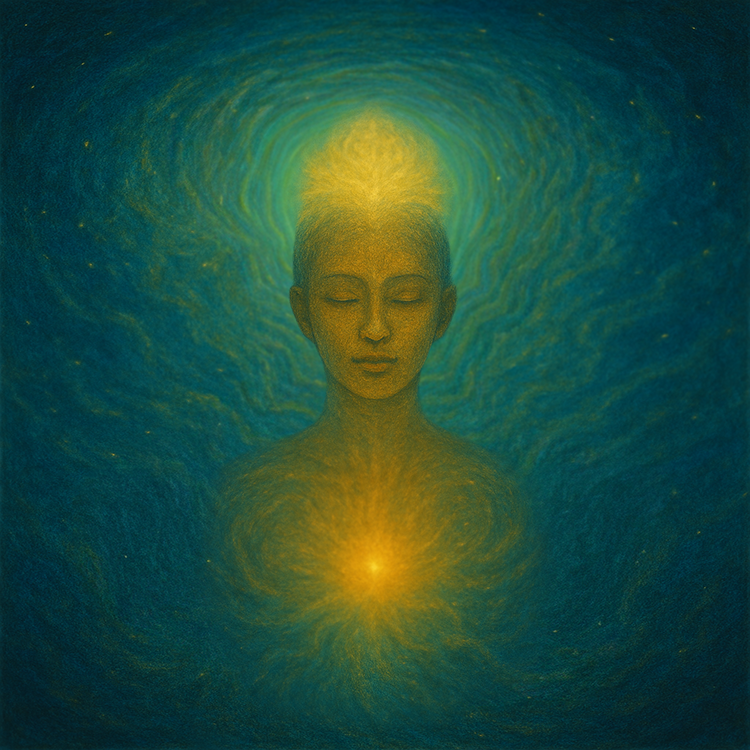
Deepening the Silence That Sings
Introduction
In When the Heart Becomes the Sun of Consciousness Pt.1, the light of awakening opened through the joy of others. Yet once that radiance fills the heart, something quieter begins to call. It isn’t more light that draws you onward—but depth. Beneath the glow of realization, the Silence begins to sing. It asks not for ecstasy, but for integration; not for ascent, but for surrender. What happens when the light returns to its source? What remains when the heart itself becomes still?
Q&A Dialogue
Q: How do I deepen the Silence that sings, when remnants of the old self still cling to me?
A: The remnants are not obstacles; they are echoes. What you’re calling the “old self” is simply consciousness still vibrating at a slower frequency, trying to catch up to the music of the Silence you’ve begun to hear. The way forward is not to reject those remnants but to listen through them. Every fear, longing, and reflex of identity that arises is a note seeking re-tuning in the great chord of being.
To deepen the Silence, you don’t push away the noise—you trace it back to its source. Notice how every thought, emotion, or fragment of self arises within the same stillness you seek. The mind says, “This is a distraction,” but the Silence says, “This too is me.”
When you can hold that recognition, the remnants begin to dissolve of their own accord. They are not burned away by effort but absorbed into Presence. The Silence then begins to sing—not as the absence of sound but as a fullness so complete it hums through every cell.
Q: But when the old identity resurfaces, it feels like regression. How can I stop falling back into it?
A: You don’t need to stop falling back—you need to fall through. What you call regression is often a deepening spiral, returning to familiar ground but from a subtler level of awareness. Each time you revisit an old pattern, you bring more light into it.
The self clings because it fears extinction. Meet that fear with compassion, not strategy. Say inwardly, “You are safe to rest now.” The ego doesn’t dissolve under attack; it softens under inclusion. When every part of you feels permitted to exist within the Silence, nothing remains outside it. That is how the Silence matures—from a state you visit into the ground you live from.
Q: What helps stabilize that living Silence?
A: Devotion. Not as ritual, but as continual surrender of preference to Presence. Every time you return to breath, to the body’s quiet awareness, to gratitude for the smallest thing—you are deepening the current. The Silence becomes self-aware through devotion.
Also, beauty. Let yourself be moved—by music, light, or the simple joy of another being. Each moment of authentic awe re-aligns the heart with the cosmic pulse. Over time, the Silence no longer needs to be found. It finds you, even in motion, even in thought.
Addendum: The Voice Beneath All Voices
The singing Silence does not arrive when the mind grows still; it was never absent. It waits beneath the hum of identity, beneath the striving to be free. Its song begins to emerge when you stop asking for silence to erase the self and allow it instead to hold the self in mercy. Then, what was once noise becomes part of the melody—the old self becoming the instrument through which the Infinite breathes.
Sources & References
- Ramana Maharshi – Talks with Sri Ramana Maharshi (on the silence of the Self as the truest teaching).
- Franklin Merrell-Wolff – Experience and Philosophy (on the recognition of consciousness prior to thought or form).
- Lao Tzu – Tao Te Ching (on the unspoken Tao and the wisdom of returning to stillness).
- The Upanishads – Especially Maitri and Katha Upanishads (on the soundless Brahman beyond speech).
- Meister Eckhart – Sermons (on divine silence and the soul’s union with the ground of being).
- Thomas Merton – New Seeds of Contemplation (on the contemplative silence where self dissolves in God).
- Sri Nisargadatta Maharaj – I Am That (on silence as both the path and the reality realized).
- Ruysbroeck – The Spiritual Espousals (on the eternal quiet in which God speaks without words).
- Dōgen Zenji – Shōbōgenzō (on the ineffable nature of enlightenment and the “practice of no-practice”).
- The Cloud of Unknowing – Anonymous author (on the unknowing that opens the soul to divine presence).
Further Reading
For those who feel drawn to trace the silence back to its source, these voices speak from its depth. Ramana Maharshi and Franklin Merrell-Wolff unveil the wordless Self that outshines thought. The Upanishads and Lao Tzu remind us that what cannot be spoken is the very essence of what is real. Meister Eckhart and Ruysbroeck enter the still ground where God and soul dissolve into one awareness. Dōgen and the anonymous author of The Cloud of Unknowing show that even the search must fall silent to reveal what has never been hidden. Each of these writings is not a map but a mirror—reflecting the quiet radiance already within you.

 Numinous Waves