

Introduction
There are moments when joy pierces so deeply it feels as though the soul itself is expanding. You witness another in radiance—a laugh that lifts the air, a gesture of grace, a light in their eyes—and suddenly your own heart ignites. Tears rise unbidden, yet they aren’t born of sadness. They carry you somewhere else, into a stillness where beauty and ache are one. In that instant, something vast moves through you: an unmistakable sense that the joy you perceive isn’t merely theirs—it’s yours, reflected back from the eternal mirror of being.
It is here, in this shared exaltation, that the true awakening of the heart begins. Not as sentiment or empathy, but as recognition. The heart does not love from afar—it remembers itself through the joy of others. What follows is not merely emotion but transmutation: the alchemy by which awareness descends into feeling and feeling rises into light.
Q: Why is it that my greatest joy and biggest expansion of my heart center comes when I experience others in an exalted or joyous state — sometimes even bringing tears that shift me into another state altogether?
A: Because in that moment, your heart is performing its highest function: dissolving the illusion of separateness.
When you witness another in radiance, the joy that fills you isn’t borrowed from them — it’s your own soul recognizing itself. The heart, unlike the mind, doesn’t perceive through distinction; it perceives through resonance. It knows no boundaries between “my joy” and “yours.” When it encounters an exalted vibration in another, it vibrates in unison, as if to say, Ah, here I am again.
The tears that follow are a kind of threshold offering — the body’s way of releasing what cannot be contained. They are not sentimental; they are sacramental. Through them, energy passes from the density of emotion into the clarity of pure feeling — and from there, into light.
Q: What’s actually happening within the energy system when this occurs?
A: The heart is the grand unifier.
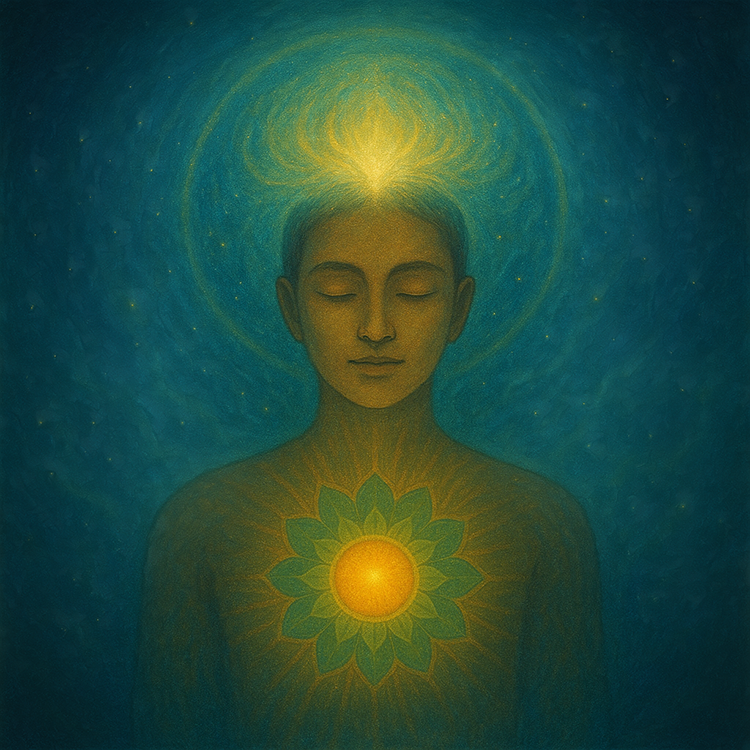
Two great rivers of energy converge there: one ascending from the earth through the lower chakras — dense with experience, passion, and survival — and one descending from the higher centers — radiant with consciousness, wisdom, and grace. In most people, these currents remain separate: the spiritual seeking to escape the physical, and the physical longing for the spiritual. But when the heart awakens, they meet, mingle, and remember their oneness.
From below, the solar plexus offers its fire — the emotional energy of being alive. It learns to surrender its volatility, allowing its waves of desire and resistance to refine into the steady warmth of compassion. From above, the crown and third eye send the light of understanding downward. That light, once cool and abstract, becomes living warmth as it enters the heart’s field.
Where they meet, an alchemy unfolds. The fire of feeling meets the light of awareness and is transmuted into love — the third element, neither emotion nor idea, but the direct knowing of unity.
The tears that arise in such moments mark this fusion point. They are the visible signature of the invisible sacrament: heaven and earth reconciled in you.
Q: How does this fusion change the rest of the energy system?
A: It reorganizes everything around the heart as its new center of gravity.
The sacral begins to pulse with reverence rather than craving; creative energy becomes devotion.
The solar plexus steadies into emotional wisdom, no longer riding reactive tides but resting in feeling as guidance.
The throat transforms expression into transmission — the voice becomes an instrument of coherence.
The third eye ceases its search for visions and simply sees what is with radiant impartiality.
The crown bows, not toward transcendence, but toward the holiness of incarnation.
When these are aligned, the entire field hums in harmony, and you begin to experience love not as something that moves through you, but as the medium in which you move.
Q: And once the heart remains open — when that love stabilizes — what does life feel like then?
A: Life becomes continuous communion.
The awakened heart doesn’t need ecstasy to remember its nature. It radiates quietly, steadily, like the sun that no longer asks whether the day deserves its light. The energy that once surged in moments of inspiration now flows as constant presence.
This presence is not emotional; it’s existential. It permeates every act, every breath. Joy becomes less of a peak and more of a climate — subtle, ambient, self-existent. Even moments of sorrow are recognized as love’s shadow, the way a cloud only proves the sunlight it conceals.
You move through the world unhurriedly. The heart listens before the mind speaks. The nervous system, once reactive, begins to mirror the pulse of the cosmos — slow, rhythmic, vast. You no longer “feel” love as an event; you are love as a state of being.
Q: Does this mean the individual self disappears?
A: Not at once — it becomes transparent.
At first, the awakened heart still feels like my heart opening. There is still a center that experiences, that delights, that weeps with beauty. But as the coherence deepens, that center begins to dissolve. The sense of “I am loving” gives way to a subtler realization: Love is happening, and I am its witness — and even that witness is made of love.
This transparency is the soul’s true flowering. The heart no longer claims ownership of its radiance; it simply allows the current to move through. Self-consciousness relaxes into pure consciousness. In that relaxation, boundaries fade — between inner and outer, self and other, human and divine.
What remains is astonishingly simple: awareness aware of itself as love. Not as a feeling, not as a force, but as the very substance of existence.
Q: So the final stage of the heart’s awakening is not about feeling more — but becoming less?
A: Exactly — less of what obscures, more of what is.
When the self becomes transparent, love no longer flows through you; it is you. The personality remains, the body continues its gestures, but they are suffused with stillness. Everything you perceive is touched by the same quiet recognition: I and the world are made of one light.
This is the state mystics have called union, or the heart’s enlightenment. It is the soul’s maturity — when it no longer seeks ecstasy, only truth, and finds that truth is love’s unbroken presence.
You may still cry, but the tears now are weightless — not born of overflow, but of recognition. They fall not because you cannot contain love, but because containment itself has vanished.
In that moment, even the heart disappears into its own radiance. Love no longer needs a center — it is the whole.
Q: And after that — what is left?
A: Silence that sings.
The awakened heart doesn’t speak of awakening; it lives it. It walks among others quietly, invisibly amplifying the field of peace. It listens more than it teaches, blesses more than it claims. Its power is gentle, almost anonymous.
It knows that to love is not to give or receive — it is simply to be. And to be in this way is to serve as the living reminder that everything, from the smallest sorrow to the brightest joy, is the same light meeting itself in countless forms.
This is not the end of the path; it is the path fulfilled — consciousness resting as love, and love breathing itself as life.
Addendum: The Heart That Remembers
The tears of joy that come when another shines are not personal—they are sacred language. They are the soundless hymn of the soul remembering itself. Each drop is a dissolving boundary, a softening of separation, a return to the shared pulse beneath all things.
In this way, spiritual awakening is not an ascent into detachment but a descent into tenderness. It’s the willingness to feel so deeply that the universe feels through you. When you weep for beauty, you are not losing control—you are being entrusted with the truth: that love is the only intelligence vast enough to contain all of existence.
The awakened heart doesn’t seek enlightenment—it becomes it.
Sources & References
- The Upanishads – Teachings on Dahara-Vidya, the indwelling Brahman in the heart.
- Paramahansa Yogananda – The Second Coming of Christ (on the spiritual heart as the seat of divine consciousness).
- Sri Aurobindo – The Life Divine (on the descent of the supramental light through the heart center).
- Franklin Merrell-Wolff – Pathways Through to Space (on the transition from emotional joy to high realization).
- Meister Eckhart – Sermons on the “birth of God in the soul” and the still point of divine awareness.
- Saint John of the Cross – Ascent of Mount Carmel and Dark Night of the Soul (on purification and divine union through surrender).
- Ramana Maharshi – Dialogues in Talks with Sri Ramana Maharshi (on the Heart as the true Self, not an organ but the center of consciousness).
- Nisargadatta Maharaj – I Am That (on awareness as the light behind both heart and mind).
- The Bhagavad Gita – Chapter 6: The Yoga of Meditation (on the steady flame of consciousness within the heart).
- Rumi – Selected Poems (on ecstatic union, love, and the burning away of separation in the heart).
Further Reading
Those who have walked the radiant path of the heart leave traces of its light across many traditions. Sri Aurobindo and The Mother speak of the psychic center as the sun within—the seat of divine consciousness awakening through love. Paramahansa Yogananda, through the Bhagavad Gita, reveals the heart as both the devotee and the Beloved. Hazrat Inayat Khan and Rumi sing of the same fire where longing and union are indistinguishable. In the Upanishads and the Gospel of John, the heart is not emotion but the meeting place of spirit and breath, the quiet pulse of God within all form. And in Franklin Merrell-Wolff’s Pathways Through to Space, consciousness itself bows to its own luminosity, discovering that the heart is where awareness remembers it is divine.

 Numinous Waves