

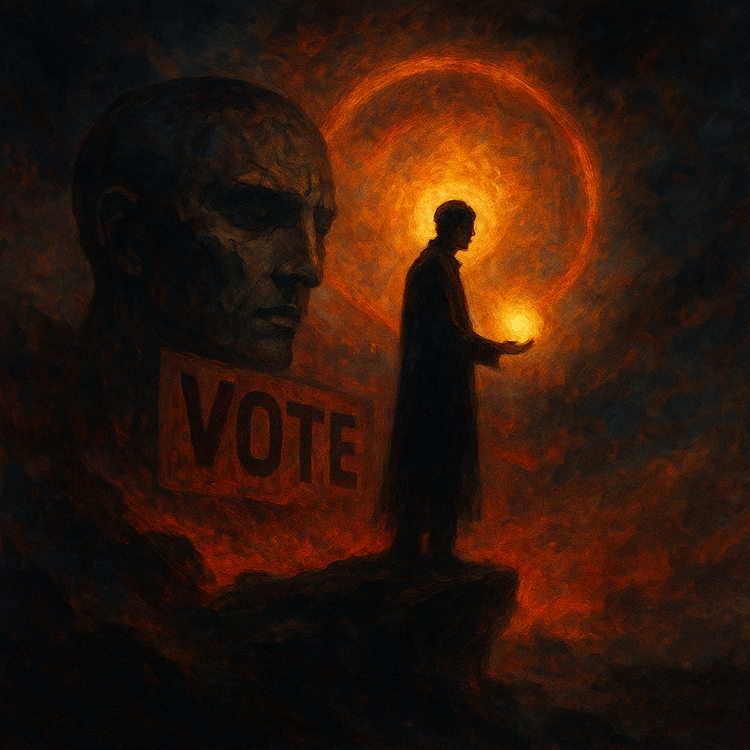
We live in a time when politics often disguises itself as faith. The lines blur: belief hardens into dogma, leaders take on the weight of prophets, and loyalty replaces truth. To understand this moment, we must look not only at power but at the spiritual hunger beneath it. For what masquerades as politics is often the same impulse that once bound tribes in temples, myths, and sacred fires.
Q: Why do people cling so fiercely to political myths, even when reality contradicts them?
Because belief is not merely about facts—it is about identity, belonging, and survival. Political myths function like sacred stories: they anchor the self within a community, explain the world in simplified terms, and promise redemption through loyalty. To question them is to risk unraveling not just an argument but an entire meaning-structure.
This is why contradictions do not break the spell. A lie can be obvious, yet if it protects the group’s cohesion, it feels more trustworthy than truth. Belief here is less about accuracy than allegiance. People cling because letting go feels like stepping into nothingness, with no tribe, no certainties, no protection. And so loyalty hardens where logic cannot.
Q: Isn’t this the same dynamic we see in religious faith?
Yes. The mechanisms are nearly identical. In both religion and political devotion, the leader becomes a prophet or a messiah-like figure, embodying the hope of the people. The movement transforms ordinary loyalty into sacred duty. Outsiders are cast as heretics, enemies, or forces of darkness. Every struggle is dramatized as a cosmic battle between good and evil.
What results is not reasoned debate but faith-based fervor. Doubt is demonized; questioning is betrayal. The leader’s words become scripture, even when inconsistent. The system thrives not because it reflects truth but because it fulfills the primal human need for clarity, certainty, and belonging. What begins as politics ends as religion.
Q: What happens when cracks appear in that salvation story?
The crisis of faith arrives. Every system that demands absolute loyalty eventually collides with reality: promises fail, contradictions multiply, leaders falter. The believer is forced into painful dissonance. Do they admit the illusion, or double down to preserve identity?
This is why disillusionment feels less like a change of opinion and more like a spiritual collapse. Just as early religious communities wrestled with failed prophecies, the politically devoted face a reckoning: was everything I believed a lie?For many, this is unbearable, and they cling tighter. For others, the cracks widen, and light begins to enter. But the process is traumatic—like watching the ground beneath you dissolve.
Q: Leaving such devotion must feel like exile.
It does. To leave is not simply to alter a worldview—it is to lose a home. The old language no longer fits, the old community no longer welcomes, and the old certainty no longer shelters. Those who depart often face mockery, shunning, even rejection by family and friends.
Exile is the wilderness. It is the place of unknowing, where identity is stripped and certainty cannot be reclaimed. Yet exile is also holy ground. In mysticism, exile often precedes illumination: the dark night of the soul, where everything collapses so something deeper can emerge. Politically, too, exile can become initiation—if one endures the loneliness long enough to find a truer ground of belonging.
Q: Can someone escape this kind of brainwashed devotion if they’re still tied to the ego?
Yes, though the path is paradoxical. The ego is often what binds a person to ideology, but it can also be the very tool that sets them free. Ego clings to identity, loyalty, and story—but it also resists betrayal, hypocrisy, and humiliation. When reality clashes with the myth, ego feels the sting: I have been lied to. I have been used. I deserve better.
Escape often begins in such egoic wounds—anger at deception, shame at complicity, pride refusing to be humiliated. At first, this is still ego, not enlightenment. But it creates a fissure in the wall of belief. Through that fissure, doubt, compassion, and truth can begin to seep in.
The danger is that ego may simply seek another idol, another tribe, another absolute to cling to. But even then, the pattern is breaking. Over time, if compassion deepens and curiosity grows, ego softens. It becomes translucent. The person still says “I” but recognizes that not everything revolves around it. At this threshold, indoctrination no longer holds its power. So yes—it is possible. Escape can begin even within ego’s grasp, and from there, the deeper work of freedom can unfold.
Q: And is there hope, in such a time of shadow and distortion?
There is hope, but not the shallow kind that denies reality. Hope is not the dismissal of darkness—it is the recognition that light persists even within it. Illusions may dominate the surface, but they cannot destroy the soul’s innate sense of truth. That inner spark remains unclaimed, waiting for the moment to reassert itself.
The heaviness of this age is itself evidence that awareness is sharpening. People feel the weight of falsehood more acutely because the soul cannot be entirely deceived. Every collapse of illusion, however painful, is also a revelation: it shows that the lie cannot hold forever.
Hope rests in the resilience of the human spirit. No ideology, however totalizing, has ever succeeded in extinguishing the flame of conscience. History bears this out: ages of darkness have come and gone, and yet light has returned, again and again.
So yes, there is hope—not in the fantasy that a new savior will arrive, but in the truth that awakening spreads quietly, soul by soul. The storm of illusion may rage, but the deeper current of truth cannot be silenced. Darkness is vast, but it is not endless.
Addendum
Every age of illusion is also an age of initiation. What we endure now may not be a permanent descent, but a trial—a collective dark night in which discernment is forged. If politics has become religion, the task is not to abandon belief altogether but to refine it. To strip away false prophets, to dissolve idols, to remember the quiet authority of the soul.
The truest allegiance is not to any leader, tribe, or myth, but to the inner flame that knows what cannot be faked. In times like these, that flame is the most radical act of resistance, and the most luminous source of hope.
Resources & References
- Weber, Max. The Sociology of Religion.
- Durkheim, Émile. The Elementary Forms of Religious Life.
- Arendt, Hannah. The Origins of Totalitarianism.
- Merrell-Wolff, Franklin. Experience and Philosophy.
- Fromm, Erich. Escape from Freedom.
- Campbell, Joseph. The Hero with a Thousand Faces.
- Janeway, William H. “The Politics of Belief.” Project Syndicate, 2019.
- Lifton, Robert Jay. Thought Reform and the Psychology of Totalism.

 Numinous Waves