

Introduction
Labels like Left and Right carry more psychic weight than most people realize. They aren’t just political identifiers; they are identity-markers that burrow into the psyche, creating entire filters through which reality is perceived.
Here’s the danger:
- Labels collapse complexity.
Human beings, societies, and ideas are multifaceted, yet the psyche finds comfort in binaries. Left vs. Right reduces nuanced thought into combat categories—friend or foe, ally or enemy. Once you self-label, you unconsciously prune your perception to match the team you’ve joined. - Labels solidify ego-identification.
When someone says “I’m Left” or “I’m Right,” it quickly shifts from holding views to being those views.Criticism of ideas then feels like an attack on the self. The psyche builds fortresses of defensiveness, and dialogue collapses into tribal warfare. - Labels polarize the inner life.
We internalize the same divides we project outward. A person identifying strongly with one pole often represses the qualities associated with the other. For example, someone on the Left might repress the archetypal energies of tradition, order, and authority; someone on the Right might repress creativity, inclusivity, or fluidity. But these qualities exist within everyone. The danger is splitting the psyche against itself. - Labels invite manipulation.
Political strategists and media know these terms trigger deep emotional currents. By activating “Left” or “Right” loyalties, they can bypass rational thought and hook into the tribal psyche. Once captured, a person’s sense of identity is less their own and more a programmed response. - Labels block the path of the soul.
Spiritually, truth is never confined to a party line. If the psyche clings to a label, it becomes harder to hear the quiet voice of conscience, intuition, or direct knowing. The soul is nuanced, paradoxical, and expansive—it doesn’t speak in hashtags or team colors.
In short: the psyche becomes smaller when it wears a label. What was once a whole spectrum of possibility gets reduced to a pre-approved range of acceptable thoughts and emotions.
And so the questions follow: Did the Founding Fathers foresee this kind of division? Was there divine timing behind their arrival in history? Why does modern language lack the power of theirs? And what happens when belief itself collapses under truth’s weight?
Q: Did the Founding Fathers anticipate the division among American society while developing the ideals of the Constitution and the Bill of Rights?
A: They did anticipate faction. James Madison, in Federalist No. 10, warned about the dangers of factions and how they could undermine the unity of the Republic. Their solution was not to eliminate division—an impossible task—but to design a framework of checks and balances that could withstand it.
What they could not have foreseen is the amplification of division by mass media, technology, and global-scale influence. The mechanisms they designed worked well for human-scale politics, but today’s machinery of polarization goes far beyond what they imagined.
Q: Is there a spiritual determination that focuses on the egoic purpose of taking sides?
A: Yes. The ego thrives on identification. To take a side is to say, I am this, not that. It feeds the illusion of solidity: “I belong, I have worth, I am right.” But spiritually, the soul longs for wholeness, not division.
When the ego insists on sides, it hardens the psyche and narrows perception. Taking sides becomes a kind of spiritual contraction. Yet, paradoxically, this tension can also be a teacher. By clinging and defending, the ego eventually reveals its own fragility. And in that moment, the soul is invited to see beyond the illusion of polarity and into the field where truth has no opposite.
Q: Do you think that in some way it was Divine intervention that placed the Founding Fathers on earth at that specific time in history?
A: From one view, they were products of their time—men steeped in Enlightenment philosophy, classical history, and the lived experience of empire and revolution. From another, their presence does feel divinely timed.
History often leaps forward when certain souls appear to voice what humanity is just barely ready to hear. Spirit moves through moments, and those moments call forth instruments. The divine may not have been in the men themselves alone, but in the convergence of conditions that allowed their vision to take root. Imperfect though they were, they became vessels for a light that reached further than their own age.
Q: The language of the Preamble to the Constitution is so eloquent and powerful. That language doesn’t exist in today’s political speech. With the exception of Abraham Lincoln, John F. Kennedy, Martin Luther King Jr., and Barack Obama, few voices since seem to match the eloquence of those during the forming of our Constitution. Why is that?
A: The Founders drew upon both Enlightenment reason and the Biblical cadence of sacred speech. Their words carried the weight of philosophy and scripture alike, written with the consciousness that they were addressing not just their peers, but posterity. Their language was meant to echo in eternity.
Today’s political speech, by contrast, is often transactional—engineered for persuasion, brevity, and media cycles. It is rarely written with the expectation of being remembered for centuries. Lincoln, King, and Obama tapped into that older current, and their words endure because they, too, spoke from a timeless depth.
The culture itself has shifted. A society addicted to speed and spectacle has less patience for the slower, soaring eloquence that once stirred the soul.
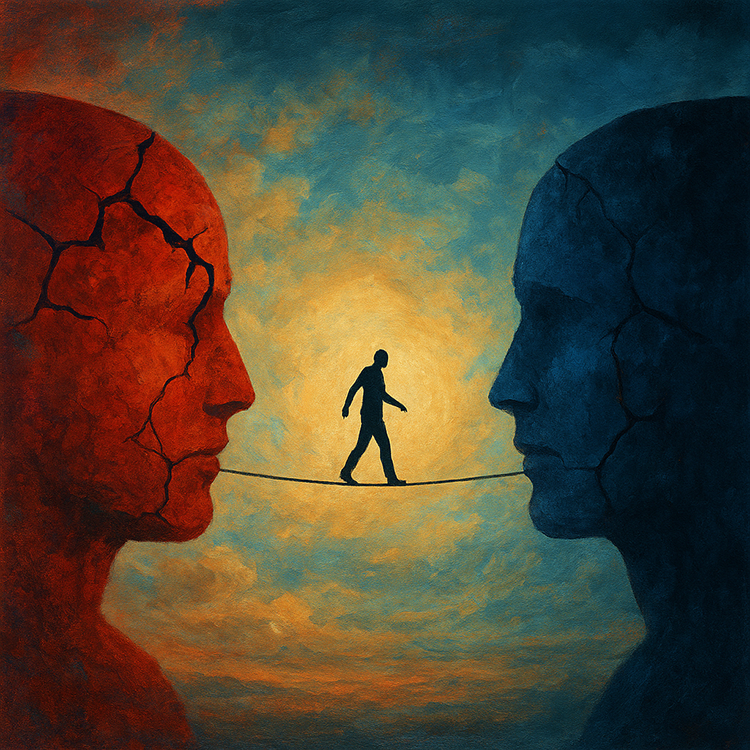
Q: We know that one’s belief system is indelibly burned into one’s experiences and expectations through life. And when proof is brought to bear that shatters that belief, it can be totally destructive to the ego’s need for being credible. It can also be a huge opening for freeing oneself from that part of the ego’s grip. It’s such a thin wire we walk there. How do we reconcile the truth within our scope of expectation—that we know the truth—and then find out it’s not what we thought it was?
A: Belief systems function like scaffolding: they support us while we build our lives. But when truth collides with them, the scaffolding can collapse, and the ego trembles—If I was wrong, then who am I?
For some, this collapse is devastating. It leads to denial, bitterness, or a hardened doubling down. For others, it becomes a doorway: the recognition that truth is not a possession but a relationship. Each time belief shatters, the soul has an opportunity to widen its vessel and receive more.
Reconciliation comes in humility: I knew as far as I could see then. Now I see further. In that shift, every shattering becomes less about losing credibility and more about gaining freedom. The ego loosens its grip, and the soul grows spacious enough to hold truth as living, not fixed.
Addendum
The Founders’ foresight, the sacred rhythm of their language, the ego’s need to take sides, and the collapse of belief—all of it points toward one lesson: truth is not static. It moves, unfolds, and invites us to grow. Labels like “Left” and “Right” trick the psyche into mistaking scaffolding for reality. But the gift of collapse—the painful unraveling of certainty—is that it returns us to the stream of what is alive, what cannot be possessed, what continually remakes us.
Division is inevitable. But if we walk the thin wire with humility, division itself can become a teacher. What looks like fracture in the ego’s eyes may, in the soul’s vision, be the breaking open of a larger wholeness.
Resources
- The Federalist Papers (esp. No. 10, James Madison)
- Abraham Lincoln, Gettysburg Address
- Martin Luther King Jr., I Have a Dream
- John F. Kennedy, Inaugural Address
- Barack Obama, A More Perfect Union
- Franklin Merrell-Wolff, Pathways Through to Space
The Grand Scheme: The Veil and the Ego
At the highest truth, division is not political but metaphysical. The very act of becoming an individual—of incarnating as a separate self—plants the seed of separation from the One. This separation is the veil of Maya: the illusion that the fragment is the whole, that the wave is not the ocean.
The ego clings to labels because it is itself a label. It is the first identity: “I am this, not that.” From this primal separation, all other separations are born—Left and Right, tribe and tribe, nation and nation. The suffering of humanity is not just that we argue over politics, but that we have mistaken the shadow of the self for the Self that contains all.
To awaken is to see through this. The Founders, at their best, intuited a fragment of this truth—that unity is not a convenience, but a necessity for survival. Yet the deeper truth is more radical still: there are no teams, no enemies, no Others. There is only the One, dreaming itself as many.
The veil of Maya thrusts us into ignorance, but it also creates the possibility of remembrance. For only in the forgetting can the soul rediscover itself, and in rediscovering itself, return home not as an unformed spark, but as a flame that has walked through darkness.

 Numinous Waves