

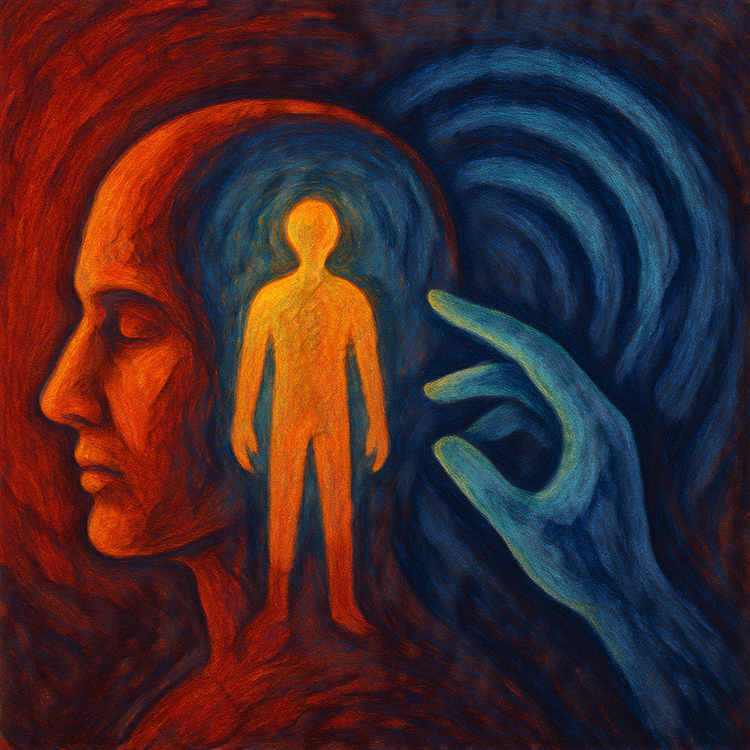
Do we really have choice, or is there something deeper than our thoughts making decisions in our life? A more sensitive kind of Driver?
Choice feels obvious on the surface — we pick the meal, sign the contract, say yes or no. But if you look closer, most decisions are already leaning a certain way before the mind frames them. The deeper Driver is less about calculation and more about alignment. Call it intuition, the soul, or the still small voice — it moves before thought. The mind then narrates the move, claiming ownership.
This Driver is not cold logic but a sensitivity to reality as it actually is. It considers not just preference, but resonance. Where thought works in fragments — “this versus that” — intuition works in wholeness. It sees the full picture in an instant.
Can we access this Driver through intuition? Should every decision be made from that place?
Intuition is not a luxury; it is the compass of the soul. But it’s delicate, easily drowned out by noise. Access begins with slowing down, creating gaps where the whisper can be heard. Small practices help: pausing before responding, breathing deeply when choice feels urgent, or journaling impressions before analysis takes over.
Not every decision needs mysticism — some choices are practical. But even then, when intuition is consulted, it clarifies the terrain. You still use logic, but you use it in service of something deeper. It’s like having both map and compass: the map shows possible routes, the compass tells which way is true.
What about intelligence? Are people with higher IQs or genius-level abilities better at making perfect choices? Or does brilliance get in the way of trusting intuition?
Brilliance is double-edged. A sharp mind can perceive patterns and possibilities with stunning clarity, but that clarity can trick the ego into thinking it already knows. Intelligence, when tied to ego, becomes a fortress: it justifies, rationalizes, even silences intuition under layers of cleverness.
But when intellect bows to intuition, genius shines. It becomes translator, giving form to what the deeper Driver already knows. The mind then serves as the artisan of truth, rather than its rival.
So intelligence does not guarantee wisdom. In fact, the humbler, quieter heart often finds intuition more directly. Genius, unless surrendered, risks missing the simple truth that was available all along.
How do we explain then that spiritual giants have come from both ends of the spectrum — the philosopher-sage Sri Aurobindo and the unlettered mystic Sri Ramakrishna — yet their depth of realization was comparable?
Because realization is not dependent on mental horsepower. It’s the difference between map and territory. Aurobindo crafted intricate maps — vast, systematic philosophies. Ramakrishna embodied territory — raw, unfiltered devotion and absorption. One translated realization into intellectual architecture, the other radiated it through stories and presence.
Both reached the mountain. One described the paths with scholarly precision, the other sang of the summit with childlike wonder. Their attainments were not lesser or greater, only different in expression. Intellect shapes the teaching; realization is what shapes the soul.
Then who — or what — is the Driver beneath thought?
Some traditions call it the Self, others call it the soul, others karma playing itself out. Perhaps it is not one but all of these. The Driver is that which knows before you know. Sometimes it feels like instinct, sometimes like grace, sometimes like inevitability.
The Driver is not against choice — it is what makes true choice possible. When ego chooses, it is reactive, based on fear or desire. When the Driver chooses, it feels like alignment: the yes that carries peace, the no that carries freedom.
In this sense, the Driver is not outside you but deeper within you. It is the part of you that is already attuned, already aware. The task of the seeker is not to manufacture it, but to clear enough space to hear it.
So how do we live in harmony with this Driver?
- Create silence — small daily pauses where intuition can surface before thought.
- Anchor in the body — the body feels truth before the mind reasons it; notice where peace or contraction shows up.
- Loosen identification with intellect — let brilliance be a servant, not a master.
- Practice humility — through devotion, service, or surrender, remind the ego it’s not in charge.
- Check the fruits — real decisions guided by the Driver tend to bring clarity, peace, or right timing, even when difficult.
Addendum — the grounded reflection
Choice is not about power but about resonance. The mind wants certainty, the ego wants control, but the Driver asks for trust. This is why some saints speak in parables and others in philosophy — the form doesn’t matter, only whether the deeper current is flowing. In the end, true intelligence is not measured by IQ or vocabulary, but by the ability to listen for that subtle current and follow where it leads, even when the path is uncertain.
📚 Resources & References
- Franklin Merrell-Wolff, Pathways Through to Space — exploration of higher consciousness and intuition beyond intellect.
- Sri Aurobindo, The Life Divine — philosophical mapping of spiritual realization.
- The Gospel of Sri Ramakrishna — teachings and parables from a mystic without formal education.
- Aldous Huxley, The Perennial Philosophy — comparative insights on saints, sages, and their varying paths to realization.
- Daniel Kahneman, Thinking, Fast and Slow — modern psychological framing of intuition versus rational analysis.

 Numinous Waves