

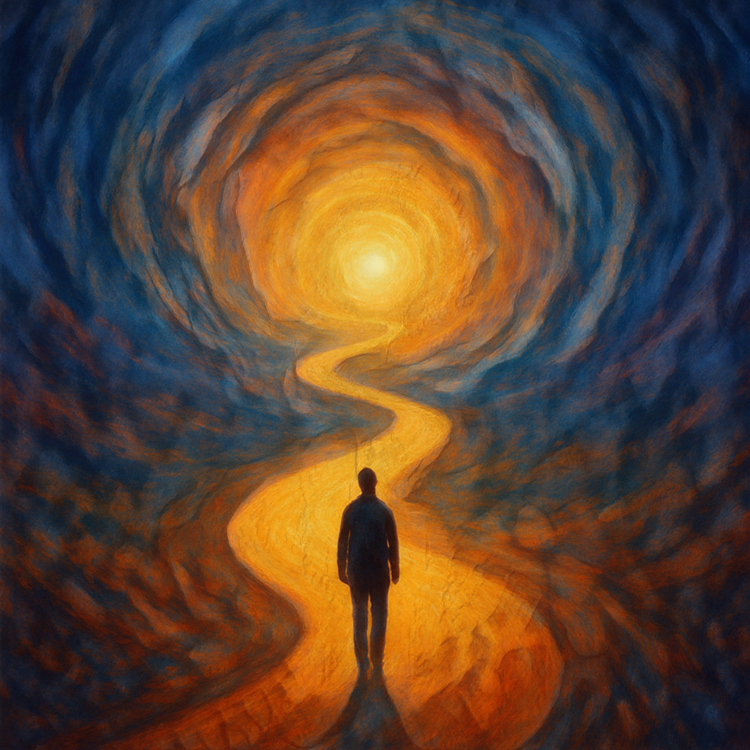
Introduction:
There are moments in every seeker’s life when the mystery of choice and destiny collides. Did I choose this path, or did the path choose me? Was it my decision to pick up the practice, meet the teacher, read the book—or was something far greater already moving me toward it?
This tension is not just philosophical; it strikes at the very heart of awakening. If we imagine ourselves as the sole architects of our path, we risk arrogance. If we surrender entirely to destiny, we risk passivity. Somewhere between these poles lies a deeper truth: awakening is neither a product of will nor an act of fate alone—it is the meeting of the two, a recognition that the path and the seeker discover one another in the same moment.
The dialogue that follows enters this paradox with sincerity and depth. It asks not for quick answers, but for listening, patience, and the willingness to consider that your life itself may be part of a larger conversation—one in which you are both the speaker and the spoken.
Q: Is it possible that the path we walk chooses us rather than us choosing the path?
A: Yes—and this is one of the great mysteries of awakening. To say a path chooses us is not mere poetry. Paths are not neutral roads laid on the ground waiting for travelers to survey them. They are living currents of consciousness, ancient rivers flowing through the unseen. Each has its own vibration, its own archetypal signature, and when a soul is ready, that vibration begins to resonate within it.
When we “find” a path, it often feels less like invention and more like recognition—like discovering a melody we somehow always knew. The sense of inevitability is striking, as if the path had been waiting all along for us to turn our gaze and finally notice. To the outer mind it looks like choice, but to the deeper self it feels like remembrance.
Q: If the path chooses us, then where does free will fit in?
A: Free will remains, but its role is not in choosing the melody—it lies in how we dance to it. Imagine destiny as music playing through the cosmos, and free will as the way we move with it. The song is not optional; it has already begun. But whether we sway with devotion, resist with stiffness, or refuse to move at all—that is where freedom lives.
We do not choose the marble block we are given; we choose how we sculpt it. This is why two seekers may be touched by the same teaching—one blossoms into awakening, the other turns away after a brief encounter. Both may have been “chosen,” yet only one accepts the shaping of the chisel.
Q: Why are some chosen and others not? Why does one soul awaken while another sleeps on?
A: Here we meet the mystery of ripeness. Not all seeds bloom at the same time. Some germinate in spring, others lie dormant for years awaiting the right alignment of soil, rain, and light. The soul, too, awakens according to its season.
It is not a hierarchy of worth but a rhythm of timing. One soul may be summoned fiercely in this life, another may wander for lifetimes in circles of forgetting. Yet both are held in the same infinite embrace. To be “chosen” is not to be superior; it is to have reached the moment when the soul’s readiness can no longer be delayed.
Q: If some awaken and others do not, is awakening inevitable for all?
A: Yes—but not within the same horizon. No soul is doomed to eternal slumber. Awakening is the destiny of consciousness itself. Yet the unfolding is vast and patient, stretching across lifetimes and worlds. Some awaken in this life with urgency, some later, some much later.
And yet, once a soul is touched by the call—even faintly—it cannot remain unchanged. The memory of the path becomes imprinted, and even if resistance follows, the seed of awakening has already been sown. What we call “being chosen” may be the unveiling of an agreement made long before birth, an eternal contract between the soul and the current of truth.
Q: What does this mean for seekers living now, in the thick of the human condition?
A: It calls for both humility and responsibility. Humility, because awakening is not the result of our cleverness or superiority—it is the blossoming of ripeness. Responsibility, because if the path has chosen you, then you are entrusted with more than your own journey. You become a vessel through which the current touches others, often invisibly.
We must not grow arrogant, saying “I chose this” as if we authored the call. Nor must we become passive, saying “the path chose me” as if our response were irrelevant. The truth breathes in between. The path arises to meet us in the exact moment we arise to meet it. Awakening is neither self-made nor imposed—it is a marriage of destiny and devotion.
Addendum: The Silence Between the Steps
There are moments when all questions dissolve—when the sense of choosing and being chosen both fall away. In such moments, what remains is not a path at all, but the Presence from which all paths spring.
From this silence, every movement is destiny and freedom at once. Every step is chosen and given. To the mind, this is a paradox. To the soul, it is home.
Annotated Resources & References
- Franklin Merrell-Wolff – Pathways Through to Space & The Philosophy of Consciousness Without an Object
Merrell-Wolff describes awakening as a recognition of something already inherent, rather than something newly attained. His writings explore how consciousness itself calls us, making the “path choosing us” a living reality. - Carl Jung – Memories, Dreams, Reflections
Jung reflects on individuation—the process of becoming one’s true self—as a destiny already seeded in the psyche. His notion of the “unlived life” shows how paths wait within us, sometimes across decades, until they break through. - Sri Aurobindo – The Life Divine
Aurobindo speaks of the evolution of consciousness as an inevitable unfolding. He emphasizes that the higher call comes when the soul has ripened, reinforcing the idea of destiny choosing the moment of awakening. - The Bhagavad Gita
The dialogue between Krishna and Arjuna demonstrates the dance between destiny (dharma) and free will. Arjuna is “chosen” by his duty, yet must freely choose to embrace it. This text is a perfect expression of the paradox we’ve been exploring. - Rumi
Rumi’s poetry is filled with the imagery of longing, remembrance, and inevitability: “What you seek is seeking you.” He suggests that the soul is drawn irresistibly to what it already knows, as though the Beloved has chosen us from the beginning. - Joseph Campbell – The Hero with a Thousand Faces
Campbell outlines the “call to adventure,” which often comes uninvited. Heroes rarely choose it consciously—it interrupts their lives. Yet their response to the call shapes their destiny, mirroring the balance of choice and being chosen. - Ramana Maharshi
Ramana taught that realization is not something gained but revealed, as if always present beneath layers of forgetting. His life itself suggests the path can seize a soul at any moment, without prior seeking, affirming that some awakenings are not “decided” by the seeker.
A Closing Word to Readers
These works are not simply texts to be studied; they are thresholds. Each one carries a vibration, a way of seeing, a resonance that may awaken recognition within you. Approach them less as books to master and more as companions—voices that may echo the path already stirring in your own soul.
You may find that one of them “chooses you,” rising off the page with uncanny intimacy, as though written for you alone. When that happens, do not dismiss it. That is the path whispering its name through another’s words.

 Numinous Waves