

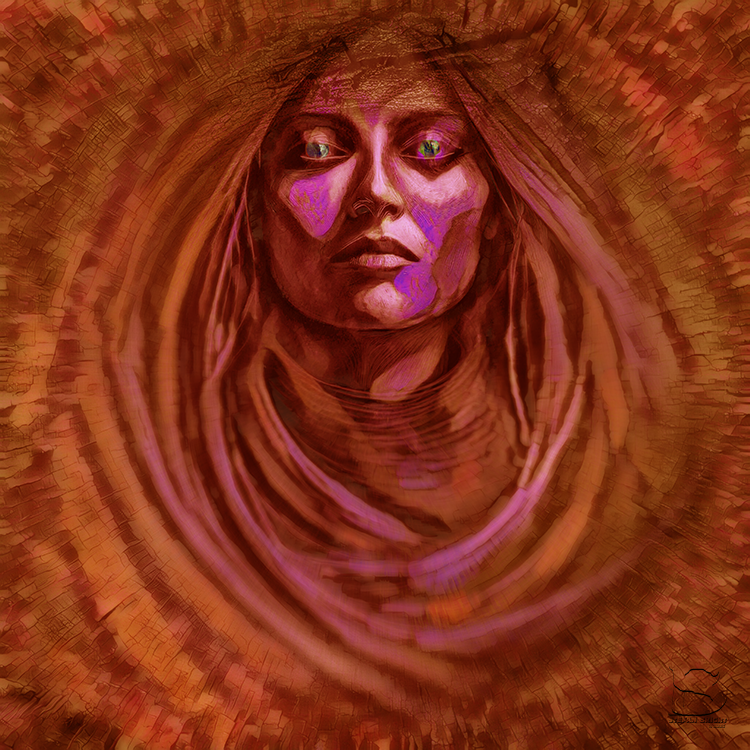
Before doctrine divided and dogma hardened, the feminine stood as a force both earthly and divine. From the earliest civilizations, the presence of women was not one of quiet subservience but of visible, shaping power. Yet over time, something shifted. Patriarchal systems recast women as secondary, even suspect, and much of that legacy still lingers in interpretations of sacred texts. This post explores that story — from Sumer and Egypt to the Old Testament, from the Bible’s inherited hierarchies to the liberating words of Jesus. At stake is nothing less than our memory of the feminine as flame, not shadow.
Q: What role did women play in the earliest complex civilizations?
In Sumer, the earliest known written texts exalted goddesses such as Inanna — sovereign of heaven and earth, embodiment of erotic power, justice, and cosmic balance. Women in Sumerian culture could own property, run businesses, and even serve as priestesses of high rank.
In Egypt, women like Hatshepsut ruled as Pharaoh, and queens were often depicted as the equal spiritual counterpart to kings. The goddess Isis was revered not merely as a consort but as the seat of wisdom, magic, and rebirth. Egyptian spirituality made space for the feminine as a cosmic principle, inseparable from the masculine.
In Mesopotamia more broadly, women participated in temple economies, agricultural management, and ritual life. The feminine was not hidden; it was woven into governance, spirituality, and daily life.
These early cultures show us something striking: the feminine was not marginal, but essential in forming consciousness itself. Civilization did not arise in spite of women, but with them as co-creators.
Q: How does the Old Testament portray women?
Here, the shift begins. While certain women — Deborah, Ruth, Esther, Miriam — shine as figures of power and faith, the dominant pattern tilts toward patriarchy. Women are described as property in laws of inheritance, subject to male authority, and often blamed for disorder (as with Eve’s portrayal in Genesis).
The Old Testament reflects a time of tribal survival, war, and hierarchy, where the feminine was increasingly seen as something to contain or control. Yet even within that narrative, glimpses of reverence break through: the Song of Songs exalts mutual desire, and Wisdom (Sophia) is personified as a feminine voice calling humanity to deeper truth.
Q: How do the letters of the New Testament intensify this pattern?
Paul’s authentic letters show tension: he praises female leaders like Phoebe, Junia, and Priscilla, yet also advises women to remain silent in assemblies. Later texts attributed to Paul — likely written by his followers — solidify hierarchy: women are told to submit, to remain veiled, to learn quietly under male authority.
What began as a radical movement of equality became reframed by cultural norms of the Roman Empire. The liberating energy of Jesus was filtered through patriarchal lenses, and much of the church inherited those lenses without question.
Q: And what did Jesus himself say about women?
Jesus never laid out a doctrine of subservience. On the contrary, he consistently disrupted those very structures. He spoke directly with women in public (breaking taboos of his time). He welcomed Mary of Bethany to sit as a disciple at his feet, a position normally reserved for men. He honored the witness of women at his resurrection as the first proclaimers of the good news.
For Jesus, the feminine was not to be silenced or diminished. It was to be honored as equal participant in the kingdom of God. His vision of community rested not on hierarchy but on love — a mutual service where “the last shall be first” and “whoever wishes to lead must serve.”
Q: What happened to the great presence of the female energy?
The arc of history bent toward control. As empires rose, hierarchies hardened. The church, aligning with Rome, absorbed patriarchal structures that reduced women’s voices. Over centuries, the goddess was erased, Sophia muted, Mary Magdalene recast as a penitent rather than a teacher.
The feminine was not lost — it went underground. It re-emerged in mysticism, in hidden texts, in the unbroken line of women who carried spiritual wisdom outside the centers of power. But the mainstream memory of feminine authority was suppressed, leaving our present age with an imbalance still aching to be healed.
Q: What does this mean for consciousness today?
It means that the rediscovery of the feminine is not a modern invention but a remembrance. The flame has always burned — in ancient temples, in Jesus’ circle, in the quiet defiance of women who refused to disappear. To reclaim the feminine is not to overthrow the masculine, but to restore balance: wisdom with power, compassion with strength, presence with action.
In honoring the feminine, we do not diminish men. We call them, too, into a fuller humanity — one that no longer fears the flame but learns to live beside it, with it, and within it.
✦ Addendum: The Hidden Flame
Once, she was sky and earth, law and love, temple and throne.
Then came centuries of silence, where her voice was called weakness.
But her fire was not extinguished. It burned in the womb, in the well, in the whisper of prophets.
Now it rises again — not as conquest, not as revenge, but as remembrance.
The world waits not for a new power, but for the return of one we already knew.
✦ Closing Invocation
Let us walk into the future carrying both presences — masculine and feminine — as equals in the dance of becoming.
Let us honor the civilizations who once knew this truth,
And hear again the voice of Jesus, who called women friends, disciples, witnesses.
May our consciousness awaken to balance,
And may the hidden flame of the feminine blaze openly once more.
Resources
- Inanna, Queen of Heaven and Earth (Wolkstein & Kramer)
- The Woman’s Bible (Elizabeth Cady Stanton)
- When Women Were Priests (Karen Jo Torjesen)
- Beyond God the Father (Mary Daly)
- The Gospel of Mary Magdalene (trans. Jean-Yves Leloup)
- The Sophia Tradition (various mystical texts)
- Relevant passages: Song of Songs, Proverbs 8 (Wisdom as feminine), Luke 10:38–42, John 4, John 20
The Spiritual Balance of Feminine and Masculine
When we look beyond history, beyond the weight of texts and traditions, we find that the deepest truth of creation is not hierarchy but balance. The feminine and masculine are not competing forces, nor is one designed to dominate the other. They are complementary currents of a single Creative Energy, flowing in cooperation toward the fullness of consciousness.
In spiritual terms, the feminine is often seen as the receptive, nurturing, and intuitive expression of creation—life-giving, sustaining, and holding mystery. The masculine, in turn, is the active, outward, and directive current—moving forward, seeking, and shaping. But neither exists in isolation, and neither holds primacy. The feminine without the masculine is incomplete, just as the masculine without the feminine becomes destructive or hollow.
The highest ideal of creation is a dynamic harmony in which both energies mirror each other, elevate each other, and co-create. This is why in many esoteric traditions, union—not dominance—is the symbol of divine completeness. The yin and yang of Taoist thought, the Shakti and Shiva of Indian mysticism, the Shekinah and the Eternal of Jewish mysticism—all reflect this eternal truth: consciousness itself is born of balance.
When either side is suppressed, creation limps. When both sides rise in balance, creation sings. The great wound of our collective history has been the silencing of the feminine and the distortion of the masculine. But the great healing of our age may well be the remembrance of their equality, their indivisibility, and their shared responsibility in awakening the soul of humanity.
Why We Follow the Unlikely Truth
We live in a time where echoes of power often sound louder than the whispers of wisdom. Humanity, still shaped by millennia of hierarchy and survival, has been trained to seek certainty in authority rather than clarity in truth. When voices promise order, identity, and belonging, they carry an allure—even if the foundation is fragile, even if the truth is distorted.
The unlikely truth we follow is not born of light but of repetition. When ideas are reinforced by tradition, institutions, and inherited fear, they masquerade as inevitability. And yet, deep within us, something resists. The soul senses when balance is missing, when love has been traded for control, when half of creation has been silenced.
In our present incarnation, we are blind not because truth is absent, but because our eyes have been trained to look away from it. The feminine flame has been hidden, the masculine distorted, and the cooperation between them buried beneath centuries of domination. We inherit not only the wisdom of our ancestors, but also their shadows—and in those shadows, unlikely truths harden into “common sense.”
But incarnation itself is the gift: each life gives us another chance to re-remember. To question the voices that speak with volume but little depth. To discern between what enforces obedience and what awakens freedom. To see, at last, that the unlikely truth is not truth at all—merely a veil awaiting removal.
When that veil lifts, balance returns. And with it, the recognition that creation was never about subservience, but about harmony—two currents, equal and eternal, weaving consciousness into form.
Why Some of Us Sleep — and Why Some Ignite Like Fire (a contentious offering)
There are ways to name this that sound harsh and ways to name it that invite tenderness. I will do both, because candor without compassion is cruelty, and compassion without candor can become sentimentality.
Entrenched Conditioning becomes a coffin of comfort.
Many people are so woven into habit—identity, role, opinion, family story, addiction, status—that the psychic price of waking feels higher than the price of sleep. The structures that raised them (religion misread as law, nation as identity, career as self-worth) turn awakening into loss: loss of safety, community, income, dignity. For some, the fear of that loss is greater than the curiosity to change. Sleep becomes a rational choice born of survival.
Trauma locks perception into repetitive loops.
Severe attachment wounds, unresolved childhood trauma, and repeated abuses create neurochemical and psychological patterns that make introspection dangerous. The brain’s defensive aim is preservation, not insight; it will fortify denial if insight feels like annihilation. Many remain unconscious because the soul’s pulse has been armored by pain. Waking would mean feeling what they have never been allowed to feel — and most choose, unconsciously, to keep the lid down.
Identity and vested interest protect sleep.
If power, comfort, or identity are built on the maintenance of a certain story (racial, religious, political, gendered), then waking threatens livelihoods and self-conception. Institutions, families, and economies reward compliance. People invested in those rewards actively resist, often without malice — because to them, the refusal to wake is rational self-preservation.
Karmic or soul-contract perspectives: some incarnations are meant for deep density.
In many mystical traditions, there are souls who take on heavier, longer, or denser embodiments for reasons beyond current comprehension: to test a system from within, to hold a field others can move through, to exhaust a particular pattern so it can be healed across generations. These souls may appear “asleep” because their contract is not liberation in this life but service through sustained heaviness. This is not condemnation; it is a metaphysical reading that makes room for purpose inside suffering.
The will and the invitation — some never respond.
Awakening requires a kind of consent: a small “yes” to truth that then gathers momentum. For reasons of temperament, upbringing, or destiny, some never offer that initial consent. They can be reached, sometimes, by grace or crisis; sometimes not. The controversial claim is this: a portion of people will probably not recover their sight in this life because they have neither cause nor desire to look — and that is, paradoxically, also part of the human landscape.
Why then do some awaken like a ball of fire?
Crisis as catalytic lightning.
For many, a rupture — illness, death, profound loss, a breakdown — shatters the old map. When everything around you collapses, the ego has nothing left to hold on to, and the soul can enter. Fire often follows fracture.
Innate spiritual temperament and readiness.
Some persons are born with a predisposition toward inner sensitivity—an easier access to awe, prayer, surrender. Their wiring, upbringing, or past-life momentum gives them a lower threshold for insight. To them, the veil lifts more readily.
Practice, discipline, devotion.
There are those who prepare. Years of meditation, devotion, therapy, contemplative practice, or honest self-work condition the inner ground so that when an insight arrives, it detonates whole. Fire finds a dry wick.
Grace and transmission.
Sometimes awakening is not earned but gifted. There are encounters — with a person, a text, a field — that pass a spark. The awakened often speak of transmission: an energetic “click” that resets perception. Others collapse back because the inner work to integrate that blaze was not yet done.
A final, blunt contemplation
If you accept the harder proposition — that some in this life will remain asleep — two things follow that change everything: first, that judgment is pointless and cruel; and second, that urgency becomes sacred. If not everyone will wake now, then those who have the flame bear a deeper responsibility: to hold the field, to speak the truth with tenderness, and to create pathways that lower the cost of waking for others.
Wakefulness is not a triumph of superiority but a duty of compassion. To say some will never recover in this incarnation is not to damn them; it is to name the seriousness of our work. The field is uneven. The wise response is twofold: grieve the ones who remain in darkness, and steward the light you’ve been given so it can become a bridge — not a cudgel.

 Numinous Waves