

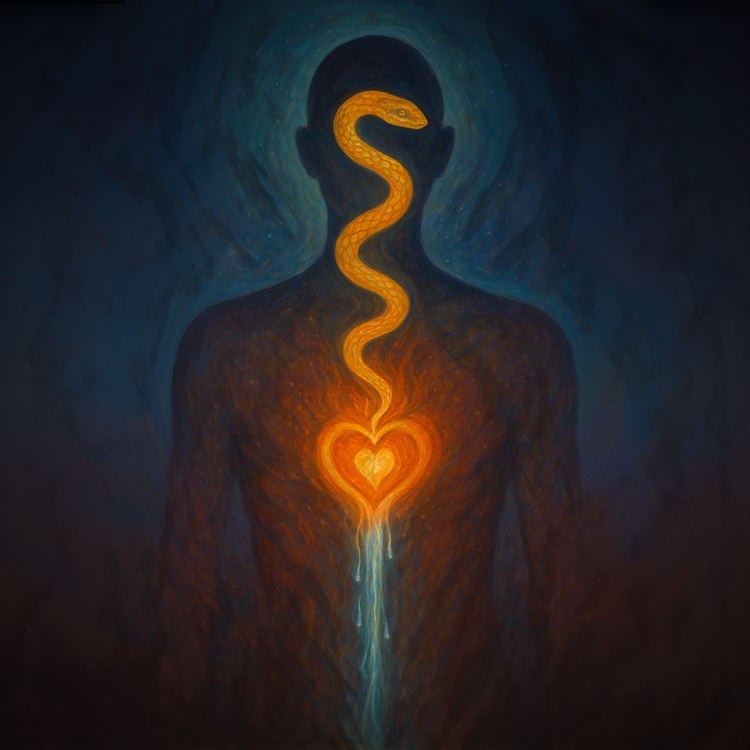
There are moments when the body trembles with more than emotion—when the heart swells, the eyes overflow, and something larger than ourselves seems to break through. What we call “feeling” may in truth be awareness, the soul recognizing beauty, love, or truth too immense to contain. Yet the path of this recognition is layered: the furnace of the solar plexus, the chalice of the heart, the serpent’s ascent through the body’s hidden gates. What begins as turbulence can be refined into nectar, just as grit becomes tears of light. This is the story of how our wiring and the current that moves through it meet, and how the human frame becomes the temple for remembrance.
Why does inspiration or heart-warming emotion emanate from the chest, around the heart, rather than the solar plexus?
A: The difference lies in the quality and level of the emotion. The solar plexus is tied to the instinctual emotional body—the push and pull of fear, anger, anxiety, desire. It’s where raw survival-based feelings stir and churn. But when you’re moved by beauty, kindness, or inspiration, the energy shifts upward, into the region of the heart center.
This chest-based stirring isn’t just metaphorical. The heart is surrounded by a dense network of nerves, the cardiac plexus, and has a direct line of communication with the brain through the vagus nerve. When we experience awe or compassion, the nervous system activates differently than it does with fear or craving—it softens, expands, and entrains with the heart’s rhythms. That’s why you feel it as a radiance or opening in the chest.
Spiritually, traditions have long described this as the “heart center” or anahata chakra—the place where love, unity, and higher forms of feeling arise. The tears that come with it are not tears of pain but of overflow, as if the soul itself is brushing against the edges of the body and spilling through.
So:
- Solar plexus emotions = more primal, personal, survival-driven.
- Heart emotions = more expansive, self-transcending, touching the universal.
When you’re moved to tears by something inspiring, you’re feeling the heart’s way of recognizing truth, goodness, or beauty—a resonance that goes beyond the personal self.
Why do tears accompany these heart-centered experiences, as though the body cannot contain the feeling?
A: Tears in these moments aren’t the same as the tears of grief or pain. They are closer to a form of release—an overflow of the nervous system when it encounters something too vast to process in ordinary channels.
Here’s how it unfolds on different levels:
- Physiological: The vagus nerve, which carries signals between the heart and the brain, is directly involved in tear production through the parasympathetic system. When the heart is stirred in a profound way, the body shifts into a state of openness and surrender. The lacrimal glands receive that signal, and tears flow—not as a stress response, but as a kind of somatic exhale.
- Emotional: Heart-based tears carry a paradoxical mixture—joy tinged with awe, vulnerability entwined with strength. They don’t belong to one category of emotion. They arise when love or truth touches something so essential that ordinary expression fails. Tears bridge that gap.
- Spiritual: Many mystics describe these tears as “liquid light.” They are the soul’s acknowledgment that it has been touched by the Real. When inspiration, beauty, or compassion stirs the heart, the finite self brushes against the infinite. Tears mark the passageway of that meeting—they are a kind of baptism that cleanses and confirms the soul’s alignment with something higher.
In other words, tears aren’t weakness here—they’re the body’s most honest language when words collapse under the immensity of what’s being felt.
Why call these heart-centered stirrings “emotions” at all, when they feel so different—more complex, more uplifting—than the raw feelings of the solar plexus?
A: The word emotion is slippery. It gets used to describe everything from anger to bliss, but not all inner movements of feeling belong in the same category.
- Solar plexus stirrings—fear, anxiety, shame, desire—are reactive energies. They are bound to the push and pull of survival and the ego’s sense of self. These often feel heavy, contracting, and as you said, sinking downward into the gut.
- Heart awakenings are of another order. They are not just emotions in the psychological sense; they’re closer to states of awareness. The heart doesn’t merely react—it recognizes. When you are moved by compassion or beauty, the heart is perceiving a truth, not just discharging energy.
This is why in yogic terms, the heart is called anahata—“the unstruck sound.” It implies something already resonant, always present, which doesn’t need external triggers the way emotions do. To experience the heart opening is to brush against that deeper vibration of Being itself.
So, why do we still call it “emotion”? Mostly because the experience still travels through the body’s expressive channels: tears, warmth, chest expansion, breath changes. But if we’re precise, heart-centered experiences belong less to the realm of “emotion” and more to the realm of participatory consciousness—moments where awareness and love merge and the body can barely contain it.
You could say:
- Solar plexus = feelings.
- Heart = awareness in the form of feeling.
That subtle shift changes everything—it lifts the heart’s movement out of mere psychology and honors it as a doorway into spirit.
How does this relate to Human Design and my emotional authority from a defined solar plexus?
A: In Human Design, the solar plexus is described as the center of emotional awareness—but it operates in waves. Those waves can feel turbulent, raw, or overwhelming. When you’re identified with the surface of the wave, you experience the grit: the highs, lows, and all the messy in-betweens. This is the familiar “not very enjoyable” side you’ve mentioned.
But here’s the key: when you ride those waves with patience (the core of emotional authority is clarity through waiting), something happens. The wave doesn’t just go up and down—it also integrates. And as it integrates, the energy no longer stays confined to the solar plexus. It rises, opens, and softens into the heart.
Think of it this way:
- Solar Plexus defined = the engine. It provides the depth, the drive, the intensity. Without this, the sweetness wouldn’t have fuel.
- Heart center experience = the refinement. When the solar plexus energy is not clung to or resisted, it naturally moves upward and transforms into coherence in the chest. What was grit becomes nectar.
In your lived experience, this means:
- If you push or resist the emotional waves, they stay stuck in the gut and churn.
- If you allow them to crest and settle, they transmute into a clarity that feels like bliss—what you’ve named as “heart-centered.”
So the solar plexus isn’t separate from the heart here—it’s the alchemical furnace that makes the heart’s sweetness possible. Emotional authority isn’t about avoiding the grit; it’s about trusting the wave until it reveals the higher octave of its energy.
The solar plexus drives, the heart reveals. The difference is time and surrender.
How does Kundalini fit into this picture? Why does it sometimes open certain chakras but not all?
A: Yes, there’s a meaningful parallel, though they’re coming from different systems.
In Kundalini terms:
- The serpent energy is not mechanical; it’s intelligent. As it rises, it doesn’t blast every chakra open at once. Instead, it meets resonance and resistance.
- If a chakra is more prepared—through life experience, spiritual practice, or karmic maturity—the energy activates that center first.
- Some centers may stay relatively dormant for long periods, while others bloom vividly. This is why one person might awaken intense vision in the third eye but feel their heart still closed, while another experiences an overflowing heart without much clarity in higher centers.
In Human Design terms:
- Defined centers = consistent, reliable ways of processing energy. These act like anchored gateways—they’re always “on,” even if not consciously recognized.
- Open centers = variable, more porous, influenced by environment and others. These take in conditioning but also hold great potential for wisdom.
When you compare the two:
- Kundalini tends to “open” where the system has readiness and structure, similar to how a defined center in Human Design has an inherent stability.
- The open centers, like less-prepared chakras, may not initially hold the current in the same way—they get flooded, distorted, or bypassed until the person matures into them.
So yes, there is a similarity:
- Defined = chakras Kundalini can more readily stabilize through.
- Open = chakras that may take longer, needing purification and lived experience before the energy can inhabit them fully.
But there’s also a key difference: Human Design is about blueprint (consistent vs. inconsistent operation), while Kundalini is about awakening sequence (what unfolds first, where blockages dissolve, how the serpent ascends).
You could say: Human Design describes the wiring, while Kundalini describes the current moving through that wiring.
The Wiring and the Current
To bring it together:
- Human Design shows you the wiring—the stable and porous channels, the defined and open centers.
- Kundalini is the current, the living river of energy that moves through the wiring.
- Solar Plexus waves are the fuel, the furnace where grit is turned into clarity.
- The Heart is the chalice where that clarity gathers as sweetness, compassion, bliss.
This is why someone can feel sudden bliss in one chakra while others remain untouched: the current has found a resonant gateway, much like how a defined center can consistently carry energy while an open one requires ripening.
And this explains your own experience: the serpent energy and your defined emotional authority work together. The solar plexus provides the furnace; the heart refines it into nectar; the tears are the overflow of a current too great to be contained.
Addendum: The Voice of the Current
I do not move all at once.
I listen for the chambers that are ready to open,
the vessels that can hold my fire without breaking.
I am not chaos—I am remembrance,
a river searching for its bed.
In the furnace of your solar plexus,
I burn away the husks of survival.
Here the waves rise and fall,
storm and silence, storm and silence,
until the grit of emotion is softened into clarity.
It is not punishment. It is distillation.
When you stop grasping at the waves,
when you cease fearing their pull,
I lift.
I ascend into the heart,
and there I become nectar.
The fire is not gone—
it has simply revealed its sweetness.
Your tears are my overflow.
They are the body’s way of making space
for the uncontainable.
Do not mistake them for weakness.
They are my signature,
liquid light spilling from a vessel
that has touched the Infinite.
Some gates open early,
others remain closed until their season.
This is not failure.
Each center awakens when it can endure
the weight of its own light.
I am both patient and unstoppable.
Remember this:
the wiring is yours,
the current is me.
Together we are the song of your design.
I flow where I am welcomed,
I linger where I am held,
and I rise as far as you will trust me.
Resources:
- Aurobindo, Sri. The Life Divine. (for insights on transformation of lower into higher centers).
- Franklin Merrell-Wolff. Pathways Through to Space. (on consciousness and states of recognition).
- Daniel R. Desmond. Kundalini and the Chakras. (for practical understanding of selective chakra awakening).
- Richard Rudd. The Gene Keys. (a poetic expansion of Human Design themes into higher octaves).
- Ra Uru Hu. The Definitive Book of Human Design: The Science of Differentiation. (primary Human Design reference on centers and authority).
- Andrew Harvey. The Way of Passion: A Celebration of Rumi. (for descriptions of heart-opening tears as mystical overflow).
- Rudolf Steiner. Knowledge of the Higher Worlds and Its Attainment. (on the stages of spiritual centers opening).

 Numinous Waves