

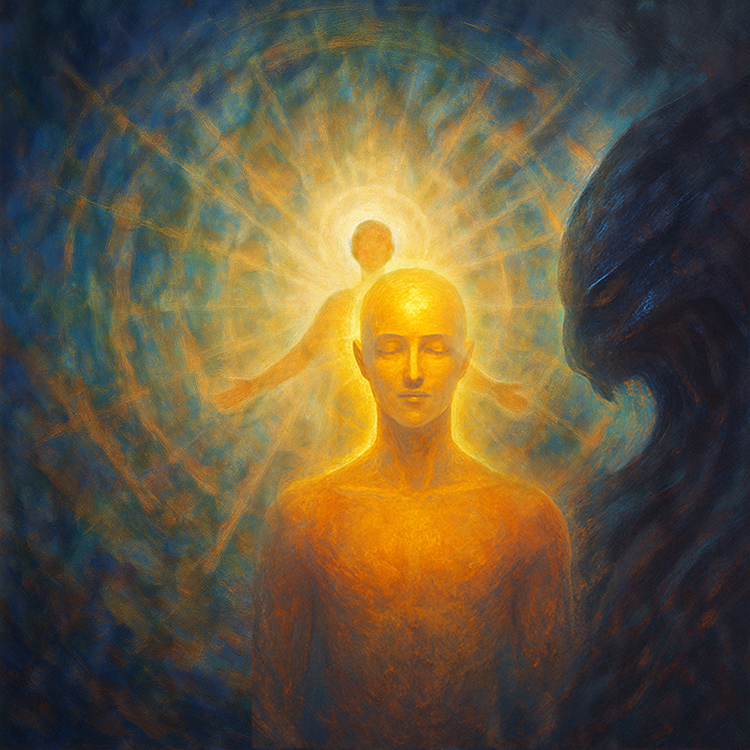
In a world where the structures of power shift and strain, it is easy to believe that the fate of our lives rests only in the hands of governments, armies, and rulers. Yet beneath the surface of history runs another, greater current—the republic that no despot can conquer, the inner commonwealth of the soul. Here the true vote is cast not in ballots or decrees, but in the quiet alignment of one’s being with truth, compassion, and light. The outer world may sway between democracy and authority, between liberty and coercion, but the inner realm is governed by a law beyond time: the sovereignty of awakened consciousness. To turn inward, to kindle that flame, is not withdrawal but participation in the deepest act of citizenship. For the republic of the soul does not merely endure—it radiates outward, becoming the invisible constitution by which hearts can be lifted and societies remembered back into their higher nature. It is here, in this luminous terrain, that deception loses its hold, and truth shines forth as the original order of existence.
Q: What form of governance exists within the soul?
A: Within each person lies a republic more ancient than empires and more enduring than any earthly state. The soul does not organize itself around domination, nor does it seek victory over its parts. Instead, it arranges its inner life in a harmony of voices: intuition, reason, feeling, memory, imagination, conscience. Each has its place at the council fire, and none holds permanent authority over the others. The soul, when whole, is self-balancing—every faculty listening, every dimension honored, each yielding to the greater rhythm that carries the whole toward truth. This is the governance of spirit: not a hierarchy of command, but a chorus of concord.
Q: How does this inner republic differ from worldly systems of rule?
A: All outer governments are fragile because they lean upon enforcement, the fear of punishment, or the promise of reward. Their unity is maintained by pressure, and when that pressure collapses, so too does the state. The inner republic thrives on a different law—one not written on tablets or proclaimed by decree, but woven into the very structure of being. This law is compassion. It holds no weapon, no prison, no propaganda; yet it governs absolutely. For whenever one listens with sincerity to the voice of compassion, one becomes obedient to truth. No ruler, no army, no ideology can enforce such obedience, because it rises freely from the deepest will of the heart.
Q: If the soul is governed by compassion, what role do its conflicting voices play?
A: They play the role of a parliament. Desire speaks loudly; fear attempts to obstruct; ambition campaigns for dominance; sorrow pleads its case. These voices are not enemies of the soul, nor intruders, but representatives of experience. To silence them completely would be to commit tyranny against one’s own being. The soul’s wisdom is not to eradicate the noisy voices but to hear them without being ruled by them. When the chair of compassion presides over the council, every voice is heard, yet none can overthrow the balance. In this way, the republic of the soul teaches us the discipline of listening without surrendering sovereignty.
Q: How does this inner republic influence the world outside us?
A: When a person lives under the authority of their inner republic, they cease to be easily governed by fear. Their actions flow from integrity rather than compulsion. Such a person is not a rebel against the world, nor a servant to it, but a presence within it that reveals another order. Their words carry a tone not of protest, but of freedom; their choices shine not as resistance, but as radiance. In this way, the republic of the soul gradually transforms outer life: not by overthrowing regimes, but by dissolving the very need for domination in the first place. A society formed by such souls would no longer seek rulers but would live in the equality of spirit.
Q: What does it mean to become a citizen of this inner republic?
A: To be a citizen of the republic of the soul is to recognize that one already belongs. There is no initiation, no oath, no flag to salute. The moment one turns inward and perceives the sacred balance, citizenship is restored. Yet, like any republic, its strength depends on participation. We must attend to its deliberations: meditating, listening, discerning, forgiving, integrating. We must show up to the inner assembly with honesty, even when it is inconvenient, even when our lesser impulses seek shortcuts. To live as a citizen of this republic is to embody its constitution daily: compassion as law, harmony as governance, and truth as destiny.
Addendum
Every civilization collapses; every regime fades; every law is rewritten. But the inner republic of the soul is eternal. It is the polity that no empire can conquer, the community that no ideology can divide. When enough of us awaken to its sovereignty, the world outside may tremble for a time, but it too will eventually find its way to harmony. For the inner republic is not merely personal—it is the seed of a universal order waiting to be remembered.
Historical & Political Foundations
- The Federalist Papers (Alexander Hamilton, James Madison, John Jay, 1787–1788) – Especially Madison’s writings on factions and the balance of liberty and order, which mirror the soul’s inner struggle.
- John Locke – Second Treatise of Government (1689) – His vision of natural rights, consent of the governed, and the balance of freedom and restraint inspired the American Founders and resonates with the inner sovereignty of the soul.
- Thomas Jefferson – Notes on the State of Virginia (1785) – His reflections on liberty, conscience, and moral responsibility provide an important parallel between civic and spiritual independence.
- George Washington’s Farewell Address (1796) – His warnings about division, corruption, and the erosion of virtue echo the need for inner vigilance against deception.
Spiritual & Philosophical Sources
- Plato – The Republic (c. 375 BCE) – His analogy of the just city and the just soul is perhaps the oldest and most profound metaphor linking politics and inner life.
- Ralph Waldo Emerson – Self-Reliance (1841) – His call to trust one’s inner compass connects directly to the sovereignty of the inner republic.
- Franklin Merrell-Wolff – Pathways Through to Space (1936) – His concept of “Consciousness-without-an-object” can be seen as the deepest form of inner freedom beyond external rule.
- Sri Aurobindo – The Human Cycle (1949) – His insights into the spiritual evolution of society mirror the movement from external governance toward inner awakening.
- The Bhagavad Gita (c. 2nd century BCE) – Especially Krishna’s guidance to Arjuna on ruling the self, standing in dharma, and aligning with higher truth.
- Meister Eckhart (13th–14th century) – His mystical teachings on detachment and the “birth of God within the soul” reflect the inner seat of divine governance.
Contemporary Thinkers
- Vaclav Havel – The Power of the Powerless (1978) – A reflection on truth versus lies in society, which also applies inwardly to the soul’s choice between light and deception.
- Howard Thurman – Meditations of the Heart (1953) – His meditations speak of the inner authority of spirit as the basis for justice and love.

 Numinous Waves