

To understand the soul without the destiny of consciousness is to miss the stage upon which it plays; to speak of consciousness without the soul is to miss the intimate gesture of its flowering.
Q — What do we mean by soul’s purpose?
A — The soul is not here by accident. By soul I mean the enduring center of personal depth — the one that survives all inner shifts and seeks love, meaning, and recognition. Its purpose is not a fixed occupation or role; it is a pattern of intentionality that guides the descent into form and the return to remembrance.
In this age, the soul’s purpose spirals through three concentric tasks:
- To remember itself within forgetting. The density of incarnation produces near-total amnesia. The veil is not punishment but crucible. The soul’s first purpose is to recover its memory — not as abstract doctrine but as lived identity.
- To embody compassion and discernment in ordinary life. The soul is not only here for its own awakening. Many live their purpose simply by embodying kindness, clarity, and integrity where they are most scarce. Service here is not grandiosity but fidelity to the moment.
- To participate in collective transformation. Each remembrance, each act of compassion, changes the texture of the field. The soul is not an isolated pilgrim but a participant in the healing of the greater body of consciousness.
Purpose unfolds through descent, purification, awakening, embodiment, and eventually transmission. Its shadow pitfalls are spiritual pride, dogma, bypassing, or despair. Its corrective medicine is humility, embodied practice, and ordinary service.
Q — And what of the destiny of consciousness?
A — Here the lens widens. Consciousness itself — not only human thought but the fact of interior experience — seems to move through an arc of evolution. Its destiny appears to be twofold:
- Integration toward unity. The drive toward coherence, reflexivity, and mutual recognition. Consciousness seeks to know itself more fully.
- Differentiation toward complexity. The flowering into ever more diverse, creative, and intricate forms. Consciousness multiplies its mirrors.
Together these drives form a spiral: unity and diversity, self-knowledge and play. Some traditions speak of it as cycles: unity → manifestation → fragmentation → return. Others imagine a trajectory toward a vast, interconnected “mind of minds,” where individuality is not erased but held within a greater coherence.
Humanity plays a catalytic role. We are the locus where reflection, language, and collective choice concentrate. Our attention, technologies, and ethics tilt the direction of the larger weave. The destiny of consciousness is not separate from us; it is enacted through us.
Q — How do these two arcs relate — the soul’s purpose and the destiny of consciousness?
A — They are not separate. The soul is the microcosm; consciousness is the macrocosm. Each soul’s remembrance and service becomes a thread in the fabric of destiny. Each act of awakening alters the trajectory of the whole.
- The soul’s purpose is the human-scale pathway by which consciousness fulfills its destiny.
- The destiny of consciousness is the cosmic-scale context within which the soul finds meaning.
One is the mirror, the other the vastness it reflects.
Q — What practical roadmap can a seeker follow to align with both?
A — The alignment must be lived, not only contemplated. A possible map:
- Daily: Silence and presence (20–30 minutes). Brief check-ins with the body. Gratitude at day’s end.
- Weekly–Monthly: Somatic practice or therapy. Creative expression as devotion. Concrete acts of service.
- Relational: Honest friendships. Peer groups or teachers for accountability. Community projects that weave meaning with action.
- Life-Arc: Create something that outlives you. Teach what you embody, not what you only imagine. Seed structures of justice, compassion, or beauty that ripple forward.
The guiding orientation is humility with courage: to act without certainty, to serve without recognition, to keep faith that the smallest acts of remembrance weave into the vast fabric of destiny.
Q — What about obstacles? How does one avoid falling off the path?
A — Every seeker meets detours:
- Bypass (using spirit to avoid pain) — countered by body-based honesty.
- Dogma (mistaking maps for terrain) — countered by lived testing of ideas.
- Despair (paralyzed by suffering’s scale) — countered by micro-actions.
- Grandiosity (messiah complex) — countered by anonymous service and shared leadership.
- Complacency (calling inaction “acceptance”) — countered by the question: does my love reduce harm, or excuse it?
Obstacles are not signs of failure; they are training in discernment.
Q — How should a seeker hold uncertainty without paralysis or arrogance?
A — Uncertainty is not an enemy but a companion. To hold it well:
- Frame beliefs as experiments, not absolutes.
- Balance brave action with readiness for correction.
- Keep practices of humility — small daily tasks, rituals of awe.
- Allow “not-knowing” to be fertile ground, not a void of avoidance.
Uncertainty is the doorway through which revelation continues to enter.
Addendum — A Resonance
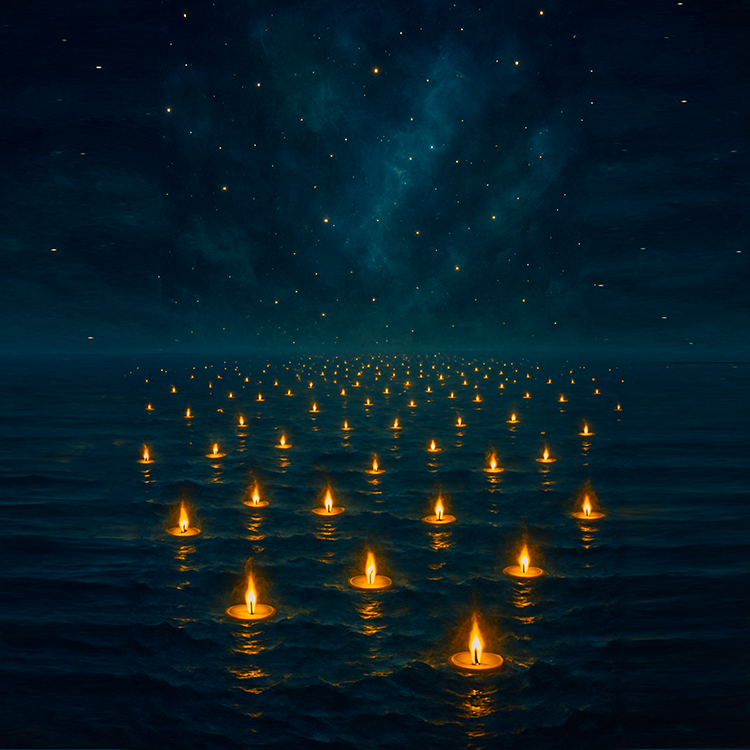
Imagine the vast ocean of being, dark and immeasurable. Across its surface drift countless lamps — the souls, each fragile, each luminous. They flicker in storms, gutter in the wind, or burn steady against the night. Taken alone, a lamp seems inconsequential. Taken together, they are constellations reflected upon the water.
The ocean is consciousness itself — depth without bottom, surface without end. The lamps are the soul’s purposes, fragile yet radiant. Destiny is not a single lamp burning forever, nor the ocean alone, but the meeting of the two — the fragile light mirrored by the vast sea, and the sea made visible by the fragile light.
The task is not to clutch the lamp, nor to drown in the sea, but to tend the flame faithfully. For each tended flame ripples light across the water, and in time the ocean becomes visible as a pathway home.
Classical & Mystical Sources
- The Upanishads — Ancient Indian dialogues that root the soul’s purpose in recognizing Ātman (the Self) as Brahman (the Absolute). They speak to remembrance within forgetting.
- Bhagavad Gita — A spiritual manual for action, showing how dharma (soul’s purpose) is fulfilled through service and surrender to the larger will of consciousness.
- Plotinus, The Enneads — Explores the soul’s descent into matter and its return to the One, a philosophy of purpose as reunion with origin.
- Meister Eckhart — A Christian mystic teaching the soul’s birth of God, where its true purpose is to discover its divine ground beyond ego.
- Rumi & Ibn Arabi (Sufi mystics) — Offer visions of the soul’s purpose as love and union, and of consciousness as an unfolding of Divine Unity.
Modern Spiritual Philosophy
- Sri Aurobindo, The Life Divine — Argues that evolution itself is the unfolding destiny of consciousness, moving toward supramental realization.
- Franklin Merrell-Wolff, Consciousness Without an Object — A radical account of pure, objectless awareness as the ground of being, pointing to consciousness beyond dualities.
- Teilhard de Chardin, The Phenomenon of Man — A Christian mystic-scientist who saw evolution aiming toward the Omega Point, a convergence of cosmic consciousness.
- Ramana Maharshi, Talks with Ramana Maharshi — Centers the soul’s purpose on Self-realization through inquiry: “Who am I?”
- Thomas Merton, New Seeds of Contemplation — A modern Christian mystic reflecting on the contemplative life as both soul’s awakening and participation in divine consciousness.
Scientific & Philosophical Perspectives
- Carl Jung, The Red Book & Collected Works — Maps the individuation process, where the soul’s purpose is integration of shadow and archetype, in service to the collective psyche.
- Ken Wilber, Integral Spirituality — Proposes a model of consciousness evolution that integrates science, psychology, and mysticism.
- David Bohm, Wholeness and the Implicate Order — A physicist who described reality as enfolded order, hinting at consciousness as fundamental.
- Evan Thompson, Waking, Dreaming, Being — Bridges neuroscience and Eastern traditions, exploring states of consciousness across waking, dreaming, and meditation.
- Iain McGilchrist, The Master and His Emissary — Examines how brain hemispheres shape perception, suggesting the destiny of consciousness (and culture) depends on integration of ways of knowing.

 Numinous Waves