

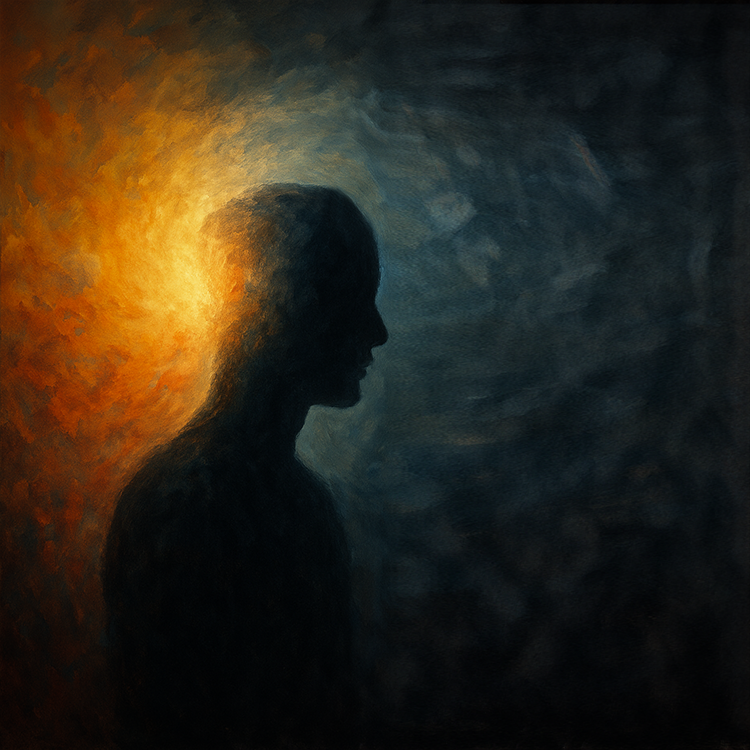
A spiritual dialogue on the shadows of the heart, the fading of integrity, and the path back to remembrance.
Introduction:
To ask why we harm each other is not merely to dwell on sorrow—it is to face the deepest shadow within the human condition. Spiritual inquiry is not only about light, bliss, and transcendence; it is also about courage—the willingness to turn toward what we fear and what we most wish to avoid. To explore the roots of human conflict is to explore the roots of forgetfulness: how we lose sight of the soul, how morality collapses under the weight of passion, and how integrity can be eclipsed by the illusions of separation.
This question belongs to spiritual inquiry precisely because it holds the mirror to our collective amnesia. Only by examining why the heart closes can we uncover the remembrance that reopens it. To pretend the shadow is not there is to risk being swallowed by it; to bring it into the open is to allow the possibility of transformation.
True spiritual work is not escapism—it is radical honesty. It asks not only, What is divine? but also, What distorts the divine when it flows through us? To ask why we harm each other is to trace the broken pathways back toward wholeness, to discover in the heart of conflict the forgotten call to reverence and life.
Q: Why do we harm each other at all?
Because in certain states we contract around survival, identity, or story. On the biological level, the body is wired for threat detection; once we tip into fight-or-flight, attention narrows and nuance disappears. On the social level, we are symbolic creatures: we don’t only protect bodies, we protect ideas—status, group identity, honor, purity. When fear fuses with a narrative (“they are dangerous,” “we are righteous”), harm begins to feel necessary or even good. On the psychological level, humiliation and unresolved grievance can ferment into aggression; the hand that strikes is often trying to erase its own pain.
Spiritually, this is the moment of forgetting. Awareness collapses into a tight “me vs. you,” and the living sense of shared being recedes. The same capacities that give us poetry—imagination, loyalty, meaning—become dangerous when they are cut off from conscience. So the root is not merely anger; it is contraction: of perception, of empathy, of memory of who we are together.
Q: Where does morality fit in?
Morality is the bridge back to the shared field. It begins as external guidance—teachings, laws, examples—and matures into inner resonance: I feel the rightness of this because it harmonizes the whole. When life heats up, two things tend to happen. First, “hot cognition” takes over—fast, emotional reasoning that justifies what we already want to do. Second, groups offer moral permission: if “my side” says it’s acceptable, I feel absolved.
A deeper ethics resists both forces. It asks: Does this action increase or decrease the life of the field we all depend on? That question reframes morality from rule-keeping to relationship-keeping. It also names what many carry as “moral injury”: the ache that follows when we’ve acted against our own inner law. That ache is not a defect—it is a lantern trying to lead us home.
Q: Is integrity really what prevents the descent into harm?
Yes—because integrity means undividedness (from integer, whole). Morality can be borrowed; integrity must be embodied. It is the alignment of motive, word, and deed even when no one is looking. Where morality can be situational, integrity is stable: it does not change with audience or advantage.
Practically, integrity grows through small, repeatable acts:
- telling the truth when a lie would be easier,
- keeping a promise that costs you,
- repairing quickly when you miss the mark,
- refusing language that dehumanizes—even when your group rewards it,
- pausing in heat, so action arises from clarity rather than impulse.
Integrity does not make you passive. It sets a clean boundary: I will protect life—including yours and mine—without betraying what is sacred in me.
Q: What about the emotions—anger, envy, despair—that override conscience?
Each emotion carries a healthy function and a distorted form.
- Anger is the energy to protect what matters. Distorted, it becomes vengeance or humiliation.
- Envy is a signal of unlived potential. Distorted, it seeks to destroy what it cannot yet become.
- Despair is the honest cry of a heart at its limits. Distorted, it declares that nothing matters, so anything is permissible.
When arousal spikes, the brain’s threat circuitry outruns deliberation. The skill is not to suppress emotion but to transmute it: name it (“anger is here”), ground the body (breath, feet, longer exhale), widen perspective (“what will this create in ten minutes, ten months?”), and then aim the energy: let anger defend the vulnerable without contempt; let envy become apprenticeship; let despair become a request for help. In spiritual terms: return the wave to the ocean before you act.
Q: Why do some people seem to harm without remorse?
Several pathways converge. Repeated exposure to cruelty can numb empathy; ideology can perform a moral swap, where loyalty to doctrine replaces loyalty to life; systems can dissolve responsibility (“orders,” “policy,” “that’s just how it’s done”). There are rarer cases where empathy is constitutionally blunted, but most callousness is learned: armor grown over wounds, habits rewarded by one’s group, language that makes persons into objects.
None of this excuses harm; it explains how the inner voice gets silenced. The remedies are likewise layered: accountability that is real (so conscience has teeth), communities that refuse euphemism, practices that re-sensitize perception (direct encounter, storytelling, service), and structures that interrupt the machinery of dehumanization. Spiritually, it is the slow thaw of a heart that has forgotten it was made to feel.
Q: Then what is the spiritual root of harm?
Separation—the trance of “I-It” instead of “I-Thou.” When I believe I am a sealed unit against a hostile world, survival becomes a zero-sum game. From there, myths of scarcity and purity take over: there is not enough; they contaminate us; we must defend the story at any cost. In the trance, the other becomes a symbol rather than a someone.
Remembrance breaks the trance. It is not sentimental; it is perceptual: the felt recognition that life is continuous across apparent boundaries. In that recognition, the cost of harming another is immediately clear—I am tearing the very fabric that holds me. The spiritual traditions name this in different ways, but the logic is shared: unity isn’t an idea; it is the condition we forgot.
Q: What, then, saves us from this fate?
Practice, people, and pre-commitments.
Practice: simple, repeatable acts that widen your window of presence. Breath that lengthens the exhale. A daily pause to ask, What would increase the life of this field? A commitment to speak about people as if they were in the room. Regular exposure to beauty and grief (both soften the heart).
People: we heal in witness. Sit where your circle tells the fuller truth, where repair is honored, where no one jokes about harm to make it palatable. Shared practices—meal, prayer, service—grow a culture of conscience stronger than any mood.
Pre-commitments: decide in clarity what you will not do in heat. Write it. Share it. I will not dehumanize. I will not spread language that primes harm. I will pause before acting when flooded. These are anchors in the storm.
Q: Is there a greater purpose hidden in our struggle with harm?
Our wounds can become wisdom, personally and collectively. Every time a person interrupts a cycle—choosing repair over revenge—they open a path that wasn’t there before. Communities can do this too: truth-telling over denial, restoration over erasure, dignity over domination. The culture’s soul matures when enough individuals live from the deeper law.
Spiritually, the “purpose” is not that harm was needed, but that freedom is real: in any moment, remembrance can return. The very capacities that once fueled division—story, loyalty, passion—can be reclaimed in service of the Whole. The question is not whether darkness exists; it’s whether we will use it as the backdrop against which the light becomes unmistakable.
Addendum
When conscience falters, it is not that the soul has vanished but that its voice has been drowned beneath the weight of fear, desire, or confusion. Morality, in its highest sense, is not simply a list of rules but the living pulse of truth within us. To step away from it is not only to harm another, but to silence a part of ourselves that knows better. Every act of betrayal or cruelty reflects not the strength of evil, but the fragility of forgetting—the forgetting of who and what we truly are. And yet, even in the moments of deepest violation, the soul does not withdraw. It lingers patiently, as if keeping vigil, waiting for the return of remembrance.
To ask why humanity drifts so far from integrity is not to dwell on shadows, but to begin the work of uncovering how the light is lost. Our failings—whether born from anger, envy, or blind survival—reveal the tension between our human fragility and the soul’s unwavering presence. In this tension lies the great teaching: that conscience is not a luxury for the enlightened, but a compass given to every being. When ignored, we lose direction; when honored, it becomes a guide that returns us to the path of wholeness. By exploring this question, we are not circling around despair, but entering the heart of transformation itself.
For the greater truth remains: the soul does not war with itself. It cannot, for its essence is unity. All violence and estrangement are but distortions of perception, moments when we mistake separation for reality. The work of remembrance is to see through these distortions—to recognize that to harm another is to harm ourselves, and that to restore integrity is to restore our own being. This is not an abstract ideal, but the deepest longing of the spirit within: to heal, to reconcile, to reawaken to the luminous wholeness that has never truly been lost.
References & Resources:
- Jung, C.G. The Archetypes and the Collective Unconscious.
- Arendt, Hannah. Eichmann in Jerusalem: A Report on the Banality of Evil.
- Gandhi, M.K. Non-Violence in Peace and War.
- Franklin Merrell-Wolff. Pathways Through to Space.
- Thich Nhat Hanh. Peace Is Every Step.

 Numinous Waves