


Part I- The Fog of the Faithful
When Devotion Turns into Disguise
Q: What does it mean to live inside “the fog of the faithful”?
It means to surrender one’s clarity to the haze of unquestioned belief. Faith, when it breathes freely, is a compass—it points the soul toward what is real. But when faith becomes fog, it does not clarify; it obscures. People enter temples, churches, mosques, ashrams—or even new-age circles—believing they are drawing nearer to truth, yet too often they are walking into thicker clouds of illusion. The sincere heart bends its knee, but instead of rising in freedom, it becomes tangled in loyalty to dogma, personality, or ritual without meaning.
Q: Why do seekers lose themselves in this fog?
Because belief offers safety. To step outside the unknown is frightening. To cling to certainty, even if false, feels like a shield against the rawness of life. The faithful often mistake the comfort of belonging for the presence of truth. The fog grows thicker because surrendering the burden of discernment feels easier than carrying the flame of questioning. And yet, in this comfort, the self quietly dissolves into something less than soul, less than free.
Q: What are the signs that devotion has become distortion?
- Unquestioned authority: a leader’s word becomes gospel, beyond examination.
- Fear of exile: leaving the group feels like betraying God, truth, or destiny.
- Loss of individuality: the seeker’s own insight is mistrusted in favor of the group’s consensus.
- Spiritual bypassing: pain, doubt, and human struggle are brushed aside in the name of “higher truth.”
- Idolatry of form: rituals, words, and symbols are mistaken for what they point to.
The fog is not only religious. It exists in politics, celebrity culture, even fandoms. Wherever a soul forgets its own clarity, the fog creeps in.
Q: Is there a way through the fog?
Yes—but it is not easy. The way out begins with self-responsibility. To recognize when devotion no longer liberates but binds. To question what is presented, even when the question feels disloyal. To turn inward to the quiet flame of conscience and intuition, which no dogma can extinguish. The fog lifts not by rejecting faith, but by purifying it—transforming faith from blind allegiance into luminous trust in what the soul itself can recognize as true.
Q: Does this mean the faithful are foolish?
Not at all. They are often the most sincere souls—people who yearn for meaning, belonging, transcendence. But sincerity can be manipulated. The fog of the faithful is not evidence of weakness, but of misdirected strength. What is needed is not cynicism, but clarity: faith rooted not in the shadow of another’s authority but in the sunlight of inner recognition.
Addendum: The Shape of the Fog
The fog has no villain’s face. It is not only the leader who deceives, nor the follower who is deceived. It is a collective veil woven of longing, fear, memory, and hope. When seen for what it is, fog is simply water vapor—transitory, without substance. And so is false faith: it dissolves in the presence of true seeing. Beyond the fog lies the horizon of freedom, where faith and discernment are not enemies, but companions.
Part II – The Soul Distorted by Belief: False Leaders and True Guides

The seeker’s hunger for truth can be both the gateway to freedom and the opening for deception. When spiritual authority is misused, the soul bends under borrowed belief. Yet in that distortion, the path to discerning true guidance quietly reveals itself.
Q: Why does the soul seek leaders in the first place?
A: To walk the spiritual path is to walk into mystery, and mystery often terrifies the unprepared mind. Leaders—especially charismatic ones—offer a comforting shortcut. They seem to embody clarity in a world of chaos. Their presence reassures the seeker that the path is real and attainable. This longing for assurance is deeply human. Yet when unexamined, it becomes fertile ground for exploitation.
Q: What defines the problem of false spiritual leadership?
A: The problem lies not only in deception, but in dependency. A false leader anchors the seeker’s devotion in themselves rather than in the timeless ground of truth. They redirect the seeker’s natural longing for the infinite into loyalty to a person, an ideology, or an organization. In this redirection, the seeker’s sovereignty is surrendered. What begins as trust slowly mutates into subservience.
The distortion unfolds in recognizable stages:
- Enchantment – The leader radiates certainty and vision, offering belonging and hope.
- Identification – The seeker confuses the leader’s charisma with genuine spiritual authority.
- Dependency – Practices, teachings, and even morality become defined by the leader’s word.
- Erosion – Doubt is punished, individuality is diminished, and the seeker’s inner compass begins to atrophy.
- Exploitation – The leader extracts devotion, money, labor, or intimacy, justifying it as “part of the path.”
What is most tragic is that the seeker often mistakes this erosion for progress, believing sacrifice of self is purification rather than enslavement.
Q: What psychological traits allow such deception to succeed?
A: Several forces converge:
- Charisma as hypnosis – The ability to flood followers with dopamine and oxytocin through eye contact, storytelling, and ritual.
- Absolutism – Presenting complexity as simplicity; wrapping mystery in neat answers.
- Isolation – Cutting off external voices that could challenge the leader’s narrative.
- Moral inversion – Redefining vice as virtue: exploitation as teaching, obedience as freedom.
- Fear of separation – Using the threat of exclusion, damnation, or cosmic failure to keep followers compliant.
These dynamics are not unique to religion—they appear in politics, celebrity fandom, and even corporate cultures. But when cloaked in sacred language, they carry a uniquely piercing betrayal.
Q: What becomes of the soul under such leadership?
A: The soul itself is incorruptible, but the psyche—the vessel through which the soul expresses—becomes warped. Instead of clarity, it moves in fog. Instead of trust in its own knowing, it seeks constant validation from the leader. A spiritual life becomes a performance of loyalty rather than a journey of awakening. The soul whispers still, but its voice is drowned in the chorus of borrowed belief.
Q: Then what makes an enlightened leader?
A: The enlightened guide embodies the exact inversion of the false leader’s methods. Their defining qualities include:
- Decentralization – They never set themselves as the source, but point seekers inward toward their own truth.
- Humility – Not a performance, but an effortless lack of self-importance. The true guide does not need followers.
- Transparency – They welcome doubt, scrutiny, and even departure, knowing truth cannot be threatened by questioning.
- Service – Their authority is expressed as service to the seeker’s awakening, never as exploitation.
- Empowerment – Instead of dependency, they cultivate sovereignty in others, making themselves gradually unnecessary.
Such leaders are not rare, but they are often quieter, less visible, and less sensational than their distorted counterparts. They do not gather large cults because they are not interested in owning anyone’s devotion. Their mark is the freedom they awaken, not the empire they build.
Q: How does one discern the difference?
A: There are practical tests:
- Does the leader make me more dependent, or more free?
- Do I feel smaller in their presence, or more vast?
- Is doubt punished, or welcomed as part of awakening?
- Are their teachings grounded in reality, or sustained by endless promises just out of reach?
The soul knows, but the seeker must dare to listen. Discernment is the spiritual immune system, and like any immune system, it strengthens through exposure to both toxin and nourishment.
Q: What is the solution when one has already followed a false guide?
A: Healing begins when the seeker reclaims authority. This is not merely leaving the leader—it is retrieving the parts of the self that were projected outward. The pain of betrayal becomes the catalyst for discernment. The disillusionment, though bitter, can ripen into an inner immunity that makes the soul more steadfast than before.
Some find true guides after false ones. Others walk without guides, trusting the quiet authority within. Either path is valid, for the real aim is not to find the perfect leader, but to remember that truth itself is the only master.
Addendum
The distortion of the soul through false leadership is a paradox: what feels like a detour may be a hidden initiation. The seeker who has been deceived and then awakens from deception carries a flame of hard-won clarity. They have seen both shadow and light, illusion and truth.
An enlightened leader does not rescue seekers from false ones. They instead affirm: “Your soul was never broken. Even your time in distortion has served your awakening.” For in the end, no leader—false or true—can own the soul’s journey. The path winds through shadows and light alike, and always, it leads home.
References & Resources:
- Janja Lalich & Madeleine Tobias – Take Back Your Life
- Anthony Storr – Feet of Clay
- Chögyam Trungpa – Cutting Through Spiritual Materialism
- Franklin Merrell-Wolff – Pathways Through to Space
- Ramana Maharshi – dialogues on the guru-disciple relationship
- Sri Nisargadatta Maharaj – I Am That
Part III – The Machinery of Belief: Collective Distortions

Not all fog belongs to the solitary seeker. Entire cultures can move under a haze, sustained by belief-systems that perpetuate distortion across generations. The soul that learns to pierce personal illusion must also face the machinery that clouds collective vision.
Q: How does belief become machinery?
A: When an idea repeats long enough, it hardens into structure. Stories become doctrines. Doctrines become institutions. Institutions become powers that enforce compliance not only through persuasion, but through fear, reward, and social expectation. The machinery of belief is the web of systems that sustains illusion long after the original spark of faith has faded. It is what makes entire societies move in sync, not out of awakened truth, but out of inherited habit.
Q: What does this machinery look like in practice?
A: It wears many masks:
- Religion that centralizes power in hierarchy rather than spirit.
- Politics that feeds identity more than wisdom.
- Nationalism that sanctifies borders as sacred truths.
- Consumer culture that makes desire itself a creed.
- Media ecosystems that echo only what affirms their narrative.
All of these are belief-machines. They churn out meaning, security, and identity—at a cost: the cost of independent vision. The fog spreads because each system thrives when people surrender the discomfort of thinking for themselves.
Q: How does the machinery sustain itself?
A: By playing on the same vulnerabilities that draw seekers to false leaders:
- Fear of exclusion – To reject the collective narrative risks exile.
- Promise of belonging – To comply ensures safety, community, and even perceived virtue.
- Emotional resonance – Rituals, slogans, and symbols bypass the rational mind, embedding themselves in the nervous system.
- Convenience of certainty – Complexity is replaced with simple binaries: good/evil, us/them, saved/lost.
These mechanisms ensure that the fog is self-perpetuating. Even when cracks appear, most prefer the safety of collective blindness over the solitude of clear sight.
Q: Is the collective fog different from the fog of the individual seeker?
A: It is the same pattern writ large. Where an individual may lose themselves in the aura of a false leader, whole societies lose themselves in myths and ideologies that become untouchable. In both cases, authority is externalized, and discernment atrophies. But there is one difference: collective fog is harder to see, because it feels like the “air we breathe.” It shapes language, laws, and culture itself. To question it is to appear strange, even dangerous.
Q: Can collective fog be pierced?
A: Rarely from within the machinery itself. It takes individuals who step outside, who reclaim inner sovereignty, to hold the lantern high enough for others to glimpse another way. But even then, the machinery resists, often persecuting those who awaken as “heretics” or “traitors.” History is littered with such figures.
Yet the machinery cannot last forever. Belief structures, no matter how vast, eventually crumble when they can no longer contain the complexity of lived reality. What matters is whether the soul waits for collapse, or chooses to walk out of the fog while the machinery still hums.
Q: What, then, is the responsibility of the seeker in such an age?
A: To become a living point of clarity. Not by fighting every machine, nor by clinging to the fog’s comfort, but by holding discernment so steady that one’s very presence begins to disrupt illusion. A soul that refuses distortion—even quietly—becomes a fracture line in the machinery. And through many such fractures, the fog thins.
Addendum
Collective belief is not sustained by tyrants alone, but by the willing compliance of millions. And so, the machinery’s unraveling begins not in revolt, but in remembrance. One by one, souls recall their own authority. One by one, they cease to feed the gears.
What remains when the machinery falters? Not chaos, but clarity. Not a void, but a return: truth unmediated, free of slogan or institution. This is the dawn the fog most fears—the dawn in which each soul, luminous in its own right, no longer needs the machinery at all.
References & Resources:
- Hannah Arendt – The Origins of Totalitarianism
- Charles Eisenstein – The More Beautiful World Our Hearts Know Is Possible
- Joseph Campbell – The Power of Myth
- Aldous Huxley – Brave New World Revisited
- Krishnamurti – Freedom from the Known
Part IV – The Cult of Power in the Time of Kali Yuga
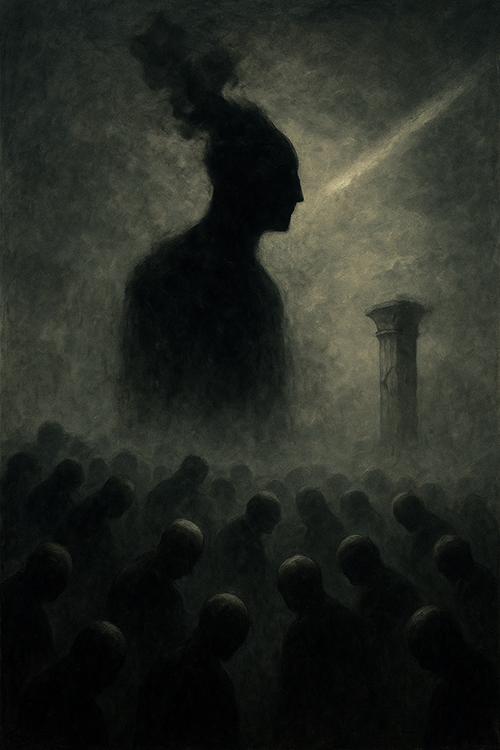
Q: In this age when shadows take the shape of saviors, and nations bow not to truth but to the fog of a man’s voice, are we not witnessing the same darkness that veils the seeker in false devotion? What then shall we call this cult of power that rises in the land—if not another face of the Kali Yuga itself?
A:
The warning of the ancients and the Founders alike is alive before us: beware the rule of illusion, where men mistake domination for strength, and lies for destiny. The cult of politics is no different from the cult of false spirituality. Each thrives where discernment sleeps. Each demands obedience in exchange for belonging. Each drowns the mind in the fog of unquestioned loyalty.
The danger in America today is not merely political—it is spiritual. For when citizens cease to think, to question, to weigh the evidence of truth against the seductions of power, the soul of the nation bends under the same spell that has misled seekers throughout time. A leader becomes idol, myth replaces fact, and democracy itself gasps for air.
This is the fog that the Founders foresaw. Madison, Hamilton, Jefferson—all feared the rise of demagogues who would seduce the people into surrendering their freedom. They understood that liberty dies not only through conquest, but through the slow intoxication of a people who abandon vigilance for certainty.
But the fog is not invincible. The power of awakening is always stronger, though it requires courage. It asks each one of us to see clearly, to refuse the easy sleep of blind loyalty, to stand in the sometimes-lonely space of truth. It asks us to remember that the Republic was not given as a gift but entrusted as a responsibility.
Epilogue: Riding the Storm
Storms of this kind do not end by shouting against them, nor by retreating into despair. They are ended when enough souls anchor themselves in clarity, in justice, in compassion, and in the refusal to worship what is false. Just as the seeker clears the fog of false teachers by listening to the inner compass of spirit, so too must citizens clear the fog of cultist politics by returning to the deeper covenant of democracy: truth, reason, and shared humanity.
The danger of this age is real, but it is not final. The fog lifts when the light of discernment rises. And when it does, both the seeker and the citizen can walk unafraid—not because the storm has vanished, but because they carry within them the only power the storm cannot touch: the light that refuses to be deceived.
Invocation: “Closing Reflection”
When the world grows heavy with shadows, the soul hungers for words that steady the heart and clear the air around us. Words, when aligned with truth, are not mere sounds—they are vibrations that shape our inner field, strengthening us against deception and despair.
Below are two offerings for those who wish to walk with clarity. The first comes from the ancient currents of the Rig Veda, carrying the soul from illusion into light. The second is a simple prayer, born for our present hour, calling each of us back into the strength of truth and the quiet anchor of love.
Speak them aloud, whisper them inwardly, or hold them in the silence of your heart—what matters is not the volume but the sincerity of your being.
1. Sanskrit (Rig Veda – Asato Ma Sadgamaya)
Original:
असतो मा सद्गमय ।
तमसो मा ज्योतिर्गमय ।
मृत्योर्मा अमृतं गमय ॥
Phonetic Pronunciation:
Asato mā sad-gamaya
(ah-sah-TOH mah sud-GAH-mah-yah)
Tamaso mā jyotir-gamaya
(tah-mah-SOH mah JYO-teer-gah-mah-yah)
Mrityor mā amritam gamaya
(mrit-YOOR mah ahm-REE-tahm gah-mah-yah)
Meaning (simple rendering):
“Lead me from the unreal to the Real.
Lead me from darkness to Light.
Lead me from death to Immortality.”
This mantra cleanses the mind from illusion and reconnects the soul to truth.
2. A Simple Prayer of Discernment
“May my heart stay clear,
my mind remain sharp,
and my soul be untouched by deception.
Let truth guide my steps,
and love anchor my being.”
3. A Protective Visualization Prayer
“I stand in the light of the Eternal.
Around me is a circle of clarity and strength.
No deception can cross,
no fear can enter.
Only love may dwell here.”

 Numinous Waves