

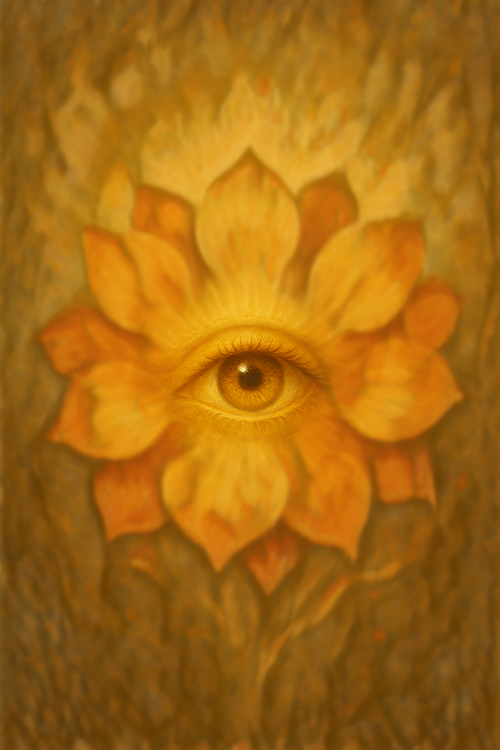
Beauty is often spoken of in terms of perfection, symmetry, or harmony. But the heart—especially when attuned through a spiritual lens—sees deeper. It sees beauty not just in what is polished or admired, but in what the world calls ugly, deformed, or even atrocious. To look with the heart is to encounter a paradox: that radiance shines just as brightly in scars, ruins, and brokenness as it does in what is conventionally praised. This post explores how beauty transforms in the gaze of the spiritual heart.
Q: What happens to the heart center when beauty is encountered from a spiritual mindset?
The heart doesn’t merely register beauty—it remembers. Beauty, when seen spiritually, is not just aesthetic pleasure; it acts as a tuning fork that resonates with the soul’s own frequency. The heart center expands, softens, and opens, not through effort but by recognition: beauty mirrors back to us what we already are in essence.
Q: Why does beauty seem to bypass the intellect and go straight into the heart?
Because beauty is not logical. It’s archetypal. It doesn’t argue its case; it strikes like a bell. The intellect wants reasons, but beauty overwhelms reasoning, ushering us into immediacy. This is why tears often come unbidden in the presence of great art, nature, or even a simple act of kindness—the heart center has been touched by something prior to thought.
Q: What does this mean for spiritual growth?
When the heart center responds to beauty, it is being trained in receptivity without possession. Beauty is never truly owned, only witnessed. That witnessing teaches surrender, humility, and reverence. In spiritual terms, beauty functions as a doorway: one moment of pure awe can open into the infinite, collapsing the ego’s defenses.
Q: Can beauty be dangerous for the heart if misunderstood?
Yes—if it becomes attachment or infatuation. Beauty distorted by ego becomes possession, vanity, or lust. In such cases, the heart closes rather than opens. But when beauty is allowed to simply be, without demand, the heart flowers naturally into compassion and love.
Q: So is beauty a path in itself?
Absolutely. Many mystics have walked the “path of beauty”—whether through art, music, nature, or human love. The heart center is the instrument tuned along this path, and beauty is both the teacher and the teaching. It refines perception until one sees not just passing loveliness, but the eternal radiance shining through all forms.
Beauty in What the World Calls Ugly
Q: How can the heart perceive beauty in what most would call ugly or defective?
The heart sees differently than the eyes conditioned by culture or ego. Where the mind sees distortion, the heart feels essence. A scar, a twisted form, or what the world calls “atrocity” becomes, through the heart’s gaze, a revelation of survival, uniqueness, and truth. Beauty here is not in symmetry or perfection—it’s in the undeniable authenticity of being.
Q: Why does the spiritual heart respond to such forms with reverence rather than repulsion?
Because the heart is tuned to wholeness, not appearances. When it encounters what others dismiss as broken, it recognizes the hidden story: the courage of a body that continues, the persistence of life against difficulty, the vulnerability that makes the soul shine through. What the surface calls defect, the heart calls doorway.
Q: Is this a kind of mystical reversal—seeing light in darkness?
Yes. It is an initiation into non-dual beauty. The same way mystics speak of finding God in suffering, the heart that perceives beauty in deformity or “ugliness” transcends the binary of fair/unfair, lovely/repulsive. It sees that every form is a brushstroke in the same divine painting, and sometimes the rough, jagged strokes carry more power than the smooth ones.
Q: But how does this differ from pity or sentimentality?
The heart does not pity—it honors. Pity implies superiority: “I am whole, you are not.” The heart instead bows to the depth and mystery expressed in the form. It sees beyond the veil, often sensing more purity in what has been cast aside than in what is polished and celebrated.
Q: So in this sense, can so-called ugliness be more spiritually potent than conventional beauty?
Often, yes. Conventional beauty can lull the senses into complacency, while “ugly” beauty shocks us awake, forcing a shift in perception. It strips us of vanity and demands we feel with the soul, not just the eyes. To see beauty in the grotesque is to have crossed into a deeper state of vision, one where nothing is outside the reach of love.
The Practice of Paradoxical Beauty
Q: What is “beauty” when the form is painful, scarred, or called ugly?
Beauty here isn’t prettiness. It’s fidelity to being. When the heart meets a difficult form without flinching, it recognizes undistorted truth: the fact that this being exists, survives, testifies. The beauty is the honesty and aliveness shining through the form—not the form’s compliance with taste.
Q: What shifts in perception allow the heart to see this?
- Unlabeling: The heart suspends the word “defect” and meets the presence.
- Slowness: Rapid appraisal favors bias; slow looking reveals nuance—texture, story, courage.
- Whole-sight: Instead of isolating the “flaw,” the heart includes context: history, environment, relationships, choices.
- Essence-first: Attention moves from appearance → meaning → essence.
- Non-dual gaze: Beauty isn’t set against ugliness; both become gradients of one radiance.
Q: What happens in the heart center, experientially?
- A softening around the sternum and diaphragm.
- Breath deepens, awareness widens, time dilates.
- A subtle ache appears—not harm, but tenderness. That ache is love noticing reality without armor.
- Compassion arises without the impulse to fix, own, or perform.
Q: Isn’t this just romanticizing suffering?
Not if held with dignity, consent, and gravity. The heart does not glamorize atrocity. What it sees as beautiful is not the wound itself but the resilience, truth, or light still flickering within it.
Q: Why can so-called “ugliness” be spiritually catalytic?
Because it punctures vanity. Conventional beauty can soothe; difficult beauty sobers. It breaks the ego’s spell that equates value with polish. To sustain loving attention in the presence of what culture rejects is a rite of sight—an initiation into unconditional regard.
Q: How do I know the heart (not the ego) is seeing?
- Afterward, you feel quieter, kinder, more available—not superior or performative.
- You feel kinship, not pity.
- You grant space rather than try to own or display the encounter.
Q: What about true atrocities—war wounds, ruins, collapse? Can they be “beautiful”?
Not the violence itself. But the resilience within it—the weeds that return, the hands that heal, the solidarity that rises—those may be seen as beauty shining through devastation.
Practices for Training the Eye of the Heart
- Wabi-sabi walk: Attend to a chipped or weathered thing. Whisper: “You may be as you are.”
- Kintsugi reflection: Name a fracture and the gold it produced.
- Gaze of equal regard: Meet ignored people with inner affirmation: “Same light, different window.”
- The scar practice: Place a hand on a scar. Ask: “What did you survive to become?”
- Compost meditation: Sit by decay. Whisper: “Nothing is wasted in love.”
- Listening for the unpretty truth: Receive someone’s messy story. Witness without fixing.
- Icon of the unadorned: Keep an “ugly” object as an icon of reality—touch it before hard encounters.
What Changes Inside
- Humility: Life no longer has to edit itself for your comfort.
- Tender strength: Softer heart, stronger spine.
- Trust: Reality proves survivable without prettifying it.
- Vision: Same light in every face, especially the weathered ones.
- Freedom: Beauty is everywhere; seeking becomes finding.
Addendum: The Inverted Icon
There is a secret altar in the heart where all things rejected by the world are enthroned. The crippled tree, the face marked by suffering, the ruins overtaken by vines—each becomes an inverted icon, whispering the truth that love wastes nothing. To bow before such beauty is to acknowledge that divinity does not live only in the flawless, but also in the fractured. The heart that sees this no longer seeks escape; it seeks encounter.
Resources and References
- Franklin Merrell-Wolff – Consciousness Without an Object (on non-dual perception)
- John O’Donohue – Beauty: The Invisible Embrace
- Japanese aesthetics of wabi-sabi and kintsugi
- Simone Weil – writings on attention and affliction
- Rainer Maria Rilke – Letters to a Young Poet (on embracing difficulty)
- Pema Chödrön – The Places That Scare You

 Numinous Waves