

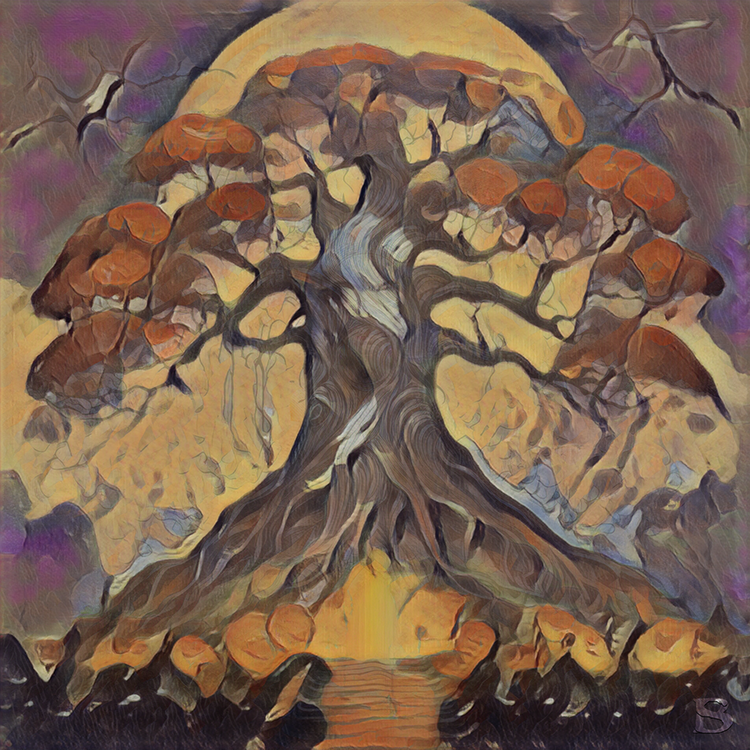
Spiritual awakening is not just a matter of insight; it is the full-body unraveling of identity. The heart opens to love, the gut releases fear, and the ego reveals itself in exaggerated form until it is seen through. Together they form the crucible in which transcendence matures.
Q: What role does the heart play in awakening?
The heart is the chamber of compassion and union. When it opens, the walls of separation soften. You no longer live only for yourself—you feel yourself woven into others, into the field of being itself. Many traditions center on this truth: love dissolves the illusion of selfhood. The heart, once awakened, cannot sustain the boundaries the ego defends. It floods them.
Q: And the gut? What is its part in this?
The gut is where instinct and survival live. It carries courage, grounding, and the capacity to surrender. A seeker may have an open heart overflowing with love, yet still be shaken by anxiety, dread, or survival fear. These often arise from karmic imprints—patterns embedded before birth, carried through lineage or past life. The gut’s role is to stabilize what the heart reveals. Without its trust, the ego can easily pull you back into fear.
Q: But if past-life fears and anxiety are part of the present seeker’s burden, how can they be reconciled with an open heart?
By seeing them not as obstacles but as chosen conditions. The soul may incarnate with both—an open heart to access love, and an anxious gut to anchor that love in the soil of embodiment. Fear is not random; it is a teaching device. It makes love practical, humbles the seeker, and keeps compassion close to the earth.
- The heart brings light: “I love, I merge, I am one.”
- The gut brings grounding: “I trust, I allow, I can dissolve without collapse.”
The tension between them cooks the ego down to essence.
Q: Why would a soul choose such a paradox—open heart yet inherited fear?
Because awakening is not meant to be ethereal only; it is meant to be embodied. Residual fear ensures that the seeker learns trust not in theory but in the trembling body. Such imprints may also carry the threads of lineage healing, karmic completion, or service to the collective. You become the place where old vows unravel, where family or cultural fear is released into love. The paradox itself is sacred architecture: light without heat would not transform, and heat without light would consume.
Q: And where does the ego fit in this drama?
The ego is the mask that makes all this possible. It dominates early life because it must—it stabilizes individuality, ensures survival, and insists on “me” long enough for wisdom to form. If ego were gentle, diluted, or half-present, it would dissolve before the soul learned anything. Its brashness is its teaching method.
Q: Why, then, do we see such grotesque forms of ego—tyrants, politicians, celebrities obsessed with “look at me”?
Because unchecked ego grows into caricature. These figures display ego’s hunger so completely that they become unintentional teachers for the world. Their endless grasping—power, fame, adoration—exposes the futility of ego’s search. By exaggeration, they reveal the path’s dead end. Humanity learns by recoil: this is not the way.
Q: What is the life cycle of the ego?
- Birth: It forms in childhood, creating identity and boundaries.
- Ascent: It seeks recognition, belonging, survival.
- Overgrowth: It inflates, craving dominance or endless validation.
- Crisis: Life dismantles its illusions—through loss, betrayal, or mortality.
- Transcendence: Awareness sees through it; the ego becomes a servant rather than a master.
At its highest maturation, the ego is not destroyed but made transparent. It still says “I,” but that “I” points beyond itself to the soul and to love.
Q: So the point is not to kill the ego but to see through it?
Yes. The ego was never the enemy; it was the mask the soul wore until recognition dawned. The heart’s openness and the gut’s surrender turn that mask translucent. Then ego still functions—allowing individuality and expression—but it no longer rules. Instead of “look at me,” it becomes “look through me.”
Integration
The seeker’s path is a braid of three strands:
- Heart: The opening into love and union.
- Gut: The grounding into trust and surrender.
- Ego: The mask that must inflate and collapse before it becomes transparent.
Seen together, they form a single curriculum. The heart without the gut would float away. The gut without the heart would collapse into fear. The ego without either would reign unchecked. But when the three interact, awakening is embodied, grounded, and lived in the world—not just glimpsed in vision.
Addendum: The Mask and the Flame
The heart opens like a sun,
the gut trembles like earth,
and the ego stands between them,
shouting its claim to be the whole sky.
But the sun does not argue.
It shines through the cracks in the mask.
The earth does not resist.
It drinks even the tremors of old vows.
In time, the mask thins,
the tremor softens,
and what was once “me”
becomes a window.
Through it, the soul looks out,
not as tyrant, not as victim,
but as the quiet flame
that never needed a name.
Resources:
- The Upanishads – Indian scriptures on Self, awareness, and liberation.
- The Bhagavad Gita – teachings on devotion, karma yoga, and transcendence of ego.
- The Yoga Sutras of Patañjali – discussions of samskaras (imprints) and ego-identification.
- The Dhammapada – Buddhist verses on craving, clinging, and suffering.
- Franklin Merrell-Wolff – Pathways Through to Space; The Philosophy of Consciousness Without an Object.
- Rumi & Hafiz – Sufi poetry on love and ego dissolution.
- Meister Eckhart & St. John of the Cross – Christian mystics on the false self and divine union.
- Kabir – devotional poetry on ego, love, and embodiment.
- Carl Jung – concepts of ego, shadow, and individuation.
- Wilhelm Reich & Alexander Lowen – body psychotherapy on stored fear in the gut.
- Stephen Porges – Polyvagal Theory on nervous system and trust.
- Antonio Damasio – The Feeling of What Happens, on the body’s role in selfhood.
- Eckhart Tolle – The Power of Now, ego as identification with thought.
- Adyashanti – The End of Your World, on post-awakening ego collapse.
- Ram Dass – Be Here Now, heart-centered awakening and the temporary role of ego.

 Numinous Waves