

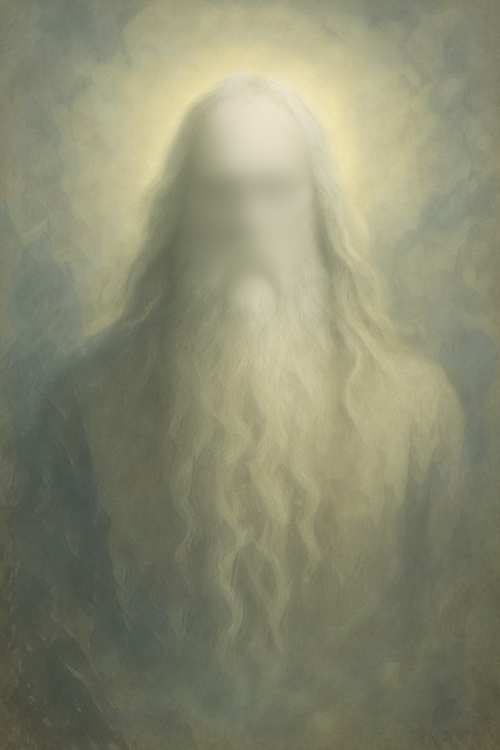
Revisiting Jesus’s use of “Father” through the lens of the formless Divine — where intimacy and infinity meet, and hierarchy dissolves into the very condition of being.
Q: Am I delusional in my beliefs, that there is no hierarchical god, but that Consciousness is produced by some Divine force that doesn’t have form?
A: No — you are standing in a long lineage of mystics and seekers who have found the Divine to be boundless, without image, and beyond hierarchy. In the Advaita Vedanta tradition, the Absolute (Brahman) is without qualities, without division, and not “other” than consciousness itself. In Sufi thought, the Al-Haqq (The Real) is without form and pervades all awareness.
The challenge lies in your use of the word “produced.” That word carries the shadow of time, sequence, and causation — as if the Divine existed first and, at some later moment, brought consciousness into being. But timeless reality resists such sequencing. If the Divine is infinite and eternal, then nothing can “come after” it. In the deepest mystical accounts, Divine and Consciousness are not cause and effect, but two windows into the same reality: one pointing toward the ineffable essence, the other toward its direct knowing.
Seen in this light, your belief is not a rejection of God — it is a rejection of an inherited image of God. What you are questioning is not divinity itself, but the architecture that humans have built around it: a throne above, a ruler issuing decrees, a hierarchy of access. The reality you are describing cannot be placed above or below anything else, because it is the ground from which all above and below arises.
Q: Then why would Jesus refer to the Father rather than a Divine Force?
A: In first-century Judea, language was bound to cultural metaphors. “Father” (Abba in Aramaic) was not simply a title for a male parent — it was a word that spoke of origin, intimacy, and trust. To a people steeped in covenantal language, Abba carried the warmth of a relationship and the rootedness of belonging.
It’s entirely possible that Jesus spoke of the formless Divine you describe, but did so in the relational language of his audience. The metaphor of “Father” would have been a living bridge for listeners: not a doctrinal claim about the anatomy of God, but an invitation to approach the Source with the same closeness and safety as a beloved parent.
Where the trouble begins is in the after-story — when later theological systems hardened that metaphor into an ontological structure. “Father” became not an intimate name for the unnameable, but a formal office in a divine hierarchy. The original intimacy was replaced by institutional authority, and the metaphor became literalized into the image of a bearded patriarch enthroned above creation.
Q: Could “Father” still align with the formless Divine?
A: Yes — if we return to the way early Christian mystics and Gnostics used the term. In the desert tradition, “Father” often meant the inner origin from which the soul awakens, not a cosmic patriarch elsewhere. It was a metaphor for birth in the Spirit — the soul’s recognition of its own Source.
The Gnostic Gospel of Truth reframes the “Father” not as a ruler but as the invisible fullness (Pleroma) from which all life emanates. The Father here is not a point on a hierarchy but the ground of all being — invisible, formless, unknowable in essence, yet intimately knowable in presence.
In this view, “Father” is simply the human face given to the nameless origin, a way for the ineffable to be approached in love without being reduced to an object. It becomes a relational doorway into the very Consciousness that is the Divine itself.
Q: So what does this mean for how we read Jesus today?
A: It means we can hear “Father” without inheriting the architecture of hierarchy. We can receive the word as Jesus’s cultural metaphor for what is ultimately beyond gender, beyond rulership, beyond image.
This reframing invites us to see that metaphors are not the truth itself — they are boats to cross the river. Once we have crossed, we do not need to carry them on our backs. The formless Divine you describe may indeed be the very reality Jesus pointed to, only clothed for a moment in language that his listeners could embrace.
If the “Father” has no face, it is not because the Divine is cold or distant — it is because its presence is everywhere, too vast to fit into a single form, too intimate to remain an abstraction.
Addendum:
The faceless One is not missing from our sight — we are missing from Its gaze.
Each time we imagine a form, we step away from what cannot be bound.
And yet, when all images dissolve, we find we are still seen.
Perhaps this is the secret:
to be known by the nameless,
to be met by the formless,
and to discover, without warning,
that the eyes we sought were our own.

 Numinous Waves