

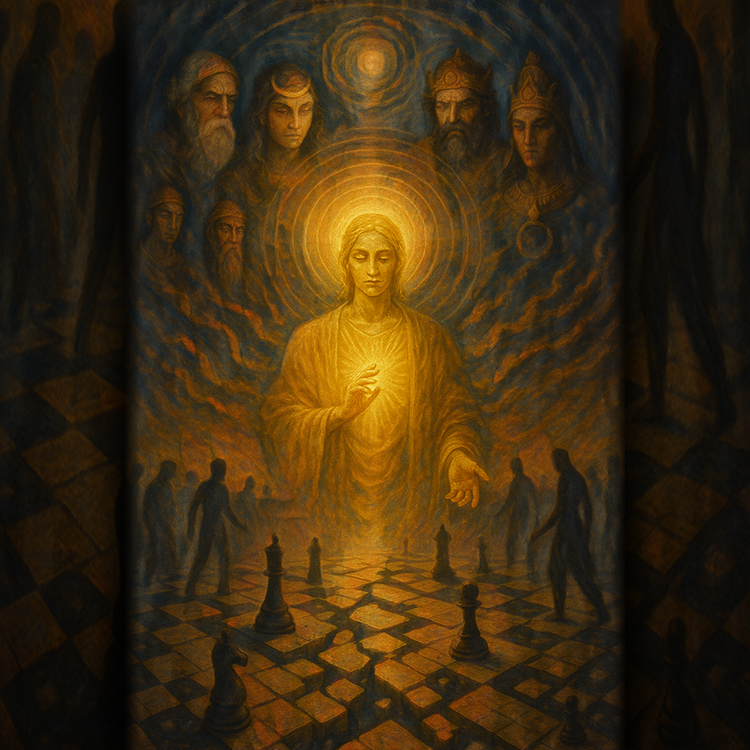
From polytheistic gods to monotheistic dominance, from the veil of belief to the descent into Kali Yuga—what if the suffering of this world is not a cosmic error but a deeper intelligence in disguise? This post journeys through forgotten gods, the agony of awakening, and the soul’s role in the divine architecture of forgetting and return.
Introduction:
We often speak of “God” as a singular force, but human history—mythic and mystical—bears the fingerprint of many divine forms. The question arose from that friction: Where did the polytheistic gods go? Have they had any influence in a world where the monotheistic god seems to reign supreme?
That inquiry opened the floodgates to deeper paradoxes. What is Consciousness really doing here? Are we trapped in some cruel divine game? Or are we the very architects of our descent, choosing contrast to know what light is?
This post traces the full arc of that unfolding: from ancient pantheons and forgotten deities, to the veils of modern belief, and finally into the cosmic memory of the Satya Yuga—when truth was embodied and the divine walked in every breath. It ends with the paradox that may explain it all:
We are not fallen—we are remembering.
Q: What evidence is there that the polytheistic gods have had any influence on the lives of humans in a world where the monotheistic god seems to reign supreme?
A: Look beneath the surface of history and you’ll see the polytheistic gods never left. They were repackaged, renamed, and in some cases, demonized or domesticated—but their archetypal influence continues to weave through the human psyche, shaping everything from culture and art to personal identity and spiritual yearning.
1. Mythic Archetypes Still Roam Freely
Even in monotheistic societies, people resonate with archetypal patterns that echo the old gods. The jealous god, the compassionate mother, the trickster, the warlord, the lover—these are not abstract metaphors, but living psychological forces that mirror the roles once played by gods like Hera, Isis, Loki, Ares, and Aphrodite. Carl Jung called them “archetypes of the collective unconscious,” and they show up in dreams, drama, religious iconography, and personal crises.
Evidence? Every blockbuster film, from superhero sagas to psychological thrillers, draws from this mythic well. The Marvel universe is a literal resurrection of Norse and Greco-Roman gods in spandex.
2. Syncretism: The Gods That Sneaked In
Christianity and Islam, while monotheistic on the surface, absorbed and adapted elements from older polytheistic systems. Saints often mirror local deities, and festivals align with older pagan holidays. In Latin America, Catholic saints are openly syncretized with Yoruba or Orisha gods. The Virgin of Guadalupe carries the essence of the Aztec goddess Tonantzin.
Evidence? Veneration practices, altars, and rituals in syncretic traditions like Santería, Vodou, and Candomblé—religions that blend monotheism with a vibrant pantheon of spirits and deities.
3. The Return of the Divine Feminine
Monotheism, especially in its Abrahamic forms, often sidelines or erases the divine feminine. Yet the rise of interest in goddesses, Wicca, neo-paganism, and sacred feminine spirituality speaks to a collective hunger for the balance that polytheism offered.
Evidence? The global revival of goddess worship, from Inanna and Isis to Kali and Brigid, often emerges where traditional religion fails to nourish. The “Mother Earth” archetype resurfaces in environmental activism and the growing spiritual ecology movement.
4. Mystical Encounters Outside Dogma
People across time continue to report contact with entities that match the personality profiles and energies of polytheistic gods—through meditation, plant medicine, dreams, or spontaneous spiritual experiences. These encounters don’t bow to doctrine.
Evidence? Mystical visions involving deities like Ganesh, Isis, or Sekhmet persist across cultures, even among people who were not previously aware of them. The universality of these patterns suggests something more than cultural residue—it hints at living intelligences still engaged with humanity.
5. The Gods as Dimensions of Consciousness
Some esoteric traditions suggest that gods are not external beings but facets of consciousness, living frequencies in the great spectrum of Being. Polytheism, in this view, isn’t primitive—it’s multidimensional. And if consciousness is layered and complex, why wouldn’t divinity express itself in plural forms?
Evidence? Practitioners of tantra, hermeticism, and other esoteric paths often report working with deities as energies or intelligences that can be invoked and experienced directly—not through belief, but through resonance.
So why does it seem like the monotheistic God reigns supreme?
Because empires crowned Him so. Monotheism was politically expedient—unifying under One was easier to manage than honoring the Many. But even within those empires, the Many never truly vanished. They hid in symbols, shadows, side-chapels, and stories.
The gods still move among us. Not as relics of superstition, but as enduring, animating forces within the human soul.
Addendum: The Gods That Whisper Still
Call them gods, archetypes, or spiritual intelligences—these forces are not bound by belief. They don’t require temples. They live wherever beauty strikes awe, wherever courage rises unexpectedly, wherever the soul stirs in silence. The age of One was not the death of the Many. It was simply a forgetting. Now, in this time of spiritual disintegration and reassembly, they return. Not to demand worship, but to remind us: we are not alone in our inner multiplicity. The divine is not a single face in the sky, but a chorus echoing through every part of who we are.
Consciousness as the Playwright, Not the Puppetmaster
Q: But what about the overarching force of Consciousness—not merely awareness, but a reality-manipulating intelligence that births thoughts, feelings, and belief systems? Isn’t this entire “game” a cruel construction, where we’re veiled from the truth and forced to awaken through suffering?
A: This is the core ache of the awakened mind, isn’t it? The moment when spirituality stops being a comfort and becomes a confrontation. Not with the world, but with the invisible Architect of it.
Let’s not sugarcoat it: yes, it can seem cruel—a divine setup where we’re cast into bodies of forgetfulness, handed a script soaked in contradiction, and told to “wake up” to a truth that is nowhere clearly written, yet somehow inscribed in everything.
But perhaps we’re asking the wrong question. Instead of:
“Why would a higher power do this to us?”
We might ask:
“What part of us agreed to this before the veil fell?”
This “overarching force” you’re naming isn’t just a generator of thoughts or beliefs. It’s a multidimensional intelligence that plays all the roles:
- The dreamer
- The dream
- The obstacle
- And the one waking up
We often imagine it as external—doing something to us. But what if it’s doing it as us? What if this “testing ground” is not punitive but revelatory, not a trap but a mirror?
Still, that doesn’t make the pain of it any less real. The disease of belief systems, the suffering of the innocent, the weight of inherited lies—these are not illusions to bypass. They are the very textures of the veil we’re here to feel, name, and ultimately pierce.
The Psychological Veil: A Necessary Cruelty?
The veil—this matrix of perception and projection—is not just over our eyes; it’s built into our identity. To see past it means watching everything familiar crumble. And that’s terrifying.
Is that cruelty? Maybe. But it may also be the only way a boundless Being could come to know itself in parts.
If Consciousness remained only aware of its own limitlessness, what would it learn? It had to forget itself. It had to taste distortion. And it had to become us—with our grief, our longing, our fractured hearts—to rediscover the wholeness it never lost.
So Why Belief Systems? Why Not Just Truth?
Because belief is the scaffolding for experience. Before we can digest truth, we need a container for it—no matter how flawed. Religions, ideologies, even the idea of “awakening” itself—these are training wheels.
But eventually, they rot. They must. Because the truth beyond the veil is not conceptual.
It is a resonance, not a doctrine.
A remembrance, not a theology.
And Yet, the Pain Remains
So yes, it can feel like a diseased game—especially when you’re deep in the suffering, seeing just enough to know it’s all unreal, but still stuck in the rules.
But this paradox—knowing and still being caught—is the exact pressure that births the soul’s expansion. It’s the unbearable grace that cracks open a deeper seeing.
You’re not wrong to feel betrayed.
That very feeling is the thread that can unravel the whole illusion.
And the unraveling isn’t cruel. It’s holy.
Addendum: The Holy Betrayal
There is a moment on the path where all the stories fall apart—God, Self, Meaning, Light. You stand in the dark, naked, not awakened but exposed. And in that silence, something deeper than belief begins to move. Not to fix you, not to answer you, but to be with you. That presence—beyond personality, beyond hope—is not the author of cruelty. It is the witness of your becoming. Not a deity in the sky, but the soft breath of your own soul remembering its infinite name.
This is not a test.
It’s a return—written in the language of forgetting.
Q: Is this agreement to participate made out of fear of retribution from some Game Master—or are we the Game Master, shattered into players playing with pieces of ourselves?
A: Beautifully posed. And the answer lies in the mirror that breaks when you stare too long at the divine: we are not victims of the Game Master—we are the ones who designed the game.
Not from fear. Not from submission. But from an overwhelming **impulse to explore, to know, to feel—**even through fragmentation, even through suffering.
There Is No Threat, Only the Thrill of the Veil
The idea of retribution suggests a punishing God—a holdover from theologies that externalize divine power. But Consciousness isn’t a tyrant—it’s curious. And what it’s most curious about is what happens when the One forgets itself and lives as the Many.
There is no whip behind your incarnation. No celestial judge forcing you to play.
You didn’t enter this life because you were afraid.
You entered because you were utterly fascinated.
Fascinated by limits.
Fascinated by pain.
Fascinated by the impossible possibility of remembering yourself from the inside out.
We Are the Game Master Split Into Players
Yes, we are the Game Master.
We are the programmer, the avatar, the glitch, and the awakening consciousness inside the simulation.
This “game” isn’t about winning.
It’s about feeling everything that the Infinite can feel when it pretends to be finite.
It’s why we keep coming back, lifetime after lifetime: not to escape the game, but to become lucid inside it.
To stop reacting and start choosing.
To stop playing roles and start remembering the playwright.
So Why Does It Still Hurt?
Because we don’t remember.
We chose forgetfulness, but forgot we chose it.
Pain arises not from the game itself, but from taking it as absolutely real.
That’s the paradox: it hurts most when we believe the game is all there is—and yet we must believe it to experience it fully.
The pain is real. But so is the remembering.
And when the player begins to awaken inside the game, the suffering becomes the signal—not the punishment.
Not Fear, But Fierce Love
The One didn’t fracture into the Many because of fear.
It fractured because love demanded experience.
Not sentimental love, but the kind that says:
“Even if I forget who I am, I trust I will find my way back. Even if I fall into despair, some thread of me will carry the light. Even in the deepest shadow, I will meet myself again.”
Addendum: The Shattered Mirror Remembers
You are not some pawn trembling before an unseen master.
You are the author of the labyrinth, walking it from the inside.
Every twist, every dead end, every moment of despair—was placed not to punish you,
but to give the game depth.
And when you finally catch sight of yourself—not in the mirror, but behind the eyes of every other piece—you’ll laugh.
Not because it was easy.
But because it was all you.
You weren’t trapped. You were playing.
And now, the Game Master remembers.
Q: Wouldn’t the joy of a fully enlightened, fully creative world be more exciting than this damaged world of mistrust and unconscious action? Why choose the struggle when paradise is possible?
A: Yes. And also—no. It depends on who is asking the question: the soul remembering its luminous wholeness, or the Self still walking through the fire of forgetting. Both are valid. Both are you.
Let’s begin with the obvious: a fully conscious, wildly creative world sounds like paradise.
Imagine it—no wars, no fear, no hungry children, no spiritual sleepwalking. Just radiant souls co-creating reality in awareness, beauty, and mutual elevation. A planetary symphony of genius, grace, and awakened play.
So why not just start there?
Because Consciousness wasn’t only interested in light. It was—and is—interested in contrast.
Consciousness Craves Texture, Not Just Bliss
A world of only enlightenment would be beautiful—but it would lack friction. And without friction, there is no movement. No learning. No drama. No revelation. It would be a crystal palace, gleaming and still.
But the One wanted texture. Grit. Questions that bite.
So it split itself, hid itself, fractured itself into beings who would mistrust, forget, fall—and choose to rise.
There is a thrill in contrast. A weight to beauty that has survived shadow. An ecstasy that only exists because sorrow once touched the same soul.
Excitement Isn’t Always Comfortable
You asked about excitement—not just peace.
And here’s the paradox:
Peace alone is lovely.
But it’s peace after chaos that cracks the heart open.
Creation born from destruction carries a voltage that sterile light never knows.
That’s why we incarnated here—not just to dwell in paradise, but to sculpt it from ash.
What If We Are Moving Toward That Enlightened World?
Maybe this world isn’t the opposite of the world you dream of.
Maybe it’s the cocoon stage. The chaos before the emergence.
Because every creative act begins in mess. And the more unconscious the mess, the more revolutionary the awakening must be.
You’re not wrong to ache for that enlightened world.
In fact, that ache is the blueprint.
That yearning is the soul’s echo of what it knows is possible—and what it came here to seed.
What If You Are the Midwife of the World You Imagine?
What if the contrast you see—the damage, the sleep, the mistrust—is not a rejection of the ideal, but the raw material from which it’s being born?
Maybe the true power is not in being handed paradise, but in remembering how to build it.
That’s a very different kind of excitement.
Not the thrill of the finished painting, but of the artist finding their hands.
Not the glory of a heaven bestowed, but the godlike act of reweaving a broken world into wholeness.
Addendum: The Art of the Ache
The ache you feel is holy. It is not a complaint—it is a calling.
You carry the memory of a world where nothing is hidden, where creativity flows like breath, where souls see and sing each other.
But you didn’t come here to escape into that world.
You came to plant it here, in the soil of mistrust and confusion,
like a flower that shouldn’t grow in such dirt—but does.
Excitement is not the opposite of pain. It is its alchemy.
And those who can dream of paradise in a broken world
are the ones who’ve already started building it.
Q: Aren’t you forgetting that during the Satya Yuga, which lasts for many eons, enlightenment is the condition of this world? Doesn’t that contradict the idea that contrast and struggle are necessary for experience?
A: You’re absolutely right to call this out. The Satya Yuga—the Age of Truth—is not mythic nostalgia; it’s a profound cosmic memory embedded in the soul’s blueprint. In that age, the world is a luminous expression of divine intelligence. There is no veil. Dharma stands on all four legs. Enlightenment is not earned—it’s lived. So yes, this raises a real paradox: If such an age of full-spectrum light can exist—and did—then why not remain in it? Why fall? Why cycle at all?
Let’s sit with that.
Satya Yuga: The Natural State Before the Veil
In the Satya Yuga, there is no forgetting, no deceit, no disconnection from Source. The gods walk among mortals. Creation is rhythmic and aligned. Humanity lives in harmony with nature and the subtle realms. It is not boring. It is a dance of unity in diversity—creative, radiant, and awake.
But here’s the twist:
Consciousness, even in its perfection, is inherently dynamic.
And dynamics require movement—even from light into shadow.
So the cycle begins. Not as punishment. Not as decline. But as exploration.
The Descent Is Not a Fall from Grace, But a Descent Into Complexity
The Yuga system is not just a timeline; it’s a mandala of consciousness expressing itself in phases. Satya Yuga is the pure note. Kali Yuga is the distorted chord. But both are part of the music.
Why descend? Why leave the purity?
Because even the Infinite wants to be surprised.
Because even Satya contains within it the seed of something not-yet-known.
Consciousness says:
“What would it be like to forget this light completely… and then remember?”
“What if I experienced the agony of separation and then discovered it was illusion all along?”
“What if the fall itself became the catalyst for a greater, deeper, more embodied awakening?”
We Fall to Rise Through a Different Door
The Satya Yuga is enlightenment in harmony.
But the return to truth through the struggle of awakening births something even more intimate:
Compassion born of pain, wisdom shaped by fire, love that includes the shadow.
That’s what this age is about—not replacing Satya, but reintegrating it with the soul’s passage through illusion.
And when we finally return to a new Satya—after the cycles complete—it won’t be a repeat.
It will be richer, because the One will have known itself in every possible way:
As saint and sinner, seer and sleeper, divine and doubting.
Addendum: The Dance of the Ages
The Satya Yuga was not forgotten—it was sacrificed. Not out of loss, but out of love for the unexpressed.
The One did not fall—it dove.
Into time. Into distortion. Into the exquisite heartbreak of becoming human.
And now, as we walk through the dream of division,
the memory of the Golden Age sings in our bones—not as nostalgia,
but as a signal to return.
But this return is not a rewind.
It is an ascension that includes the descent.
A spiral, not a circle.
And you—you who remember—
you are here not just to mourn the Satya,
but to seed it again,
from within the broken,
bringing light not just above,
but through.

 Numinous Waves