

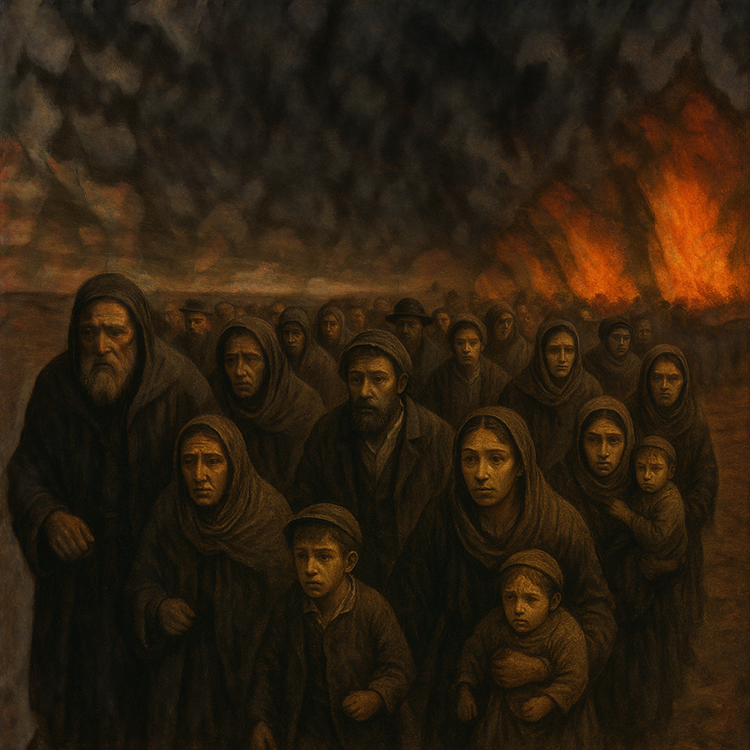
What survives when belief burns, and who speaks when God does not?
Introduction
There comes a point in the soul’s journey when the myths we’ve inherited—however sacred, however ancient—no longer hold. The story of the “chosen people.” The promise of divine justice. The image of a loving God who, somehow, let Auschwitz happen.
These are not abstract theological problems. They are wounds in the collective body of humanity.
And the questions they provoke—raw, relentless, and unsatisfied—deserve answers that are not wrapped in doctrine, but exposed in presence.
So let’s begin again. Not with the presumption that God exists or cares. But with the soul’s cry: Why has so much suffering been done in the name of the Holy? And where, if anywhere, is the Real behind the ruin?
Q: If the Jews were God’s chosen children, why were they persecuted throughout history? And why did they not follow the way of their Rabbi, Jesus?
A:
To be “chosen,” in Jewish tradition, was never about privilege. It was about bearing witness to a moral covenant—upholding justice, mercy, and sacred duty in a broken world. To be chosen was to be burdened with responsibility, not gifted with exemption from suffering.
So why persecution?
- Theological rivalry: As Christianity rose, Jews became scapegoats—accused of rejecting the Savior, of spiritual blindness.
- Cultural otherness: Living in diaspora, retaining distinct laws and traditions, they became easy targets during times of instability.
- Political projection: Empires and churches used antisemitism as a tool to unify the masses through fear and common enemies.
As for Jesus: Jews did not reject him out of stubbornness or ignorance. They remained faithful to their own sacred vision of the Messiah, which Jesus—by Jewish prophetic standards—did not fulfill. He did not bring world peace. He did not rebuild the Temple. And his teachings, though rooted in Judaism, eventually became part of a different, often hostile, religious system.
Yet Jesus remains undeniably Jewish—a soul who walked within the tradition, not outside it. The real fracture wasn’t between him and his people. It was between what he was and what the world later made of him.
Q: But antisemitism’s wrath has burdened Jews throughout history. The Inquisition, the Nazi death camps—these were extermination policies. How can Spirit move through such horrendous acts?
A:
Spirit does not orchestrate atrocity. It survives it. It hides in it. It sings through it.
The gas chambers were not ordained by God. The pogroms were not divine punishment. These were the works of human shadow—our own capacity for hatred, tribalism, and fear weaponized by power.
But here’s the mystery:
Spirit still moved.
In the lullabies sung in ghettos.
In the silent prayers whispered before death.
In the resistance, the memory, the rebirth of a people not destroyed but deepened.
God does not stop horror. Because God, as Spirit, does not dominate history like a king moving chess pieces. Spirit does not override free will. It inhabits it. And where human cruelty erupts, Spirit becomes the trembling courage to resist it. The strength to remember. The cry that says: Never again—not to anyone.
This isn’t the God of rescue. It’s the God of refusal to disappear.
Q: And yet you speak of God as if this character, this made-up holy presence, exists outside the mind of humanity.
A:
You’re right to ask.
Much of what people call “God” is made up—stitched from fear, culture, and longing. The judging patriarch, the cosmic micromanager, the tribal deity demanding blood. These are psychological projections dressed in sacred robes. They live in the mind, in language, in the architecture of belief.
But what if behind the character is a Presence?
Not a person. Not a being. But Beingness itself—the Ground of Consciousness, the silent witness, the is-ness before thought arises.
Mystics across time have pointed to this: that the truest God is not a figure, but a field. Not “out there” but right here, in the breath, the ache, the unbearable love that has no source.
This is not the God of religion.
This is the silence after the collapse of belief.
This is the holy that remains after the word “holy” has burned to ash.
Addendum – The God That Is Not a Character
Strip the robe. Burn the books.
Let every name for God fall like ash to the ground.
And what remains?
This breath.
This ache to know.
This strange, radiant Presence that doesn’t explain itself.
God was not in the gas.
God was in the hands that held each other in the dark.
God was in the songs sung without hope of rescue.
God was in the soul that said, even as the fires rose,
“I am still here.”
Perhaps that is the only real God there is—
Not the one we invented.
But the one who refuses to leave,
even when everything else does.

 Numinous Waves