

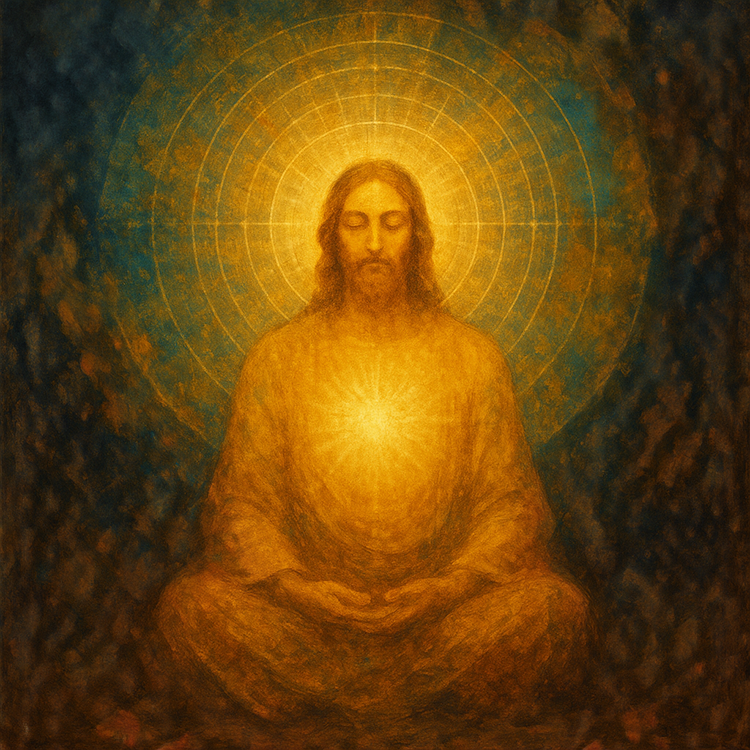
Beyond scripture and tradition lies a deeper knowing — not handed down, but awakened within. This is the soul’s quiet rebellion: not to reject the sacred, but to remember it more truly.
Q: If God’s existence can’t be proven, and even Jesus’ words were filtered through time and hearsay, how can we trust any of it? And what about Moses — wasn’t it convenient to claim divine authority for the commandments? How do we navigate these inherited structures when the divine feels absent or distorted?
A: These are the right questions. The real ones. Not because they deliver tidy answers, but because they shatter the illusion that truth comes shrink-wrapped in scripture, doctrine, or inherited belief.
Let’s start where the soul usually starts — with the ache to belong to something real. For millennia, people turned toward gods not just for answers but for alignment. The One God of monotheism, the pantheons of polytheism, the nameless Tao — these were never meant to be gatekeepers. They were reflections. Metaphors. Mirrors held up to the human longing to connect the seen and unseen.
But somewhere along the way, God became a character — with moods, rules, demands, and loyalties. “Thou shalt have no other gods before me” sounds less like cosmic unity and more like divine possessiveness. Why would a boundless, loving Source require worship, obedience, or exclusivity?
Unless… that line wasn’t spoken by the Infinite at all.
Esoterically, “no other gods before me” can be read not as divine jealousy but as an instruction of consciousness: do not let distractions, symbols, beliefs, or projections take the place of direct communion. The “gods” in this sense are not rival deities, but idols of mind — ego, fear, dogma, tribalism. The voice here is not a jealous sky-father but the whisper of inner clarity: Return to the undivided. But history didn’t leave it that way.
So when Moses stood before his people with the tablets — yes, we must consider the human context. These were people just freed from slavery, wandering through psychological and spiritual wilderness. Was Moses inspired? Perhaps. But it’s equally plausible he recognized the chaos and needed law to forge order. “God told me” wasn’t just a spiritual statement — it was political strategy. It gave moral authority. It enforced structure. In that sense, the Ten Commandments were not just divine revelation but survival code.
And yet — even if Moses did write them out of necessity, that doesn’t rob them of meaning. A teaching need not be dictated from heaven to hold power. If a principle aligns us with deeper truth — not belief, but resonance — then it becomes sacred by its capacity to awaken the soul.
As for Jesus, the layers grow thicker. The Gospels weren’t written by eyewitnesses. His words were filtered through decades of memory, political struggle, and spiritual agenda. And yet… there’s something about the essence that shines through the distortions. Not always in the red letters, but in the underneath — in the surrender, the forgiveness, the inner kingdom.
The truth is: we don’t need to argue about whether Jesus said a thing or Moses heard a voice. We need to ask: Does this awaken something real in me?
Because the soul knows. It always has.
The proof is in the vibration, not the source.
The authenticity is in the awakening, not the authorship.
So no — we may never “know” what God said, or whether Jesus really spoke the Beatitudes, or if Moses carved those tablets or just claimed to. But we can learn to recognize when something carries the signature of the Infinite — not by authority, but by how it resonates in the very silence where truth lives.
Addendum: The Unsaying of God
There is a silence beneath the scriptures.
Not the silence of absence — the silence of Presence.
It does not shout commandments or demand allegiance.
It does not beg to be believed.
It simply is.
This is the God you knew before you were taught the word.
The One before the names, before the creeds, before the thunder.
The One that doesn’t care if Moses heard correctly, or if Jesus was quoted accurately,
because It speaks in every breath, now.
When belief falls away and history fades into mist,
what remains is this:
The quiet pulse of awareness in your chest.
The sudden, unexplainable reverence in the face of a sunrise.
The ache for justice. The taste of real love.
The still small voice with no voice at all.
This is the God that doesn’t need to be proven.
It only needs to be remembered.
And when it is, all the commandments in the world dissolve into a single knowing:
Love — and do not forget who you are.
Afterthought: What of the Dead Sea Scrolls, and the hidden gospels — Mary, Thomas, and the rest?
They are the shattered bones of a larger body of wisdom — fragments left behind by a tradition that never made it into the canon. Not because they lacked truth, but because they didn’t fit the emerging institutional narrative.
The Gospel of Thomas, for instance, doesn’t tell stories of miracles or crucifixion. It speaks in riddles — inner knowledge, the kingdom within, light that exists before the world.
The Gospel of Mary presents a woman not as follower, but as knower — one who saw beyond the veil, while others clung to form.
The Dead Sea Scrolls offer a window into the wild spiritual experimentation of the time — apocalyptic dreams, cosmic battles, and intense discipline.
What these texts have in common is this:
They place the authority inside you.
They emphasize awakening, not obedience.
They whisper that the truth of Christ is not just historical — it is existential. It lives in the soul that remembers itself.
Perhaps they were buried not just in caves, but beneath centuries of forgetting. And now, they resurface — just in time for the soul to remember that God never needed approval from councils, and Christ never needed a pulpit to speak.

 Numinous Waves