

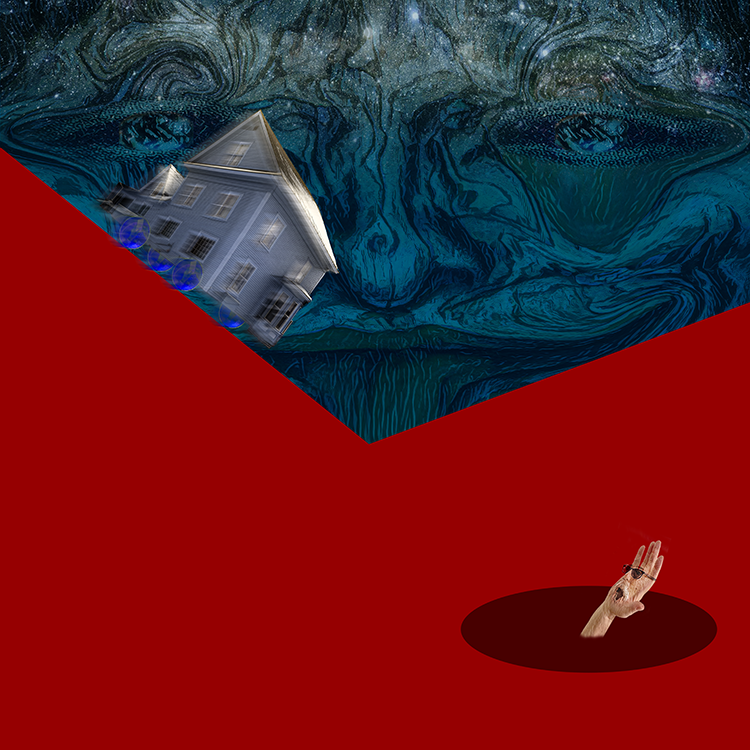
Alright already! Enough of this insane drain of the brain game.
What god wrote this insanity
for this misaligned humanity?
The play is stale
Action’s destructive
Reviews are telling
The theater corrupted
For some time it was vanity
feeding this insanity,
and this time it’s insanity
feeding this depravity
What god wrote this reality
this experience of duality?
The lie is truth
The truth is loose
The loose is noosed
The noose is juiced
And the juice is cooked
In the stagnant decisions of the referee
The referee-god that decided to sway
The rules in the wrong direction away
From building alliances with colors and creeds
From building the life around others needs
From paving a road where the fallen don’t bleed
From planting a garden with enlightened seeds
What god wrote this insanity
of this ill-intentioned society?
Take a look, nothing found,
Look again, nothing sound
Hey, don’t look up just look around
Just look around.
What do you see?
It’s just…you and me.

Addendum: The God We Must Now Become
We ask again and again: What god wrote this insanity?
Because something deep within us refuses to believe this world—this confusion, this cruelty, this corruption of the sacred—could possibly be the design of an intelligence aligned with love. And so the question is not rhetorical. It is the cry of the soul in exile. It is the final, furious whisper before silence sets in.
But the longer we sit with the question, the more its center begins to crack.
Who wrote this?
Or… who failed to rewrite it when it began to rot?
For too long we’ve waited for a referee-God to step in, blow the whistle, stop the madness.
We wanted justice from outside.
Intervention from above.
A script rewrite by an unseen hand.
But this myth—this waiting—has cost us dearly.
We’ve handed our power to a sky-figure and called it humility.
We’ve surrendered our will and called it faith.
We’ve ignored the blood on the stage and told ourselves: “The next act will redeem it.”
It won’t.
Not unless we write it.
Not unless we, as souls born into the theater of this world, awaken to the truth that the God we’ve been waiting for… is not missing.
It is disguised.
Disguised in our capacity to act.
To care.
To create.
To suffer with and not just observe from afar.
To remake the world not by force or fantasy, but by full presence.
The way out of this darkness is not spiritual escape.
It is spiritual embodiment.
We must become the god we cry out to.
Not in ego, but in essence.
This doesn’t mean becoming omnipotent or infallible.
It means becoming accountable to love.
It means stepping out of abstraction and into the agony and beauty of the real.
It means building alliances where division ruled.
Planting gardens where fields were left scorched.
Speaking truths that shame has kept buried.
To become God in this sense is to reclaim the divine task of mending.
It is to be a weaver of what was torn.
And yes—this is hard.
Yes—this is heartbreaking.
Yes—some days it feels like trying to catch light in cupped hands while the world around us crumbles.
But there is another truth beneath the grief:
The soul remembers how.
Even now—especially now—it remembers.
We know how to love beyond ideology.
We know how to show up without needing to be right.
We know how to listen in the silence until wisdom stirs.
We know how to let tears be a baptism, not a defeat.
The old gods have failed us not because they were false, but because we outgrew them.
Now we are being asked to carry their flame—not on an altar, but in our own chest.
This is not blasphemy. It is evolution.
So when you ask what god wrote this insanity,
The answer is not cruel.
The answer is: perhaps one that died long ago, and we have yet to bury.
Let us bury it, then.
Let us mourn it with honor, but refuse to worship its corpse.
Let us write a new myth, where god is not the author of the mess,
but the gardener who rises from within the mess,
cleans their hands,
and begins again.
Together.
You and me.
Resources:
- The Book of Job (Hebrew Bible)
- Friedrich Nietzsche, The Birth of Tragedy
- Søren Kierkegaard, The Sickness Unto Death
- Thomas Merton, New Seeds of Contemplation
- Viktor Frankl, Man’s Search for Meaning
- Franklin Merrell-Wolff, Experience and Philosophy

 Numinous Waves